Approval to remove four zeros from the national currency; 1,000 tomans will become 1 toman today
The Iranian government has approved the outline of a bill to remove four zeros from the national currency. The bill defines the base unit of Iran’s currency as the “toman.” According to the bill, the current 10,000 rials is a “new toman.” One new toman will be equal to 100 rials.
Finally, after a long period of uncertainty about reforms to the base unit of Iran's currency, today, Wednesday, July 31, government spokesman Ali Rabiei announced the approval of the general outlines of the bill to remove four zeros from the national currency in the twelfth government.
According to the government's resolution, the base unit of Iran's currency will be changed from rial to toman, and one new toman will be equivalent to 100 rials.
According to this bill, four zeros will be removed from the rial and three zeros from the toman, and thus, after the bill is approved by the parliament, the current 10,000 rials will be one new toman.
The government-approved bill must be approved by the Islamic Consultative Assembly for finalization and then placed on the agenda. The government spokesman said: "We are trying to send the bill to the Assembly with two urgent measures."
According to ISNA, Ali Rabiei stated that "the implementation of the plan to remove four zeros from the national currency will increase the efficiency of the national currency and bring it into greater harmony with the current customs of society," noting: "Removing four zeros from the national currency will ensure that the apparent prestige of the national currency is respected compared to other international currencies, and coins that have been removed for some time will be put into circulation. The depreciation of paper will also be reduced."
The government spokesman also denied the connection between removing four zeros from the national currency and “inflation and purchasing power,” saying, “By implementing this plan, we are merely seeking to increase the efficiency of the national currency.”
The long history of the project
The discussion of removing zeros from Iran's national currency had been raised since the 1980s, during the presidency of Mahmoud Ahmadinejad, as a solution to combat rising inflation. However, these discussions remained fruitless due to currency crises and the implementation of the subsidy targeting law, which itself fueled inflation.
The plan was raised several times in the Hassan Rouhani government, but Valiollah Seif, the former governor of the Central Bank of Iran, while approving it at the time, postponed the implementation of such a plan until conditions were met, including "economic stability and sustainable single-digit inflation."
With Abdolnaser Hemmati at the helm of the Central Bank, the discussion of "reforming the monetary system, defining a new currency, and reviewing the distinction between banknotes and coins" was put on the agenda with greater seriousness, ultimately leading to the approval of the general outlines of the Central Bank's proposed bill to remove four zeros from the national currency in the twelfth government.
The details of this plan are now to be reviewed and approved by the government. After that, the bill will be implemented if approved and ratified by the Islamic Consultative Assembly.
According to the Central Bank's proposal, which was approved by the government today, the base unit of Iran's national currency will no longer be the rial, but will be changed to the "toman." Each "new toman" will be equivalent to 10,000 current rials and 100 "new rials."
A two-year process
The head of the Central Bank of Iran had previously said about the time required to implement this plan: "It is a time-consuming process from a legal and technical perspective, and based on our experts' estimates, its implementation will take nearly two years."
Abdulnaser Hemmati also said about the process of introducing new banknotes and removing old banknotes: "After legalization, the new money will gradually enter circulation by replacing them with the previous worn-out banknotes, and its cost will not be comparable to the cost of printing a large volume of current banknotes."
The head of Iran's Monetary and Credit Council, while emphasizing the impact of eliminating zeros on "improving the image" of Iran's national currency on the international stage, considered it a measure that "in many countries, along with other measures, is considered the beginning of serious economic reforms."
According to Tasnim News Agency: "By implementing the plan to remove 4 zeros from the national currency, while facilitating and restoring the role of cash payment instruments in domestic monetary transactions and reducing the costs of printing and issuing banknotes and coins, the efficiency of the new monetary system will continue in the coming years, and the parity rate of the national currency with world currencies will have positive psychological effects in the short term."
The Central Bank has proposed a "transition period" from rial to toman of 24 months, during which old banknotes and coins are to be collected and replaced.
The issue of reforming Iran's monetary system is not a new one. Severe inflation and the devaluation of the national currency had long made reform of the monetary system in Iran mandatory.
The most important reason for the need to reform Iran's monetary system is the devaluation of Iran's currency compared to other countries' currencies, as well as inflation. For example, the consumer price index in Iran has increased more than 2,700 times from 1978 to 2018.
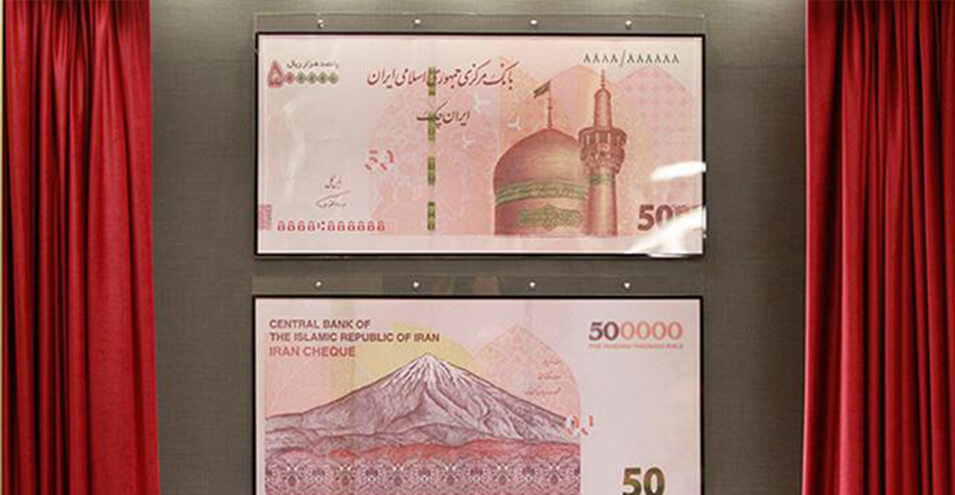
This is despite the fact that, according to a report by IRNA news agency in late April, "the largest denomination of banknotes, including the Central Bank's Iranchek, has not been adjusted in line with the inflation rate during this period and has only increased 50 times (from 10,000 to 500,000 rials)."
The existence of chronic inflation and the decline in the purchasing power of the Iranian currency are cited as other reasons for the need to reform Iran's monetary system.
Iranian officials cite increasing the prestige of the national currency, reducing the volume of banknotes in circulation, facilitating simple everyday monetary transactions and eliminating current computational difficulties, returning coins to the cycle of economic transactions, using the official name of the country's currency, reducing the cost of printing and destroying banknotes, and reducing costs resulting from the high depreciation of ATMs and money counters as part of the positive consequences of removing four zeros from the national currency and changing its base unit from rial to toman.
Source: DW