Trump Threatens “Destruction of Iran” in Response to Baghdad Explosion
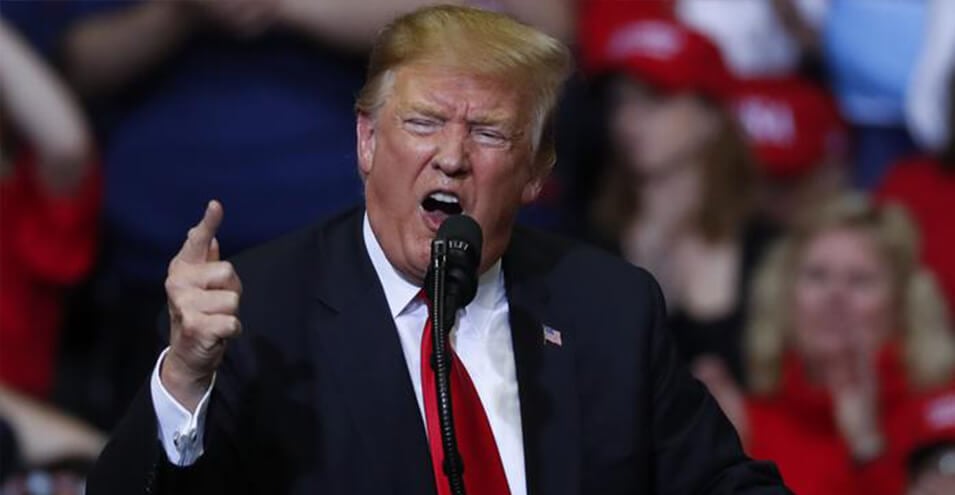
After a rocket struck Baghdad’s Green Zone, where the US embassy is also located, Trump threatened Iran with “destruction.” A few days earlier, news sources reported that American officials said Trump did not want war with Iran.
On Sunday evening, May 19, an explosion occurred in Baghdad’s Green Zone, which Iraqi security officials said was caused by a “Katyusha rocket” strike.
Government buildings and several embassies, including the heavily protected diplomatic office of the United States in this area, are located in the zone. France’s news agency states that this explosion occurred “near” the US embassy, and Iraqi officials said the incident caused no casualties.
So far, the circumstances of the explosion and its possible perpetrators remain unclear, however, the US President has attributed this attack to the Islamic Republic.
According to Reuters, Donald Trump, in response to the explosion in Baghdad’s Green Zone, wrote in a tweet: “If Iran wants to fight, that will be the official end of Iran.” He warned the Islamic Republic never to threaten the United States again.
Tensions between Tehran and Washington have intensified, especially following the explosion at Saudi oil facilities and the “sabotage attack” on several oil tankers in Fujairah port in the United Arab Emirates in the waters of the Oman Sea.
After intensifying sanctions against the Islamic Republic, which is aimed at imposing “maximum pressure” on Iran and bringing its oil exports to zero, the United States has strengthened its military forces in the region. One of the main reasons for this is said to be countering potential action by Iran and groups under its support against American interests and its allies.
The Threat of Iran-Backed Militias
American officials assess Shiite militias backed by Iran in Iraq as a potential threat, and based on this, the United States issued an order last week for the evacuation of “non-essential” employees from its embassy in Iraq.
Bahrain also recently issued a statement referring to “unstable conditions and increasing tensions” in the region, asking its citizens to leave Iraq and Iran “as soon as possible.”
Bahrain’s Foreign Ministry called the regional situation “precarious and dangerous” on Saturday and advised Bahraini citizens to refrain from traveling to Iran and Iraq.
Meanwhile, Salman bin Abdulaziz Al Saud, King of Saudi Arabia, has called upon member states of the Gulf Cooperation Council and members of the Arab League to hold an emergency meeting to discuss “recent hostile actions and their consequences in the region.”
Emergency Meeting of Arab Countries
Western news sources reported on Sunday, May 19, citing Saudi Arabia’s state news agency (SPA), that this meeting is scheduled to be held on May 30 in Mecca.
According to Reuters, coinciding with the announcement of King Salman’s invitation to Arab countries, Adel al-Jubeir, Saudi Arabia’s Foreign Affairs Advisor Minister, stated that the country is seeking to prevent war in the region.
Adel al-Jubeir, while emphasizing Riyadh’s desire to prevent war in the region, warned that Saudi Arabia is ready to respond with “force and decisiveness” to any tension-provoking action. He says that in the dispute between Tehran and Riyadh, now “the ball is in Iran’s court.”
General Hossein Salami, Commander-in-Chief of the Islamic Revolutionary Guards Corps, said on Sunday in a ceremony that today the development of “fighting youth” in Islamic countries whose “fighting the enemy is among masculine virtues” has caused American concern, and this very concern has transformed the region into a “potential battlefield” for Americans.
IRGC Commander: We Are Not Seeking War
According to “Sepah News,” Salami, stating that “we are not seeking war, but we do not fear war and are prepared,” said: “Our enemies also do not have the will to fight, but the difference between us and them is that they fear war, and their limit is where their lives are at risk, and defeating an enemy of this nature is easy.”
Reuters news agency reported a few days ago, citing senior US government officials, that Donald Trump emphasizes that he does not want military confrontation with Iran.
Trump has repeatedly claimed that maximum pressure on Tehran will be effective and the country will soon be ready to negotiate. The Supreme Leader of the Islamic Republic, Ayatollah Khamenei, assured high-ranking government officials last week that there would be no war between America and Iran, and at the same time called any negotiations with the Trump administration “double poison.”
Source: DW