Khamenei sets seven conditions for Iran to remain in the JCPOA
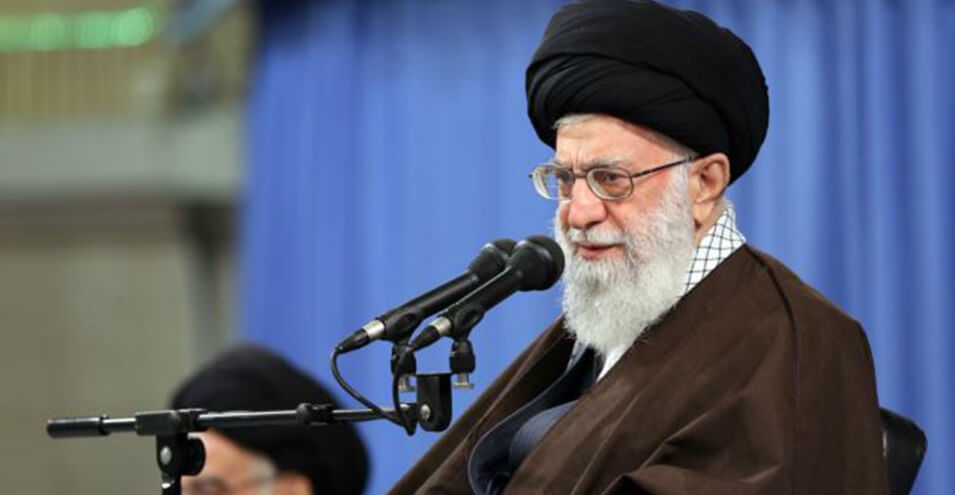
Ayatollah Ali Khamenei strongly criticized the new US policies towards Iran and its withdrawal from the JCPOA, while at the same time setting seven conditions for the Europeans, which if implemented would allow Iran to remain in the nuclear deal.
On the evening of Wednesday, June 2, at an "iftar ceremony" for Islamic Republic officials, the Leader of the Islamic Republic said, referring to the withdrawal of European companies from presence in Iran, that the country's economy cannot be repaired through the "European JCPOA."
He put forward six conditions for continuing the JCPOA with European countries and threatened that if these conditions were not implemented, Iran would resume its past nuclear activities.
"Issuing a resolution against the United States in the UN Security Council," "Iran's missile program and regional actions not being raised in the negotiations," "guaranteeing trade with Iran by European banks," "guaranteeing full sales of Iranian oil," "compensation for past breach of promise," and "confronting US sanctions" are Ayatollah Khamenei's six conditions for Iran to remain in the JCPOA.
He also said about his seventh condition: "If the Europeans delay in responding to our demands, Iran reserves the right to begin nuclear activities."
Explaining his first condition, the Iranian leader said: "Three European countries committed a major breach of promise 13-14 years ago (the Saadabad Agreement during the Mohammad Khatami government)... They must prove that they will not commit that dishonesty and breach of promise today."
He claimed: "In the past two years, America has repeatedly violated the JCPOA and the Europeans have remained silent. Europe must make up for that silence."
Ayatollah Khamenei also stated that "America has violated UN Security Council Resolution 2231 by withdrawing from the JCPOA," and called for "Europe to issue a resolution against America's violation."
UN Security Council Resolution 2231 was issued in support of the Vienna nuclear agreement.
The Leader of the Islamic Republic emphasized that Europe "must commit that it will not raise the issue of missiles and the region with the Islamic Republic."
He emphasized: "Europe must confront any sanctions imposed by the Islamic Republic and stand firmly against American sanctions."
"Guaranteeing full sales of Iranian oil" and "guaranteeing trade with Iran from European banks" are other conditions set by Ayatollah Khamenei.
Following the US's announcement of withdrawal from the JCPOA, European countries have announced that they will remain in the JCPOA.
They have called on Iran to abide by its commitments and have announced their efforts to find a way to evade strict US sanctions against European companies operating in Iran.
Strong criticism of US policies and withdrawal from the JCPOA
In much of his speech, the Iranian leader strongly criticized the United States' new policies toward Iran and its withdrawal from the JCPOA, saying that Washington "will fail again, like the famous cat in the Tom and Jerry story."
Ayatollah Khamenei claimed that after the 2018 Bahman Revolution, the United States had "organized" "various" political, economic, military, and propaganda measures against the Islamic Republic.
He emphasized that America's goal in these actions was to "overthrow" the Islamic Republic, and this word has been repeated recently.
John Bolton announced at a gathering of the People's Mojahedin Organization that we would celebrate 2019 in Tehran, a reference to the overthrow of the Islamic Republic government this year.
However, Mr. Bolton, who is now the national security adviser to US President Donald Trump, announced on May 13 that regime change in Iran is not currently on the Trump administration's "agenda."
Ayatollah Khamenei says that all of America's actions over the past 40 years have "failed" and will fail again, like "the famous cat from the Tom and Jerry story."
The Leader of the Islamic Republic added: "The current US president will not have a better fate than his predecessors, such as Bush, the neocons, and Reagan, and will be lost in history."
Mr. Khamenei's remarks came as the currency market in Iran was in turmoil on the eve of the US withdrawal from the JCPOA.
Also, despite issuing government directives and police pressure, Hassan Rouhani's government has failed to control the price of foreign currencies. According to reports, the price of the dollar has reached seven thousand tomans, and the prices of currencies of Iran's neighboring countries, including the Turkish lira and the UAE dirham, have also increased significantly against the Iranian currency.
On Monday, US Secretary of State Mike Pompeo announced "12 conditions" and said that his administration would impose "the strongest sanctions in history against Iran, and if the Iranian government does not change its behavior, the pressure of sanctions will increase."
Halting uranium enrichment, releasing imprisoned American citizens, halting the ballistic missile development program, stopping support for groups such as Hamas, Hezbollah in Lebanon, and Islamic Jihad, non-interference in the affairs of Iraq, Syria, and Yemen, non-support for the Taliban, and ending the threat from Israel, Saudi Arabia, and the UAE are among the 12 demands made by the United States from the Islamic Republic.
Hours later, however, the Iranian president described the US Secretary of State's remarks as similar to those made by officials in the George W. Bush administration 15 years ago, saying, "What are you doing to make decisions for Iran and the world and say what Iran should do in the field of nuclear technology?"
The US Secretary of State's remarks were welcomed by a number of US allies, including the governments of Israel, the United Arab Emirates, and Bahrain, while a number of other US allies have also expressed criticism or doubts.
"The Islamic Republic cannot interact with America"
In another part of his remarks on Wednesday, the Leader of the Islamic Republic also said that we should not "get carried away by trivial things."
He added: "They say that in the JCPOA issue, America has failed morally and in terms of reputation. Did we negotiate to discredit America or did we negotiate to lift sanctions? Now that they have said that secondary sanctions will also return."
Hassan Rouhani and his government officials have said that the US withdrawal from the JCPOA has "dishonored" the country in the international arena.
The Leader of the Islamic Republic has acknowledged that the goal of the nuclear talks was to lift sanctions, even though he had always considered Western sanctions ineffective.
In 2011, the Leader of the Islamic Republic said in response to Western sanctions that "one is reminded of the cat from the cartoon Tom and Jerry. He moves a lot, he barks a lot, and he is big, but the result of his work is not what he or the viewers expect."
He emphasized: "That's really how it is. It depends on your cleverness. They said smart sanctions or crippling sanctions; but we see that these sanctions were neither so smart nor so crippling."
In his remarks on Wednesday, Ayatollah Khamenei considered one of the "experiences" of the US withdrawal from the JCPOA to be that it proved that "the government of the Islamic Republic cannot interact with America."
He emphasized that this incident is "an answer to those" who were saying, "Why don't you negotiate and interact with America?"
Before direct negotiations between Iranian and American officials in the Hassan Rouhani government on the nuclear issue, the two countries held secret talks in Oman several times at the level of deputy foreign ministers during the final years of Mahmoud Ahmadinejad's government.
Ali Akbar Salehi, head of the Atomic Energy Organization in the Hassan Rouhani government and Foreign Minister in the Mahmoud Ahmadinejad government, had said that these negotiations were conducted with the permission of the Leader of the Islamic Republic and that Ayatollah Khamenei ordered that only the nuclear issue be negotiated.
Mr. Khamenei also said on Wednesday: "In the face of the JCPOA, political and press elements should refrain from blaming each other. There is nothing wrong with fair criticism, but there should be no insults or desecration, and there should be no bipolarity based on the JCPOA."
After the US withdrawal from the JCPOA, those close to the Leader of the Islamic Republic have strongly attacked Hassan Rouhani and the nuclear negotiation team, as exemplified by the statement of Ahmad Jannati, the Chairman of the Assembly of Experts, and the speeches of Friday prayers.
Source: Radio Farda