Second day of teachers' sit-in in Iran
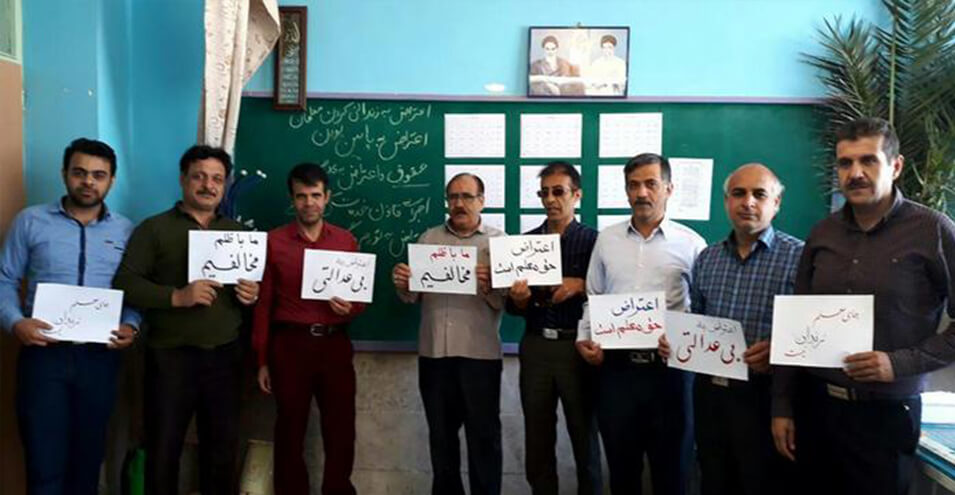
The sit-in by teachers and educators across Iran, which began on Sunday, October 12, continued on Monday. The teachers are protesting high prices, inflation, and the imprisonment of a group of their colleagues. Pressure has increased on the teachers to end the sit-in.
The "Coordination Council of Iranian Teachers' Unions," which organized the teachers' sit-in, wrote on its Telegram channel on Monday, October 15, that "teachers, through their unity, organized a nationwide teachers' sit-in on the first day."
The council's Telegram channel also reported that "an attempt has been made to make the nationwide October teachers' sit-in group inaccessible and to shut down the group by intimidating colleagues in order to destroy our unity."
Iranian teachers have shared images of their union sit-ins on the second day of the sit-in on the Telegram channel of the "Coordination Council of Iranian Teachers' Unions" and on Twitter with the hashtag "National Teachers' Sit-in."
Arrest of the Secretary of the North Khorasan Teachers' Union
In some cities in Iran, pressure on teachers has increased.
Mohammad Reza Ramezanzadeh, head of the Coordination Council of Teachers' Unions and secretary of the North Khorasan Teachers' Union, has been arrested by intelligence agents in the city of Bojnord. According to his colleagues, Mr. Ramezanzadeh has been on a hunger strike since his arrest.
In addition to working teachers, retired teachers have also participated in the protests.
Elaheh Bahrami, a retired middle school teacher in Tehran who retired in 2010, told DW: "Working and retired teachers have protested many times before, but unfortunately their demands have not been addressed. In Iran, anyone who goes on a sit-in or strike by any means is arrested and imprisoned instead of being addressed."
The retired teacher further emphasized that many teachers have no hope of resolving their problems because their demands have not been heeded. He continued: "This issue has been repeated many times, but teachers have not been coherent and united so far, and strikes or sit-ins have not achieved positive results."
According to Bahrami, teachers cannot make ends meet with their pensions and are forced to have second or third jobs.
Niknejad, a teacher living in Tehran, also told DW Persian that the sit-ins were widespread this time and that the authorities were familiar with the teachers' demands. He added: "The teachers' sit-ins have certainly had an impact and our voices have been heard and reached the authorities. Cyberspace has been an opportunity for civil society groups, which has had a good impact."
Mr. Niknejad continued: "The current sit-ins are in line with previous protests by the country's educators. Because the educational and union situation has not changed or improved in recent weeks, the sit-ins and protests have continued. And if there is no one to listen to it, this issue will fluctuate and fluctuate. We hope that these movements will bear fruit and that our voices will be heard and have an impact in the medium and long term."
The difference between the current teachers' sit-in and previous protests
Leila Zori, who has been a teacher for several years and currently lives in Germany, told DW: "Teachers have protested every year before, but this year's teachers' sit-in is different from last year or the years before that in several ways. First, the number of teachers who participated in the sit-ins is greater, and these protests have taken on a public and nationwide aspect. Second, the teachers have succeeded in using social media to make their voices more audible and to present their demands better. But most importantly, the teachers' public sit-in was accompanied by truck drivers' protests. That is why Iranian teachers hope that this time their voices will be heard instead of pressure and arrests."
Source: DW