International Workers' Day: Imposing the right to strike on the government and employers
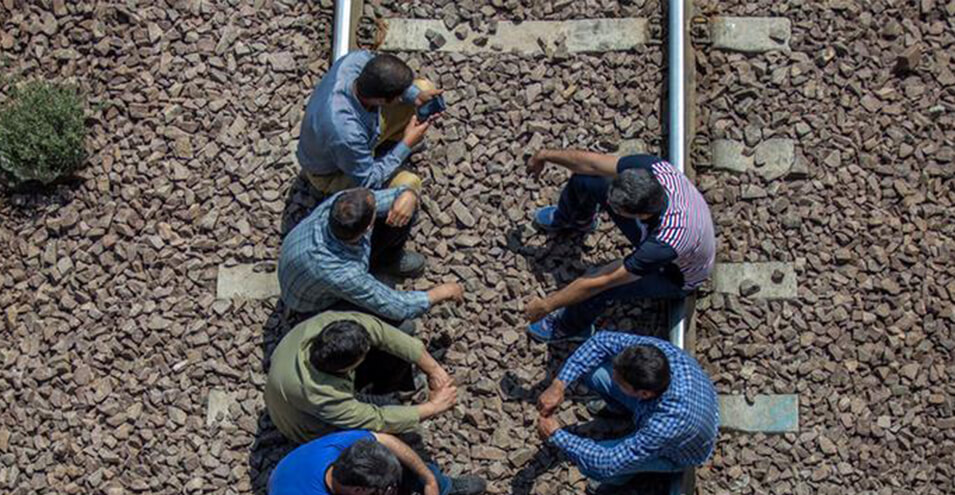
Fair wages, job security, the elimination of temporary contracts, and the right to organize and assemble are among the main demands of Iranian labor society. In recent years, workers have been able to obtain the right to strike and protest from the government and employers. A right that comes with punishment.
The minimum wage for Iranian workers in 2019 was set at 1,517,000 Tomans, or 50,562 Tomans per day. With this wage, a person can make it through the day with a kilo of onions, three blocks of cheese, and ten loaves of bread, provided they sleep on the street or in the desert.
The table of working-class families is becoming more humble every year and the working-class community is becoming more destitute, but the problems of workers are not limited to the pressure of livelihood. The weak economy and dying industrial units threaten the job security of this class. For every factory and workshop that closes, dozens and hundreds of workers become unemployed, and at the same time, every protest and demand is stigmatized as security.
With the intensification of economic pressures in 2018, a large number of manufacturing units have either been dismantled or are operating at minimum capacity. Government sources say that out of the 43,000 units in Iran’s industrial parks, 11,000 to 12,000 are in recession and semi-closed, and only 25% of the units are operating at more than 70% capacity. In the latest examples, the Deputy Minister of Planning and Planning of the Ministry of Industry announced on May 1, 2019, the identification of 2,000 semi-closed units, and the governor of Isfahan announced the closure of 300 manufacturing units in the province’s industrial parks.
Economist Fariborz Raisdana believes that 70 percent of Iranian workers live below the absolute poverty line. He estimates the minimum wage at 3.5 million tomans, taking into account inflation of 30 to 40 percent.
In March 2018, during the minimum wage review, four independent labor organizations issued a joint statement calling for a minimum wage of 7 million tomans. The Waheed Company Workers' Union, the Haft Tappeh Sugarcane Union, the Coordination Committee to Help Establish Labor Organizations, and the Pensioners' Union also called the Supreme Labor Council incompetent to determine workers' wages.
Such announcements are issued in circumstances where independent labor organizations are either experiencing divisions and divisions or witnessing "constructed" and "parallel" unions such as the "Haft Tapeh Islamic Labor Council" or the "Unified Syndicate General Assembly."
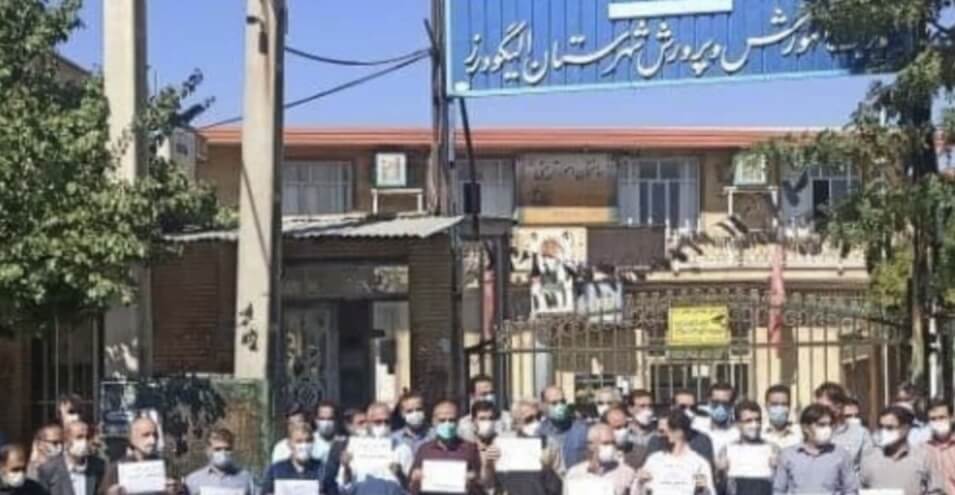
In these circumstances, temporary contracts have become customary and general, and are gradually giving way to oral contracts. 2018 was a year of labor protests and strikes, and at the same time a year of arrests and repression of activists in this field.
To review the demands and indicators of the labor movement in recent months, DW Persian sat down with Alireza Navai, a labor activist and member of the International Union for the Support of Iranian Workers. Referring to the slight growth of the protests, he welcomes the arrival of a new generation of independent trade union organizations and considers “the imposition of the right to assemble and strike on the government” as a notable achievement.
● DW: From last year to this year, Iranian society has witnessed turbulent days. What has been the most significant development in the working class society?
Alireza Navai: The first indicator is the growth of labor protests in quantitative terms. Continuing the growing trend of labor protests in the 1990s, we witnessed a 27% growth in these protests. According to statistics, which are of course not complete, we had at least 1,700 labor protests last year among employed, unemployed, or retired workers. Another issue is the threat to workers' job security as the privatization process continues. Factory closures, layoffs, temporary contracts, and contracting companies.
● Have workers also protested about reduced purchasing power and halving of income?
No. They did not directly fight or rally for a wage increase, but they protested the plan to equalize wages and reduce purchasing power.
● Why don't we see strikes and protests in factories and very large industrial centers?
Because since the beginning of the revolution, they have banned the activities of unions in large factories. They have mostly opposed the formation of workers' unions and have scattered the workers. Of course, for example, in the oil industry, perhaps in the form of Hepco or Steel or Haft Tappeh, we have not witnessed strikes and gatherings, but contract workers have opposed the equalization plan with letters and protests of this kind. We have even witnessed protests in Iran Khodro, although it does not reach the level of gatherings and strikes in the factory itself.
● The security perspective on labor union protests is very common, and with every protest we witness people being arrested.
They have always wanted to stop or limit protests by arresting and expelling organizers, but this method no longer works in the 1990s. That is, despite the fact that protests and gatherings are not free, workers have imposed it on the government. The protests are at a level that they have been forced to accept, but at the same time, they stand up to independent labor organizations. For example, when the Haft Tappeh and Ahwaz Steel sugarcane strikes progress and the discourse of establishing an independent organization increases and even steps are taken, they resort to mass arrests. The indicator of the past year is that they have arrested labor activists en masse. Not only in Haft Tappeh or Ahwaz Steel, they have arrested groups of twenty or more people, but they have even done the same thing in the protests of municipal employees.
● Is this method successful and does it cause fear and division?
A strike may be suppressed or communication between workers may be disrupted during arrests, but experience has shown that after a period of decline in protests, the working masses see that the problems are not only unresolved but have become more widespread, and therefore they turn to protest again.
● Why are there divisions within the organizations themselves, to the extent that they make statements against each other?
This gap has both external and internal reasons. Labor organizations suffered a heavy blow in the early days of the revolution. Of course, it was not just repression, but those of us who were active in this way in the 1950s also contributed to the weakening of these organizations for various reasons. In the 1960s and 1970s, labor activities were scattered and underground in a sense. In the 1980s, we witnessed new labor activities such as the Coordination Committee to help create labor organizations, the Unified Syndicate or the Sugarcane Syndicate or the Free Workers Union. These marked a new chapter in the Iranian labor movement, but in the 1990s, a rift arose between them.
● What does external division mean?
The workers' power has reached the point of imposing protest, but the balance of power is not at the point where those in power will retreat. The government uses various tools to divide. They fire organizers and activists to sever their ties with the labor body. They use the method of luring, for example, offering jobs with very high salaries or indirectly encouraging activists to leave Iran.
The way these organizations deal with differences of opinion is also in a way that fuels division and division. In the 1990s, a new generation entered the field, and the government is trying to prevent these three generations from building together. The division between generations has prevented experiences from being transmitted properly and correctly. Last year, we saw how successful teachers were in organizing nationwide protests, but we did not see anything like this among workers, despite a slight increase in protests.
● Do you mean the organized protests at Hepco or Ahvaz Steel?
Yes, those 15 Hepco workers or 30 steel workers who went on strike and were arrested, these are the new generation of the 90s.
● But politics seems to have cast a heavy shadow over labor actions.
No, at least not in the 1990s. Epistemologically, there was a false expectation and misapprehension of the 2017 protests, that in 2018 we would see a resolution, and this was misleading. When steel and sugarcane workers gathered at the same time, some expected that petrochemical and oil workers, drivers, and teachers would all take to the streets and witness a major change.
The main issue is that in terms of labor activity, the parties accuse each other of having ties to the yellow organizations, and the yellow organizations sow this seed and do things to intensify this suspicion. Regarding the division, we are sure that the ruling think tank has a plan and is working.
● Why don't independent organizations unite and hold a few small rallies each year for Labor Day?
What the Workers' House is launching is not workers' protests, but workers' protests. These gatherings used to be held in sports halls because they had decided not to march and to hold controlled ceremonies, and they gave entry cards to certain people. Now, when they come to the streets, the entire march is surrounded and under control so that they can tell international organizations that we are having a May Day march.
Let's not forget one thing. One of the secretaries of these yellow organizations was the leader of the occupation of the Workers' House in 1958. That is, it is better to say the black organization. They present themselves in international forums as representatives of the union, but domestically they say that the union is a bi-union.
● Is this why scattered programs are held?
In terms of tactics, labor activists now conclude that these gatherings are no longer as productive as they used to be, but the fact that you say that protests on union issues are small is due to the division in independent organizations that has its roots in the past. We even witnessed some labor activists believing that they should cooperate with this or that yellow organization at certain points. During the Master-Apprenticeship plan, they formed a campaign with the Workers' Representatives Assembly, which was ineffective and did not materialize. Now, workers want to hold the ceremony in the same factories and express their demands on the spot. For example, some of the Ahvaz Steel workers have this opinion. Regarding the 50% increase in insurance premiums, construction workers have said that if they do not withdraw this, we will protest in our own unit.
● What is the status of blank contracts given the deteriorating employment and labor situation and high prices?
The number of these contracts is increasing year by year. We are now witnessing an increase in oral contracts, while oral contracts are not valid at all. In today's world, they ask you to sign everything you do. In the current situation, we have workers who do not even receive the official minimum wage. That is, they work for five hundred thousand tomans a month. Don't think that they accept such wages in underground workshops, they receive such salaries in official companies and production units.
● Do you have any statistics on this trend?
No, we don't have separate statistics, but they themselves officially say that in the past forty years, temporary contracts have increased from ten percent to over 90 percent, meaning that the previous trend, where permanent contracts were 90 percent and temporary contracts were 10 percent, has now been reversed.
Source: DW