Prison for protesters who fired missiles at passenger plane; Bahareh Hedayat: Those 176 people will not return, including those killed in Aban
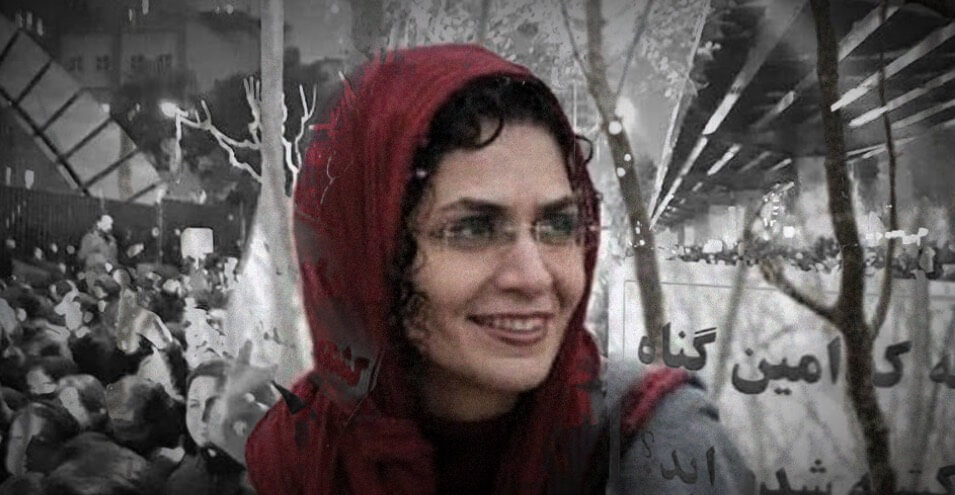
Bahareh Hedayat, a civil activist and master's student in political science at the University of Tehran, has been sentenced to 4 years and 8 months in prison and banned from membership in groups for participating in demonstrations protesting the shooting down of a Ukrainian plane.
Bahareh Hedayat, who was beaten and arrested after being summoned to Tehran University security on February 11, 2019, is free on bail of 200 million Tomans. Ms. Hedayat's trial was held on February 11, 2019, and Branch 26 of the Revolutionary Court sentenced her to imprisonment and deprivation of liberty.
Bahareh Hedayat announced on her personal Twitter account on Saturday, August 25, that she had been notified of the court's verdict, and based on it, she was sentenced to 4 years in prison on charges of gathering and collusion for participating in a rally in front of Amir Kabir University to protest the downing of the Ukrainian plane, and 8 months in prison on charges of propaganda against the regime for her tweets in the same context.
According to Article 134 of the Islamic Penal Code, this sentence is enforceable for 4 years.
Ms. Hedayat explained that she was sentenced to 2 years of ban on membership in groups and 3 months of service in a nursing home as a secondary punishment.
In response to the verdict, this student activist wrote, "These are only sentences of a few years of imprisonment and deprivation, but those 176 people (those killed in the Ukrainian plane crash) are gone and will not return, nor will those killed in Aban."
Bahareh Hedayat, born in 1989, a student and women’s activist, former member of the Central Council and spokesperson for the Office of Consolidating Unity, and member of the One Million Signatures Campaign to Change Discriminatory Laws Against Women, was arrested on January 1, 2009, and sentenced to 9 and a half years in prison, consisting of 2 years for “insulting the leadership,” 6 months for “insulting the president,” and 5 years for “acting against national security and spreading lies.” This prominent student activist was released in 2016 after 7 and a half years in prison. Bahareh Hedayat received the Harald Edelstam Award from Sweden in 2012 for “extraordinary courage and commitment to active justice against human rights violations in Iran.”
Bahareh Hedayat is not the only person to be sentenced to prison for protesting the downing of the Ukrainian passenger plane. While none of those who ordered the missile attack on the Ukrainian passenger plane have been summoned so far, and Islamic Republic officials have announced that the person who pulled the trigger is in custody, dozens of protesters have received prison sentences for the missile attack.
On the morning of Wednesday, January 8, 2019, a Ukrainian plane carrying 176 people crashed minutes after taking off from Imam Khomeini Airport near Tehran after being hit by a missile from the Revolutionary Guards, killing all on board. Officials in the Islamic Republic blamed a technical malfunction for the crash, and three days after the disaster, the General Staff of the Islamic Republic’s Armed Forces admitted in an official statement that the Revolutionary Guards’ defenses had mistakenly targeted the plane. They blamed “human error” for the horrific disaster.
Since Saturday, January 11, thousands of people in Tehran and various cities in Iran, especially students, have held protests against the downing of a Ukrainian plane by the Revolutionary Guards. In some cases, these protests have turned violent.
In the city of Mashhad, Masoud Hokamabadi, an artist and theater producer who was arrested on January 18 of last year after withdrawing from the Fajr Theater Festival in protest of the downing of a Ukrainian passenger plane by the Revolutionary Guards, has been sentenced to three years in prison.
Mostafa Hashemizadeh, a civil engineering student at the University of Tehran, and Amir Mohammad Sharifi, another student at the University of Tehran, have also been sentenced to prison for the same reason. Amir Mohammad Sharifi was sentenced to three years in prison, and Mostafa Hashemizadeh announced on his personal Twitter account that “I was sentenced by Branch 26 of the Revolutionary Court of Tehran to five years of imprisonment on charges of collusion and gathering against national security, one year of imprisonment and 74 lashes on charges of disturbing public order and peace as the main punishment, and a two-year ban on entering the student dormitory, and three months of free and public service at the Niayesh Psychiatric Hospital in Tehran.”
In the city of Amol, more than 16 people who protested against the downing of the plane have been sentenced to prison and flogging. Protesters who planned to light candles in the city’s Ghaem Square on Sunday, January 12, 2019, to express sympathy for the families of the victims of the Ukrainian plane, were arrested by military and security forces. Five of these protesters, including Shura Fekri, Mohsen Rezaei, Meysam Khalili, Mehdi Rai, and Salman Farrokhi, were arrested by the IRGC Intelligence and sentenced to 5 months in prison each by Branch 1 of the Amol Revolutionary Court. 11 other citizens of Amol; Amin Forouhi, Ali Shokri, Azadeh and Aidin and Aida Javani, Alireza Mohammadnejad, Fereshteh Mahmoudi, Hossein Mostafa Nia, Meysam Khodabandehlu, Hamid Mohammadi Irani, Amin Forouhi and Mohammadreza Shojaei, who were arrested by the security police, were charged with propaganda activities against the regime by Branch 1 of the Amol Revolutionary Court and sentenced to a total of 88 months in prison, and sentenced to 5 months in prison and 20 lashes by the Amol Criminal Court on charges of disturbing public order. The criminal court's sentence is suspended for one year.
Source: Iran Human Rights Campaign