The confusion of fundamentalists in the face of protest rallies
Many fundamentalists see the recent protests as a "righteous" reaction to the government's economic policies. However, fundamentalists have different views on the origins of some of the slogans that target the government as a whole.
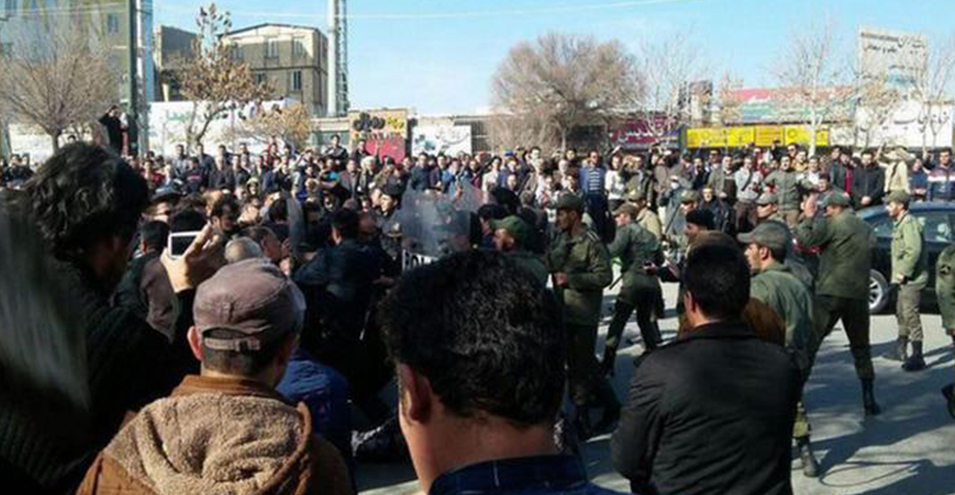
Demonstrations and protest rallies over the past two days (January 27 and 28) began in Mashhad and some cities in Khorasan Razavi Province and spread to many other cities, including Kermanshah, Khorramabad, Shiraz, Isfahan, Rasht, Hamedan, Qom, and Qazvin.
The protests in Mashhad took place under the slogan "No to Expensiveness," and with the presence of a number of those who lost money in financial and credit institutions, slogans against widespread corruption in the Islamic Republic system were also widely heard.
In many cities, protesters chanted “Police, go catch the thief” in response to the violent crackdown by law enforcement and security forces. Protesters also chanted other slogans that Hassan Heydari, the prosecutor of Mashhad, attributed to “some structurally disruptive individuals” in an interview with Fars News Agency.
According to the conservative Borna news agency, on Thursday, protesters in Mashhad "chanted slogans against the president and the government, and these slogans gradually became louder, and then began to chant harsh, destructive slogans."
According to what can be heard in videos posted online, demonstrators in various cities have chanted slogans including: "Leave Syria, think about us," "No Gaza, no Lebanon, I will sacrifice my life for Iran," and "Independence, freedom, Iranian Republic."
Referring to such slogans, Hojjatoleslam Mohsen Mahmoudi, head of the Islamic Propaganda Coordination Council, told ISNA news agency on Saturday morning: "We consider the accounts of the patient, faithful, revolutionary, suffering, unemployed, and poor people separate from the accounts of the hypocrites and seditionists, and the Islamic system must definitely reach out to the people."
Protesting "for the people's rights"
In yesterday's prayer sermons, Hojjatoleslam Ahmad Alam-ul-Huda, the Friday Imam of Mashhad, considered the people's protest against the high prices "rightful," and at the same time said: "These people are not bad with the system, but rather they are under pressure from economic and livelihood problems."
According to reports, Alam al-Huda, referring to Maryam Rajavi, leader of the People's Mojahedin Organization, said: "It is not right for a group to say in a rally, 'Leave Syria alone, think about us.' It is not right for an American prostitute, who is the leader of the hypocrites, to come and thank you for this slogan, and we should not provide food for the enemy media."
The Friday prayer leader of Mashhad addressed the demonstrators in the city, saying: "Your demands were completely right and your slogans against high prices were right, but we should know that the enemy wants to hurt us and we should not allow them to exploit these demands."
Kayhan newspaper, one of the main media outlets of the extreme fundamentalists, has accused officials in Hassan Rouhani's government of dealing with "the people's economic grievances" in a partisan and political manner, and calls citizens' protest movements a "conspiracy by rivals."
The newspaper accused Persian-language media abroad and “Western-affiliated opposition activists and institutions” of “taking advantage of such events to reflect the atmosphere of protest against livelihood problems in a political manner.”
Kayhan and the denial of anti-government slogans
The editorialist of Kayhan newspaper added: "This is while the slogans of the people present at the protest rallies have been based on economic and financial issues, as well as the government's indifference to election slogans and promises."
It seems that at least some of the fundamentalists and opponents of the government are pleased with the protest rallies and consider them a result of the government's inefficiency, but they remain confused by the "structurally disruptive" slogans.
Kayhan wrote in another note: "The root of the popular protests is economic problems that have been neglected by the government, but anti-revolutionary circles are trying to turn this legitimate protest against the expropriation system into something desirable."
"Criminals" for changing slogans
In this note, Kayhan newspaper accused "some media outlets supporting the government and the sedition movement" of "welcoming the attempt to create tension and turn the aforementioned livelihood protest into political unrest."
“Fitnah” is the title used by the Leader of the Islamic Republic, Ali Khamenei, and supporters of the regime for the protest movement against the announced results of the 2009 elections. Kayhan claims that the slogan “No Gaza, No Lebanon,” which was also repeated in the 2009 protests, was “dictated” to the protesters by the Israeli Foreign Ministry.
Thus, from the perspective of fundamentalists, a wide range of people have been involved in or welcomed the transformation of the protest over the "right" to livelihood into political unrest, but as the Friday prayer leader of Mashhad has claimed, "people are not bad with the system."
Meanwhile, the Rasht fundamentalist representative and vice-chairman of the provincial independent faction of the Islamic Consultative Assembly told ILNA news agency on Saturday, January 29: "Attributing the [protest] gatherings to the Hypocrites and royalists is a clear mistake."
Gholamali Jafarzadeh Aymanabadi, who is also a member of the Budget Consolidation Commission, said the recent protests were motivated by concerns about price increases and the elimination of a large portion of subsidy recipients, which are included in the proposed budget bill for next year. He assured that the parliament and the government have received the protesters’ “message” and do not need to worry about price increases.
Questioning the “top to bottom” of the system
Jafarzadeh believes that the incitement of people to chant anti-government slogans is due to the behavior of the government's extremist opponents: "The issue is that in recent days, extremists and pacifists have questioned and criticized the system from top to bottom in their speeches, under the pretext of destroying the Rouhani government."
The Rasht MP told ILNA News Agency: "It's the same everywhere in the world, and when people see the government moving towards economic austerity, they try to make their voices heard by the government, while according to Article 27 of the Constitution, arrangements must be made so that people can make their voices heard by holding non-violent gatherings."
The deputy head of the provincial independent faction in the parliament yesterday also warned those who, according to him, have targeted the government, stating that people do not distinguish between the government, sovereignty, and the system: "We are all on the same boat, and whoever punctures this boat, we will all sink together."
Source: DW