Thirty-three bridges are twisting in pain.
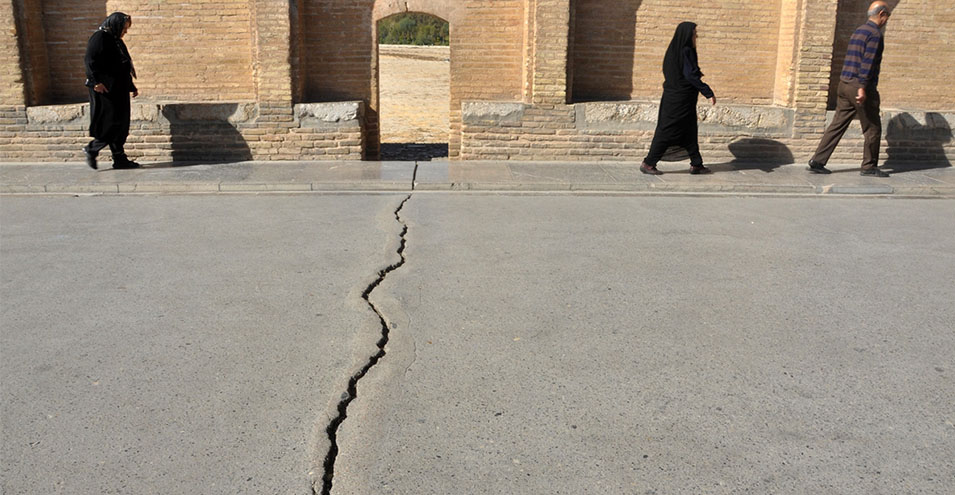
The excavation of the subway tunnel and the successive drying of the Zayandeh Rood River affected the "303 Bridges" so much that it caused the cracks to fall on one of the most beautiful bridges of the Safavid era; cracks and, of course, subsidence.
Alireza Rouhani, the head of the Coordination Council of the Cultural Heritage, Handicrafts and Tourism Councils of the country, gave another bitter piece of news to the Iran newspaper. Droughts and subsidence in Isfahan have not only affected the "30-three bridges" but, according to him, all the Safavid bridges built on the Zayandeh River are at risk of subsidence. Shahram Amiri, the director of international affairs at the Isfahan Cultural Heritage Directorate, points out that it is normal for historical bridges to crack due to water fluctuations, and pours clean water on everyone's hands, saying: "Heritage can work in the field of treatment, not prevention."
Thirty-three bridges are victims of mismanagement
According to Rouhani, the condition of the Thirty-Three Bridges is worse than other Safavid bridges that attract many tourists from around the world to Isfahan every year.
The Thirty-Three Bridge is not only damaged by drought and seasonal interruptions to the water supply to the Zayandeh River. The damage was first caused by the Metro's drilling rig so that the cracks would show themselves much sooner than drought could damage it.
The Isfahan Metro drained part of Chaharbagh before reaching Si-Se-Pol. Experts’ warnings and efforts by cultural heritage activists and the media brought the perpetrators to court, but they did not lead to a result that could save cultural heritage from the wounds of development. The blade of development continued to wound the heritage of the Safavids. During the management of the Cultural Heritage Organization by Hamid Baghai in the previous government, the Metro reached Si-Se-Pol, making the Turks tremble at one of the most beautiful historical bridges in the country.
This incident occurred as a result of a miscalculation. Although part of the public opinion claimed that there was a "treasure" under the Si-Se Bridge and the excavated section, this issue was always viewed as "ridiculous" by the executors. As Rouhani also says, the digging machine reached the Si-Se Bridge "ramp" due to a deviation and stopped the operations.
The contractors were left wondering for a long time what to do! Because the German drilling rig could not turn back. They had to pull it out of the ground vertically, but that would have cost the contractors a lot of money. There was also the possibility of extensive destruction of the 33 bridges.
According to Rouhani, they ultimately decided to continue the route and pass it under private buildings. This also required approval by the Islamic Consultative Assembly.
Rouhani says: "This happened in silence. They didn't even let many council members know about this incident." After that, the new station was built a few meters higher than the Si-Se-Pol station.
Rouhani says: "To build the first station, some of the trees in Chaharbagh were cut down, and after two years of spending, they moved on to building the new station. Another part of the trees in Chaharbagh (from the Safavid era) was also cut down to build the new station. The same amount of money was spent again." Finally, the metro route was dug 40 meters from Si-o-se-pol, which, according to experts, loosened the ground so that the subsidence of the ground in this area would also damage the history of Isfahan. Therefore, the metro first emptied the area under the "Si-o-se-pol", but the bitter plan for dam construction, water transfer for industries, and... was drawn up for this historic bridge.
The situation at the thirty-three bridges is dangerous.
Rouhani recalls an aerial map of Isfahan and says: "If one looks at an aerial map of Isfahan and the bed of the Zayandeh River, it becomes clear that this river flows in a straight line through the city, but when it reaches the 35th bridge, it curves."
According to him: "All the bridges in Isfahan, especially the Safavid bridges that were built on the bed of the Zayandeh Rood, have their foundations built on a bed of stone. The Thirty-Three Bridge is the only bridge that is not built on a bed of stone. Because they wanted to connect the backbone of Safavid Isfahan (Chaharbagh Abbasi and Chaharbagh Bala) with the Thirty-Three Bridges, they diverted the Zayandeh Rood to build the Thirty-Three Bridges on a bed of sand and gravel."
That is why the Safavids drove piles 30 meters deep under the bridge piers. This is where the life of the bridge depends on water. Rouhani emphasizes: “The durability of the mortar of the pillars of the thirty-three bridges depends on water. When water does not reach this mortar, it causes the pillars to crack and the bridge to subside.” Experts before Rouhani and in previous years have warned about the shock of cutting off and flowing water from the Zayandeh River on the pillars of the thirty-three bridges: “This flow constantly damages the thirty-three bridges.”
Warnings that, of course, did not cure the pain of the Zayandeh Rood and its historical bridges. Rice is still grown in Isfahan. Industries in Isfahan not only did not retreat, but in response to the protests, a new phase of water-rich industries in Isfahan moved towards Chaharmahal and Bakhtiari so that everything can drink water from the source.
Rouhani also considers the movement of heavy vehicles on the 33rd Bridge to be one of the causes of its current cracks. The passage of vehicles on the 33rd Bridge was stopped in the decades after the revolution, but according to Rouhani, it left its own role in creating this deep wound. According to him, all these issues went hand in hand so that the 33rd Bridge suffered from the pain of countless cracks, cracks that have persisted so long that they have affected other bridges on the Zayandeh Rood, including the wooden bridge or the “Joyi” bridge, the Khaju bridge, and so on.
Cracking of historical bridges is inevitable
Shahram Amiri, the director of international affairs at the Isfahan Cultural Heritage Directorate, also considers the cracking of historical bridges and other historical monuments to be normal and inevitable. This situation led to the formation of the “Isfahan Historical Bridges Monitoring Committee” late last year. Amiri says: “Therefore, monitoring measures have been put on the agenda for 11 bridges on the Zayandeh Rood River axis.” According to Amiri, the latest measure for the “Joyi” bridge in Isfahan was monitoring and restoration measures were carried out on this bridge. Despite this, public opinion is asking whether there is any way to prevent the cracking of Safavid monuments, which are one of Iran’s recognized identity cards in the world?! Should we witness the death of historical bridges after Zayandeh Rood?
Source: IRNA