Prince Reza Pahlavi: Only count on the Iranian people, not negotiations or military attacks
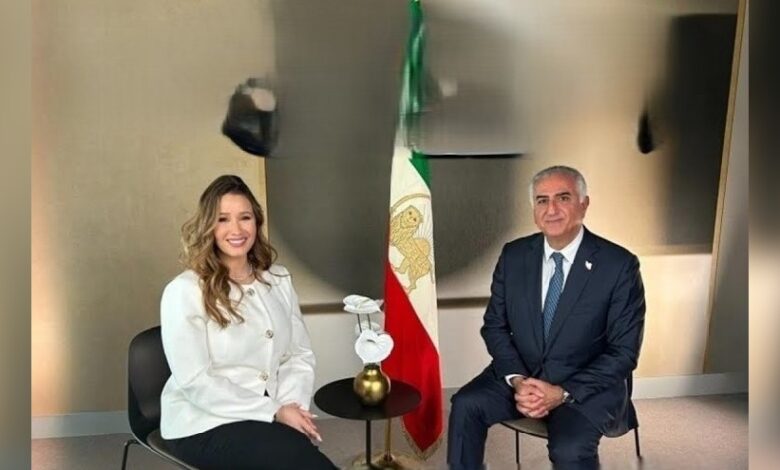
In an interview, Prince Reza Pahlavi spoke of opposing negotiations and a military attack, and instead of settling accounts with the Iranian people.
In a television interview with Israel's Channel 14, Prince Reza Pahlavi announced his opposition to attacking Iran's nuclear facilities and negotiating, and instead spoke of the support of the Iranian people by governments around the world to overthrow the Islamic Republic.
In an interview with the same channel last week, he said about the relationship and friendship between Iranians and Jews that no two nations have the 2,500-year-old bond that Iranians have with Jews. In an interview with Channel 14, Reza Pahlavi, in response to the question “Do you believe that the Ayatollah regime will fall soon?” said: “The Iranian regime today is in its weakest position in all these years for several reasons. The first reason is that this regime has completely lost its legitimacy among the Iranian people and the overwhelming majority of the people do not accept this government from the very beginning. For years, there was a belief that the regime could be reformed, but now most people, including those who were reformists in the past, believe that the time has come to move on from this regime.
"The slogan 'Death to the dictator' is constantly being chanted by the people in Iran, which shows that the people are getting fed up. So I think we are very close to change and what we are seeing is more cracks within the regime. More of them are falling apart, all of this is evidence that the regime is becoming more and more vulnerable and a real opportunity for change will soon be available."
Prince Pahlavi also responded to the host's question about the Trump administration's attack on Iran's nuclear facilities, negotiations, a military strike, or better options for overthrowing the regime, saying: "I don't agree with any of them. Because diplomacy has practically failed for this regime, and the entire basis of Western diplomacy to date has been focused on changing the behavior of this regime. In other words, they have not yet understood the nature, composition, and essence of this regime. If you are looking for peace, you must find partners to achieve it and look for peacemakers. The Iranian people, who are not represented by this regime, are the peacemakers."
"We can be the solution to this problem, not this regime. Ali Khamenei is not someone you can count on to solve this problem for you. No agreement is possible with them. This is one of the reasons diplomacy has failed, because it was wrong to expect it to do so from the beginning."
He also added about opposing a military attack: "We should not resort to military conflict. That is why I have put forward this proposal: why, after 46 years, the Iranian people are not given a chance to prove that they can bring about this change before you have to resort to a military attack on Iran's nuclear facilities?! Whether it is by the Israeli army or any other force, or whether you enter into a campaign of confrontation and conflict.
We now have a golden opportunity for the world to stand with the Iranian people as an agent of change and an element upon which they can build lasting stability and peace in the region. That is a win-win situation, both for the Iranian people and for the free Western world, and certainly for our regional partners, especially Israel as a strategic partner for Iran. Iranians, unlike this regime that hates you and wants to wipe you off the face of the earth, recognize the value of our relationship.
"A relationship that, if you think about it, is a special and unique relationship in the entire world. The relationship of Iranians with Israelis and Jews is rooted in the Bible. This relationship goes back 25 centuries. No other country on earth can claim that. That's what makes this relationship unique."
In his interview about the “Cyrus Pact” alongside the “Abraham Pact”, which he had also mentioned during his trip to Israel, the prince continued: “I say again that when there is such a relationship, then there is a strategic partnership. Let me put it this way: when we are of the same mind, it is based on our common interests. Including regional stability, which helps improve economic relations and means creating opportunities, development and many other things. Everyone thinks about Iran only in terms of oil and gas, but Iran is not just that. We are a country that can be one of the biggest tourist destinations and this industry has huge potential. Imagine the possible investments in Iran for the development of the entire Persian Gulf region, from natural resources to ecotourism and so on. In fact, there are no limits in this regard.
"But as long as this regime is in power, Iranians will not be able to achieve these aspirations, and the world will not have the opportunity to invest in our country."
In response to the last question about Iran-Israel relations, whether it is possible for this relationship to become as good as it was during his father's time, he said: "We think that these relations will become many times better, for various reasons. The first reason is because the phenomenon that led us to understand the importance of these relations had its roots in religious prejudices or religious beliefs. So naturally these relations will be more fruitful and stronger than in the past, because we have passed through that era."
We were forced to experience theocracy, a religious dictatorship that has made Iranians realize today how important it is to have a secular system of government, meaning the separation of religion from the state. And that as a basic prerequisite for a democracy and respect for human rights. In the meantime, there is no room for anti-Semitism, anti-Arabism or any other discrimination. We have missed great opportunities. They (the people) understand what is going on. They know what is happening in the outside world, they are smart.
Ordinary Israeli citizens came to me when they heard that I had traveled to Israel and probably followed the news in the media. Some had tears in their eyes and were saying how much they hoped to see this change because they knew how different our world would be. That you could sit back and enjoy life without worrying about a rocket hitting a building in Tel Aviv or Jerusalem, or another bomb going off in the street. The current regime in Iran is always financing terrorism and that is our big difference. Ultimately, it is about the people and their strength. No country can be stopped if its people are determined to succeed. If they are alone, it may be a harder path, but they will eventually succeed and that is the lesson we learned in the free world.”