Transition Plan for Iran; Prince Reza Pahlavi's Plan for the Future After the Islamic Republic
The planning of the Transition Plan for Iran by Prince Reza Pahlavi is a plan to prevent a power vacuum and prepare the country for a future after the Islamic Republic.
In recent years, the debate about Iran's political future and possible scenarios for the post-Islamic Republic era has become more heated than ever. Many political activists, experts, and opposition groups have attempted to present plans and proposals on how to manage the transition and prevent political and economic instability after the change of political regime in Iran.
One of the plans that has been put forward in this regard is a plan presented by Reza Pahlavi for managing the transitional phase after the Islamic Republic. This plan aims to prevent a power vacuum, maintain order, and prepare the country for the formation of a new political system, and includes structures for the temporary administration of the country and reconstruction programs.
In the view put forward by Reza Pahlavi, the most important challenge of any major political change is managing the transition period. The experience of many countries shows that the collapse of a political system without a clear plan for governing the country can lead to instability, economic crisis, and even internal conflicts.
Accordingly, the transition plan focuses on several main axes:
- Establishing a temporary structure to govern the country
- Maintaining security and preventing the collapse of administrative institutions
- Providing the conditions for holding free elections
- The beginning of the process of economic and institutional reconstruction of the country
This program is introduced as the "Iranian Prosperity Project" and its goal is to provide a roadmap for rebuilding Iran's political, economic, and social structures.
This plan includes an institution called the "Transitional System" whose task will be to temporarily govern the country after the change in the political system.
According to the published explanation, this system includes a group of Iranian managers, experts, and specialists from inside and outside the country who are being prepared to manage various parts of the country during the transition period.
The process of selecting members of this structure is carried out by examining the professional, specialized, and managerial backgrounds of individuals so that they can play a role in areas such as economics, security, public administration, and foreign policy.
Following the severe weakening of the Islamic Republic's government following repeated Israeli and American attacks on Iran, Prince Reza Pahlavi issued a message regarding the post-transition era and addressed the Iranian people, saying:
"My dear compatriots,
To ensure that Iran does not experience a disruption in the administration of the country with the fall of the Islamic Republic, two important tasks have been underway simultaneously in recent months.
First, developing a clear program for governing the country within the framework of the "Iranian Prosperity Project." Second, identifying and selecting qualified men and women to participate in the "transitional system" and implement this program.
In this process, many compatriots with valuable experience and the expertise needed by our country expressed their readiness to participate in the reconstruction of the country and serve the homeland.
This process has been carried out within the framework of the Transition System Members Review and Selection Committee, which is managed by Dr. Saeed Ghassemi-Nejad. Within this framework, capable individuals have been identified and reviewed in recent months, both inside and outside the country, to head various departments of the Transition System.
The transitional system, under my guidance, will be ready to take over the reins of the country as soon as the Islamic Republic falls and, in the shortest possible time, provide order, security, freedom, and the grounds for prosperity and prosperity for Iran.
"Perseverant Iran,"
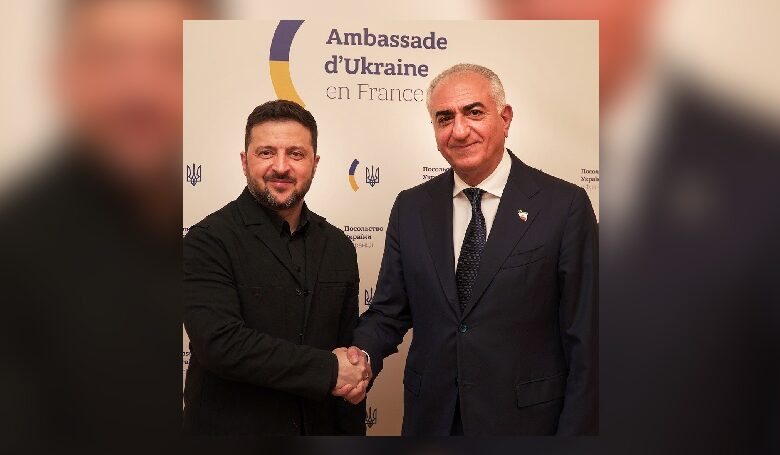
He also said about his meeting with Ukrainian President Volodymyr Zelensky: "Ukraine and Iran are both facing occupation; Ukraine with foreign occupiers and we with internal occupiers. The President of Ukraine, Volodymyr Zelensky, and I, along with our teams, discussed how we can stand together and cooperate in the fight for freedom. History is on our side, and light will eventually triumph over darkness."
In some recent political positions, Reza Pahlavi has also pointed out the similarity between the struggle of the Iranian people against the Islamic Republic government and the resistance of the Ukrainian people against the Russian invasion.
In meetings and discussions with Ukrainian President Volodymyr Zelensky, he has spoken about the possibility of cooperation and solidarity between freedom-loving movements. This comparison is mostly symbolic and is intended to draw the attention of the international community to the political situation in Iran.
The transitional plan presented by Reza Pahlavi is an attempt to answer one of the most important questions of Iran's political future: how will the country be governed if the Islamic Republic changes?
The proposal to create a “transitional system” and formulate an “Iranian prosperity project” shows that part of the opposition is trying to present a practical plan for managing the transitional phase. However, the realization of such plans in practice depends on several factors, including the level of social support, coordination between different political forces, and the domestic and international conditions at the time of political change.