25-year Iran-China agreement: Violation of three constitutional principles and trampling on the rights of the people
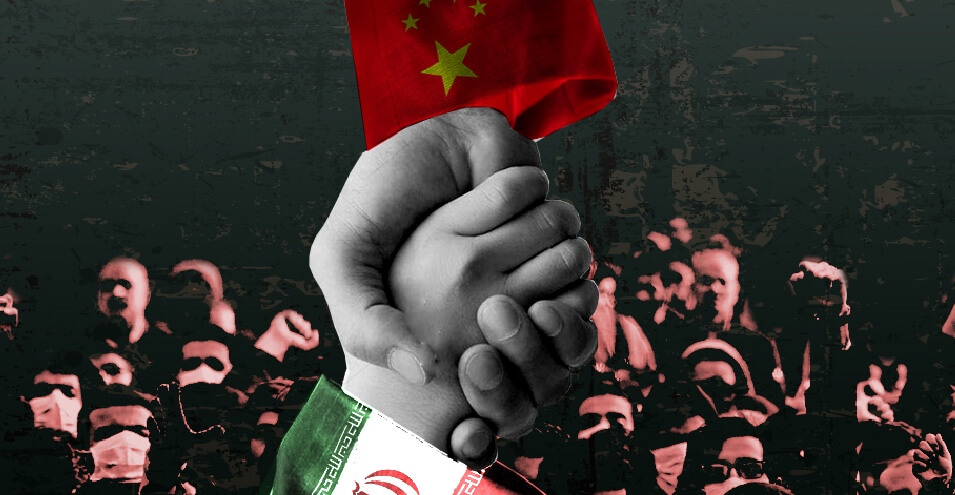
The signing of the 25-year agreement between Iran and China, or as the Islamic Republic's officials call it, the "25-year cooperation document," sparked many reactions from public opinion, from strong protests by social media users to scattered gatherings in some Iranian cities, who considered the signing of this 25-year agreement to be tantamount to "looting" Iran's capital.
The lack of clarity on the dimensions of this agreement further highlights the need to pay attention to Article 153 of the Constitution, a principle in the law that explicitly prohibits any agreement that results in foreign domination of the country’s natural and economic resources, culture, army, and other affairs. At the same time, the failure to ratify this agreement in the Islamic Consultative Assembly is contrary to Article 77 of the Constitution of Iran. On the other hand, the principle that is less discussed regarding this agreement is Article 125 of the Constitution, which considers the signature of the president or his legal representative to be valid for any agreement with foreign governments after the agreement is ratified by the Assembly. The secrecy of the Islamic Republic’s officials regarding the process of signing the agreement and the silence on the details of this 25-year-old document on the one hand and the process of its preparation and ratification on the other hand is a clear example of a clear violation of the Constitution and violation of the rights of the Iranian people, which has angered Iranian citizens. Nevertheless, senior officials of the Islamic Republic of Iran are trying to justify their decision and the clear violation of the Constitution and the rights of the people with various tricks.
A clear violation of fundamental rights by signing a secret document
The legal aspects of the process of ratifying the 25-year agreement between Iran and China can be examined from several perspectives; Article 77 of the Iranian Constitution states that “international treaties, conventions, agreements, and agreements must be ratified by the Islamic Consultative Assembly.” And Article 125 of the Constitution even postpones the signature of the president or his legal representative until after the approval of the Assembly, stating: “The signing of treaties, conventions, agreements, and agreements between the Iranian government and other governments, as well as the signing of treaties related to international unions, shall be by the president or his legal representative after the approval of the Islamic Consultative Assembly.” Although some Iranian officials, by playing with words, consider this document to be without the need for parliamentary approval, this legal principle clearly emphasizes “international treaties, agreements, contracts, and agreements,” which indicates that any document under any title that represents any kind of treaty, agreement, or consent by the Iranian government at the international level must first be reviewed by the representatives of the Islamic Consultative Assembly and, after approval, be implemented in the “House of the Nation.” This is despite the fact that despite the lack of real representation of the people in the Islamic Consultative Assembly due to the discretionary supervision of the Guardian Council and the practical dependence of most representatives on the government, this same Assembly has played no role in the process of approving and signing this agreement, and the details of this agreement have never been explained in the Assembly or to the representatives.
On the other hand, Article 153 of the Iranian Constitution states that "any agreement that results in foreign domination over the country's natural and economic resources, culture, army, and other affairs is prohibited." Although no details of this agreement have been leaked, the reluctance of senior regime officials to make this agreement public has led to much speculation among the public, highlighting the issue that this agreement will lead to China's domination over many of the country's national resources and assets.
Apart from these two constitutional principles that were clearly violated in the process of ratifying the 25-year Iran-China agreement, looking at Article 2 of the Iranian Civil Code, another aspect of the violation of the country's laws becomes apparent in the story of this document; this legal article states that "laws shall enter into force throughout the country 15 days after their publication, unless the law itself stipulates a specific procedure for the time of implementation." Therefore, considering the legal obligation to publish parliamentary resolutions, it seems that one of the main reasons for the government's action to bypass the parliament at the cost of violating Article 77 of the Constitution was its insistence on not publishing this document.
Public protests against the 25-year contract with China and the silence of the Islamic Republic of Iran authorities
After the news of the signing of the 25-year contract with China was released, many have considered the Islamic Republic's method of informing, explaining, and responding to the authorities as similar to the usual method of senior officials of the regime in "covering up" and remaining silent about the details of many sensitive events in the eyes of the public. A method that has been used in recent years, from the incident of the downing of a Ukrainian passenger plane by IRGC missiles to the failure of the country's responsible authorities to provide accurate statistics on the dead and injured in November 2019.
Several days after the signing of this agreement, numerous news and images have been published from some Iranian cities such as Karaj, Rasht, and Kazerun, indicating that some public gatherings were held to protest the signing of this agreement. In most of these protests, citizens have expressed their protest to senior officials with placards bearing slogans such as "Iran is not for sale."
The continued silence of the authorities regarding the details of this contract and the repeated excuses made by the executive and decision-making officials regarding this contract have, more than anything, created suspicion among citizens that the details of this 25-year contract are more likely to "loot" the country's resources and capital than to "benefit" the nation.
Despite the intensifying reactions to the signing of this agreement, instead of answering unanswered questions about the details of this agreement and its provisions, the authorities of the Islamic Republic of Iran are seeking to justify their secrecy about this issue and direct public opinion in a different direction.
A method and policy that can be clearly found in the statement of Seyyed Kamal Kharrazi, head of the Strategic Council for Foreign Relations and a close associate of the Supreme Leader. According to this official, "The Iran-China Cooperation Document is not a contract or agreement that contains details of the cooperation between the two countries in the next 25 years, but rather a letter of intent and a roadmap to guide the cooperation between the two countries in various fields over the coming years."
Although the term "letter of intent" is very unusual, it should be interpreted alongside other terminology used by other officials. It seems that as public protests against the ratification and signing of this agreement increase, executive and decision-making officials are using such tricks as "word-making" for this long-term agreement between the two countries to hide and justify various aspects of the violation of the people's rights in the process of ratification and implementation of this 25-year agreement.
Source: Iran Human Rights Campaign