Mustafa Moein: The attack on the university dormitory was a Mongol-like attack
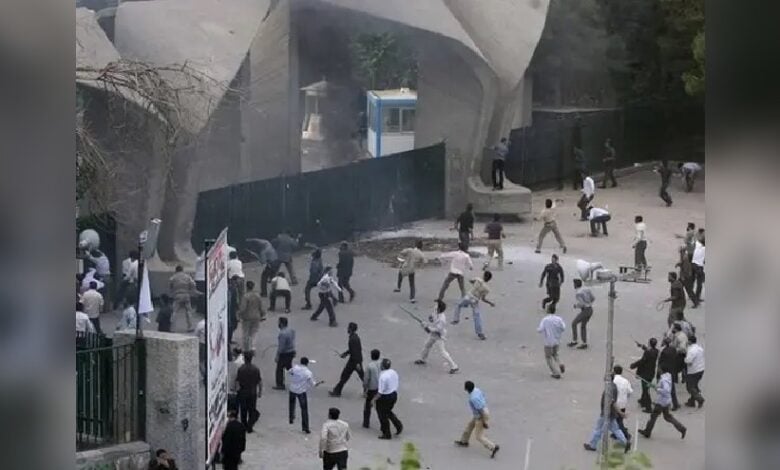
Mustafa Moin, the Minister of Science, said on the anniversary of the attack on the university dormitory that the attack was a Mongol-like attack.
Mustafa Moein, Minister of Science in the government of Mohammad Khatami, on the occasion of the anniversary of the attack on the Tehran University dormitory in July 1999, stated that the attack was a Mongol-like attack. He also confirmed that students, even foreign students living in the university dormitory, were attacked at night, their arms and legs were broken, and they were thrown down from the roof. He emphasized the victimization of students.
The attack on the Tehran University dormitory following the seizure of the newspaper "Salam" took place between students, law enforcement forces, and the so-called plainclothes Basij, between July 8 and 11, 1999. On July 6, 1999, the newspaper "Salam" published a confidential letter from "Saeed Emami," a senior official in the Ministry of Intelligence and accused of serial murders, to "Ghorban Ali Dori Najafabadi," the then Minister of Intelligence. In the letter, Emami called for restrictions on the press, and as a result of the publication of this letter, the Special Clergy Court ordered the newspaper to be seized.
A group of human rights activists in Iran announced the death toll from the attack on the university dormitory on July 8 as seven, of whom only two have been identified. The lawsuits of the victims' families and their questions about this incident and students like Saeed Zeinali, whose fate remains unknown, have kept the case of this student repression in the 1970s still open.
Mustafa Moin added in his interview with Khabar Online: "What was the fault of the university and the students? It was that they were on the scene and created that epic on June 2nd and were the vanguard for the change to happen. This incident could not have happened, because there was no reason for it. It was as if the students' behavior was a great sin, because it caused many equations to collapse. For this reason, from the very beginning, the government of reforms, clashes, and crises began, and then it reached the university neighborhood, which had to be taken care of."
Journalist Reza Hajihosseini, referring to Mustafa Moein's statements regarding the events in the University Quarter, told Iran International: "With this incident, a new chapter of protests in Iran began, as well as a new chapter of the suppression of protests in Iran. The naked form of repression on the streets during these protests still remains in our memories."
Prince Reza Pahlavi also said on the occasion of the 25th anniversary of the attack on the university dormitory: "Students and the people marked a historic turning point in the struggle to overthrow the Islamic Republic. The perpetrators and perpetrators of this crime should know that the case is still open and will one day be heard in a national court."
Mustafa Moin continued his interview, adding: "This behavior was wrong. It can be said that the attack was a Mongol-like attack that took place and caused damage. The student movement stagnated and the university became passive. The psychological and social damage is long-term, it is not something that will end in the short term. Student protests subside after a while and there was no reason for a student protest to turn into a national crisis. This crisis was imposed on higher education and the student movement."
He also made demands to "Masoud Pezhakian," the winner of the 1403 presidential election, including: seriously pursuing "the abolition of house arrest for Mir Hossein Mousavi, Zahra Rahnavard, and Mehdi Karvi," "the release of political prisoners and the removal of bureaucratic and illegal obstacles to the activities of civil society organizations based on constitutional principles," and "the pursuit of the abolition of the Ershad Patrol and the end of violence and insults against Iranian women, girls, and youth."