Desert locusts invade Iran; "125 trillion tomans" of agricultural products at risk
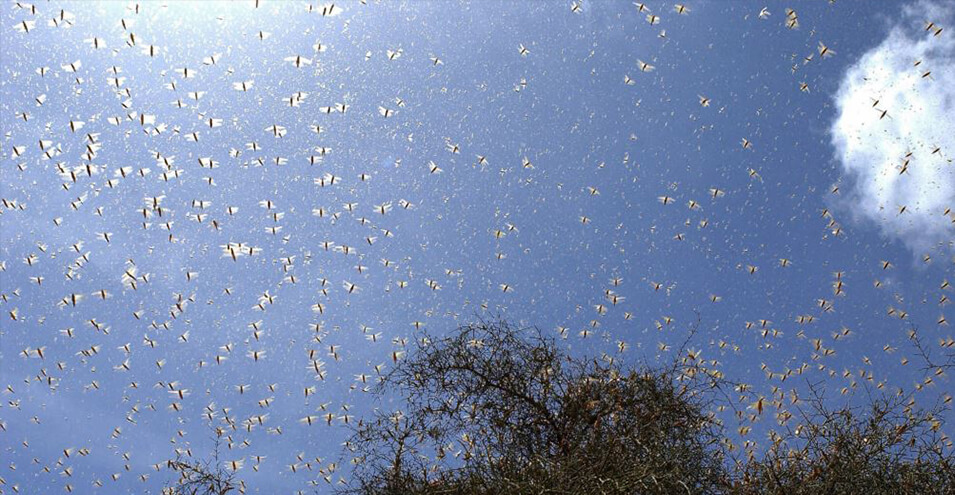
The Plant Protection Organization warned on Thursday, April 10, that if the necessary funds are not provided to combat desert locusts within the next two weeks, the work will be over and the invasion of this pest, along with the floods, will become a new crisis for Iran.
This organization has requested 12 billion tomans in funding to combat desert locusts, of which the country's crisis headquarters has agreed to 10 billion tomans.
Earlier media reports indicated that the request for this credit was submitted in February of last year and has not yet been approved by the government board.
According to IRNA news agency, desert locusts from Saudi Arabia have entered the provinces of Hormozgan, Fars, Kerman, Khuzestan, Sistan and Baluchestan, and Bushehr.
According to IRNA, the increased invasion of desert locusts in the southern provinces of Iran caused the Food and Agriculture Organization of the United Nations, FAO, to change Iran's status from yellow to orange, which means that there is a possibility of significant damage to agricultural and horticultural crops.
Earlier, in 1340, desert locusts attacked Iranian agricultural lands, damaging about two million and 500 thousand hectares of land.
The desert locust is one of the most dangerous species of locust in terms of damaging agricultural crops, and because these locusts usually fly over the Persian Gulf and reach Iran, they are also known as sea locusts among Iranians.
The Food and Agriculture Organization of the United Nations (FAO) warned on its official website two weeks ago that desert locusts had attacked an area of 80,000 hectares on both sides of the Red Sea in March and had migrated to Yemen, Saudi Arabia, and Sudan due to drought.
The report warned that a wave of locusts would soon reach southern Iran.
These locusts, which can fly up to 200 kilometers per day, destroy all vegetation in their path and reproduce rapidly.
Desert locusts can even fly over the Persian Gulf at an altitude of 100 to 1,000 meters.
IRNA news agency quoted Mohammad Reza Dargahi, head of the country's Plant Protection Organization, as saying that operations to combat desert locusts have been implemented in 40,000 hectares of land in six southern provinces of the country, but this is only a small part of the work and 200,000 hectares of agricultural land are still at risk.
He said that if desert locusts are not controlled, they will threaten food security: "So far, there has been no serious damage to agricultural lands, but the fight against this pest must be expanded because 125 trillion tomans worth of products are at risk."
Some Iranian media outlets have also warned of the risk of a "famine."
On the other hand, ISNA news agency reported, quoting Khosrow Omrani, deputy head of the Agricultural Jihad Organization of Bushehr Province, that the second wave of migratory locusts is expected to begin entering the country in mid-May.
Contrary to Mr. Dargahi's statements about the possibility of eliminating the locust pest by the end of July, Mr. Omrani says that according to the FAO's optimistic statement, locusts will be our guests for the next four years, so when we know that we will be hosting these locusts for several years, we must make a good plan to combat them.
IRNA writes that a very large swarm of this type of locust can cover a thousand square kilometers and is capable of consuming 100,000 tons of vegetation per day.
Source: Radio Farda