Reza Pahlavi's sharp warning from the heart of Europe; "We will not accept a repackaged Islamic Republic"
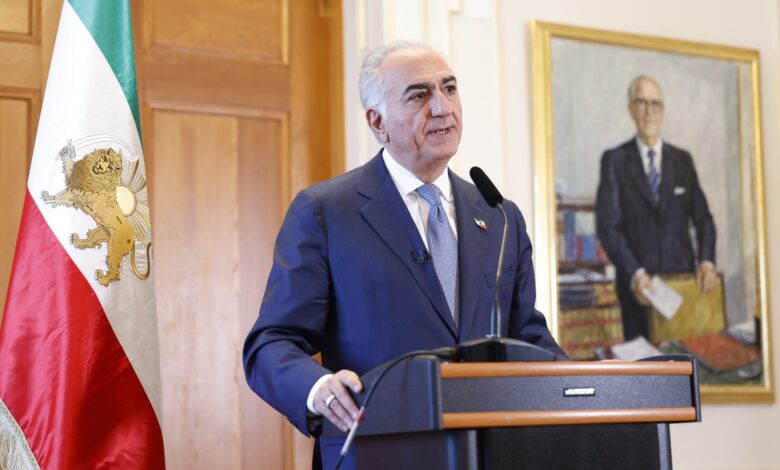
In his speech in Sweden, Reza Pahlavi emphasized and warned that "we will not accept a repackaged Islamic Republic" and called for a fundamental change in the regime.
Continuing the diplomatic and media efforts of Iranian opposition figures, Reza Pahlavi appeared in the Swedish Parliament on Monday, April 13, and in a frank speech, explained his positions on Iran's political future, the role of the international community, and the nature of domestic protests; a speech that has provoked reactions with its harsh language, especially towards any "internal structural reform" of the Islamic Republic.
This presence was at the invitation of some Swedish parties and has been assessed by observers as a sign of increased attention from some European political movements to the opposition abroad.
The main thrust of his speech was the rejection of any solution based on reforming the Islamic Republic. He stated bluntly: “The Iranian people will not accept a repackaged version of the Islamic Republic.”
This sentence, as one of the most key parts of the speech, was interpreted directly to Western politicians who are still looking for options for engagement or gradual change in Iran's power structure.
In another part of his speech, Pahlavi attempted to redefine the nature of the recent protests in Iran and see them as going beyond political differences within the government: "What is happening in Iran is not competition between factions within the system, but rather beyond that and an awakening."
With this interpretation, he introduced the protests not as a sectional or factional movement, but as a sign of a profound social change.
According to reports, another important theme of the speech was criticism of the approach of European countries towards the Islamic Republic. He implicitly questioned policies based on engagement and diplomacy, describing it as a form of “appeasement” – an approach that, in his opinion, has helped to perpetuate the status quo.
This stance comes at a time when serious discussions are underway in Europe about how to deal with developments in Iran.
Reza Pahlavi, who has been a well-known opposition figure for years, has repeatedly emphasized his readiness to play a role in the transition period in recent months.
He has previously spoken of the need to create a secular democratic system and called for a referendum to determine the form of Iran's future government.
His speech in the Swedish Parliament is notable in several ways: on the one hand, it reflects an effort to attract international support and establish relations with European political institutions, and on the other hand, it reflects the competition between different opposition movements to influence public opinion and the foreign policy of Western countries.
At the same time, the explicit and sometimes harsh positions presented in this speech could increase the intensity of the differences in views about Iran's political future, both at home and among opponents abroad.
Reza Pahlavi's speech in Sweden can be seen as part of a broader effort to define the narrative of Iran's future; a narrative that emphasizes a complete change in the political structure and rejects any middle ground.
However, the question remains as to the extent to which this view can achieve consensus and practical impact among different segments of Iranian society, as well as in international equations.