Equalization of pensioner rights in Iran: A promise that has not been fulfilled
Hadi Aboui, Secretary of the Supreme Center of Workers' Trade Unions, has asked the Consolidation Commission of the Islamic Consultative Assembly to pay special attention to the issue of the Social Security Organization's resource deficit, equalization of pensioners' rights, and payment of government debts to the Social Security Organization during the review of the 1401 budget bills.
Rasoul Farrokhi Mikal, secretary of the Interior Commission and the Councils of the Parliament, told Tasnim: "We are facing two types of discrimination in the institutions: discrimination within the same institution, meaning that employees of the same institution with the same work receive different salaries, and discrimination between executive institutions, meaning that the salaries of employees with the same conditions, jobs, and educational qualifications are different."
Regarding retirees, Article 30 of the Sixth Development Plan states that the government is obligated to pay retirees up to 90 percent of the average salary of employees so that the salaries of retirees from previous years are equal to those of new retirees. Also, according to Article 98 of the country's Employment Law, the government is obligated to compensate retirees by increasing the salaries of employees, and it is the duty of governments to increase the salaries of retirees and employees in proportion to the cost of living.
In the case of teachers, however, the problem is not just the equalization plan. Ten years ago, a teacher ranking plan was presented to the parliament, with the aim of improving the social status and professional standing of human resources. The plan defined four ranks, including teacher instructor, assistant professor, associate professor, and professor, so that teachers, regardless of their experience, would receive at least 80 percent of the salary of their peers at the university.
But Education Minister Yousef Nouri said on the sidelines of the National Research Day ceremony on December 10 this year: "There are ambiguities regarding the ranking of teachers. I consider this plan to be more of a standardization than a ranking, because for ranking there must be a document to work on. Its effect on the quality of education must be seen."
MP Muslim Salehi had previously said in a public session of the parliament on January 5: "I request the government to submit a comprehensive bill to the parliament on the equalization of employee rights, as soon as possible. Because employees in different parts of the country are facing livelihood problems, and by submitting this bill to the parliament, their problems can be partially resolved."
- Poverty line, the basis for salary increases
According to Mohammad Alipour, a member of the Economic Commission of the Islamic Consultative Assembly, the government plans to increase salaries in stages, ranging from zero to 20 percent.
Also, based on the minimum salary in 1400, which is about 3 million and 500 thousand tomans, and an increase of one million tomans in next year's budget, it is set to increase to 4 million and 500 thousand tomans. Also, the salary ceiling for university administrators and professors is set at 27 million tomans.
Dariush Abu Hamzeh, Deputy Minister of Labor, recently announced the poverty line at 4 million tomans, and in Tehran at 4 million and 5 million tomans. This is while Morteza Bakhtiari, head of the relief committee, had said in 2020: The poverty line in Iran is 10 million tomans.
In this regard, Behrouz Mohebiba Namaabadi, a member of parliament, said: "It is true that a 10 percent increase in salaries has been seen in the 1401 budget, but the parliament and the government must have a plan for salaries below the poverty line."
Ehsan Arkani, a member of the Islamic Consultative Assembly, also said in a public session of the parliament: "Referring to 40 percent inflation next year and the elimination of preferential currency, a 3 percent increase plus 530,000 tomans next year for government employees is an injustice."
- The ongoing protests
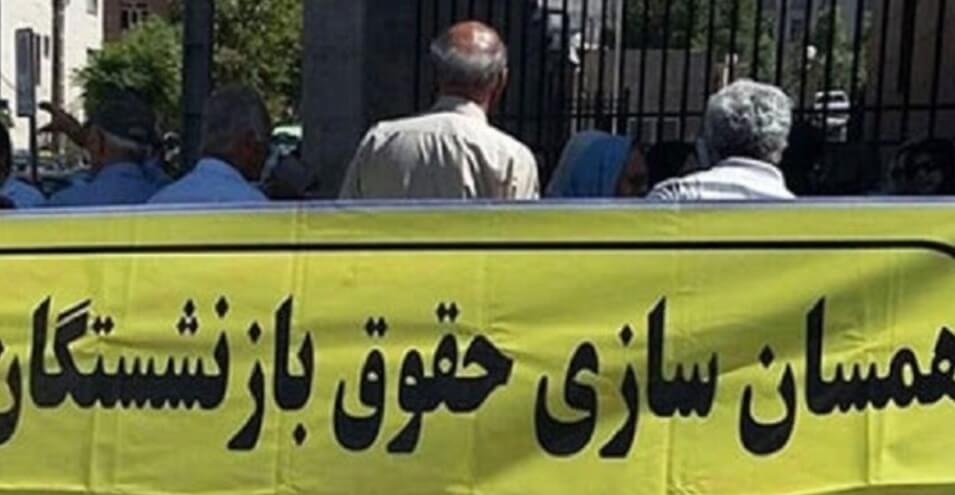
For some time now, retiree rallies have been ongoing in various parts of Iran to protest low salaries and pensions.
Their demand is the full implementation of equalization and the approval of bills to make the ranking permanent, the full implementation of the Civil Service Law, and the increase in pensions in line with the cost of living and real inflation.
Abolghasem Raufian, Secretary General of the Islamic Party of Iran, has said that the salaries received by more than 90 percent of retirees are below the poverty line.
Teachers have also repeatedly gathered in front of provincial education departments in response to the government's mismanagement in implementing the bill to rank and equalize teachers' salaries, as well as to protest arrests and security and insulting encounters by security forces.
Source: Voice of America