Iran and Israel react to attack against UAE; Saudi coalition bombs Houthi positions
A day after the Iranian-backed Yemeni Houthi group attacked several locations in the United Arab Emirates, the Iranian Foreign Ministry spokesman said that "military attacks are not the solution to the Yemeni crisis" and called for "a calm atmosphere and avoidance of the continuation of tension and the cycle of violence, and the establishment of peace and stability in the region."
Saeed Khatibzadeh made this response on Tuesday, January 18, in response to reporters' questions about recent developments related to Yemen, but did not directly mention the new attack by the Islamic Republic's proxy group on Abu Dhabi, the capital of the UAE.
UAE police announced on Monday that three fuel tankers exploded in the Mussafah area of Abu Dhabi and a minor explosion in the construction area of the new Abu Dhabi airport, killing two Indian citizens and a Pakistani citizen and wounding six others. The Iran-backed Houthis have claimed responsibility for the attacks.
The Saudi-led coalition also announced that it had intercepted eight Houthi drones that were launched towards Saudi Arabia on Monday.
The Iranian Foreign Ministry spokesman's call to "avoid continuing tension and the cycle of violence" comes at a time when Iranian state media continues to praise drone attacks on the United Arab Emirates, and the Kayhan newspaper, whose editor-in-chief is appointed by the Leader of the Islamic Republic, in its Tuesday issue considered the attack on Abu Dhabi airport in the UAE "important" and described it as the result of a "precise, strange, complex, and effective operation."
The newspaper wrote in its "Note of the Day" that "by attacking Abu Dhabi's infrastructure, the Emiratis were completely surprised, thereby making the threat to the Emirates credible and bringing the country into line."
On Monday, at the same time as the news of the attack was announced, the Fars News Agency, affiliated with the Revolutionary Guard Corps, also announced in this regard that these actions were a "new practical warning" from the Houthis to the Emirates.
Continuing his remarks on Tuesday, Saeed Khatibzadeh emphasized "the readiness of the Islamic Republic of Iran to cooperate and participate in any initiative that will lead to an end to the seven-year war in Yemen."
These words of the spokesman for the Islamic Republic's Ministry of Foreign Affairs come at a time when Iran reacted coldly to Saudi Arabia's "peace initiative" for Yemen in April of this year, making its acceptance subject to several conditions.
Israel offers security and intelligence support to the UAE
Following these developments, the Israeli Prime Minister offered to provide intelligence and security support to Abu Dhabi.
Naftali Bennett announced on Tuesday in a letter to Abu Dhabi Crown Prince Sheikh Mohammed bin Zayed Al Nahyan that Israel is ready to provide intelligence and security assistance to protect Emirati citizens from attacks similar to Monday's.
Mr. Bennett said he had instructed Israeli security agencies to provide whatever assistance their Emirati colleagues needed or were interested in. "The world must stand against terror," he said.
The UAE normalized its relations with Israel in 2020, an issue that was met with a threatening response from Iran.
Saudi-led coalition airstrikes on Sanaa
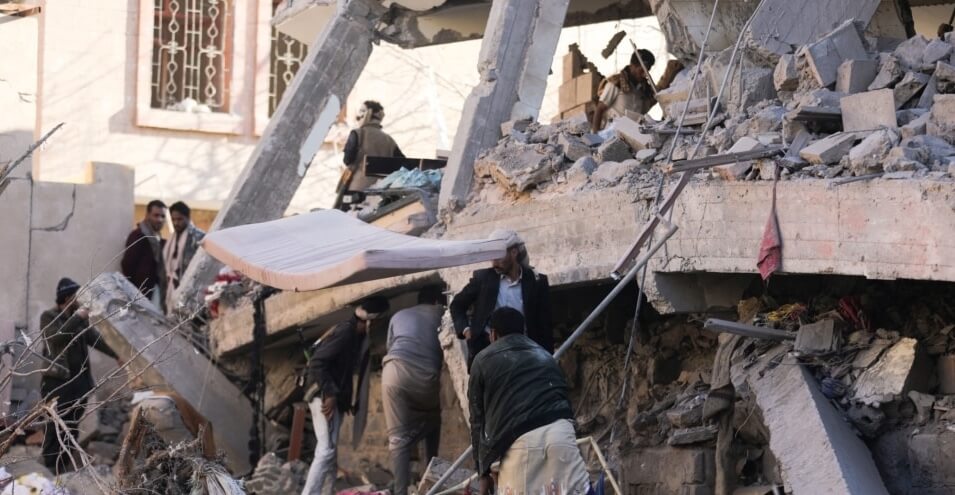
Houthi rebel media outlets report that airstrikes by the Saudi-led coalition on Sanaa, the capital of Yemen, over the past 24 hours have killed at least 20 people, including a number of civilians.
Reuters reported this news on Tuesday, January 18, citing media outlets and citizens living in areas controlled by the Houthi rebels, and wrote that this is one of the deadliest attacks by the Saudi-led coalition since 2019.
Saudi state media also announced that the coalition launched airstrikes against Houthi-affiliated bases and camps in Sanaa on Tuesday morning.
According to Houthi media, one of these attacks targeted the home of Abdullah Qassim al-Junaid, the former head of the Houthi aviation school, killing him, his wife, his 25-year-old son, other family members, and other unidentified individuals.
Al-Junaid was one of more than 170 Houthi officials sentenced in absentia to death by firing squad in August by a court in Marib province, a province controlled by the Saudi-backed and internationally recognized Yemeni government, for "a military coup and committing war crimes."
These heavy airstrikes by the Saudi-led coalition followed a missile and drone attack on the United Arab Emirates by the Iran-allied Houthis on Monday.
The UAE has also said that this action by the Houthis will not go unpunished and that the country reserves the "right to respond to terrorist attacks and criminal tension."
White House National Security Advisor Jake Sullivan also called the attack an "act of terrorism" and stressed that Washington would cooperate with the UAE and other partners to punish the perpetrators.
The United States and Britain have strongly condemned the drone attack by Yemen's Houthi rebels on the United Arab Emirates, calling it a "terrorist" act, and UN Secretary-General Antonio Guterres has also condemned the incident while calling for restraint from all parties involved.
Meanwhile, news is coming that, due in part to the Houthi attack on Abu Dhabi, which also led to the explosion of a fuel tank, oil prices reached their highest level in more than seven years on Tuesday, with the North Sea Brent crude oil index rising to $88.13 per barrel.
Source: Radio Farda