Ministry of Sports: Women can go to Azadi Stadium on October 8
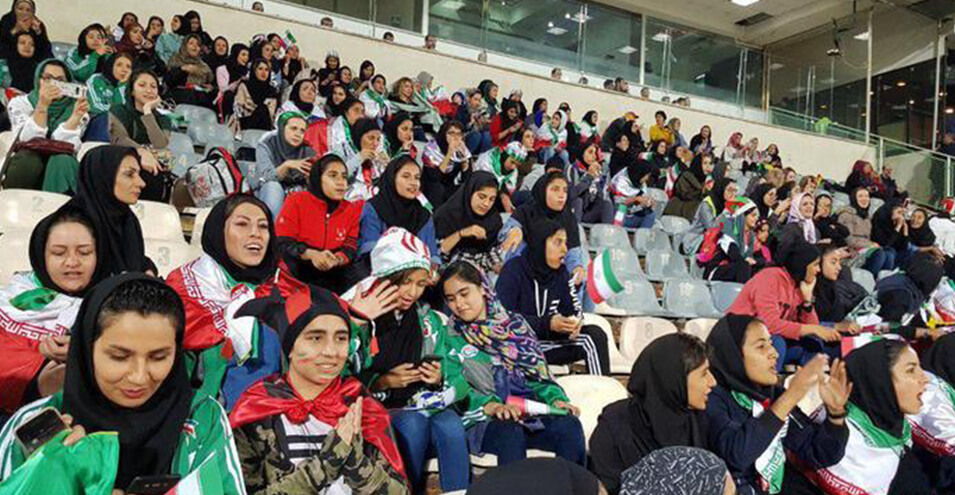
The deputy legal director of the Ministry of Sports announced that women can go to Azadi Stadium to watch the match between the Iranian and Cambodian national teams. Following pressure from FIFA, Iran agreed to allow women to attend the stadium for the Qatar World Cup qualifiers.
The Deputy Minister of Legal Affairs and Provincial Affairs of the Ministry of Sports announced on Sunday, September 23, that women can go to Azadi Stadium to watch the match between the national football teams of Iran and Cambodia as part of the Qatar World Cup qualifiers.
According to ISNA news agency, Jamshid Taghizadeh, explaining the measures taken by the parliamentary deputy of the Ministry of Sports during the Government Week, told reporters: "This is the first presence of women at Azadi Stadium, and this meeting will be held at 5:30 PM on Thursday, October 8."
The Deputy Minister of Sports says that there is no "legal prohibition" on women entering stadiums, and that all that is needed is to prepare the necessary infrastructure, which is already underway.
So far, all efforts to allow women to enter stadiums have faced strong opposition from hardline fundamentalists and a number of Shiite religious authorities in Qom.
Legal prohibition, extralegal prohibition
If the Deputy Minister of Sports' statement about the absence of a legal ban on women entering stadiums is true, then preventing this should be considered an "extralegal ban," in which some influential religious authorities in Qom play an important role. Reza Salehi Amiri, the head of the National Olympic Committee, confirmed this last Saturday and spoke of the need to consult with them on this matter.
The reality is that women's freedom to attend stadiums would not have happened so soon without the intervention and pressure of the International Federation of Association Football (FIFA). In the last days of June, FIFA President Gianni Infantino sent an "urgent letter" to Mehdi Taj, the head of the Iranian Football Federation, demanding that conditions be created for women to attend stadiums during World Cup qualifiers.
He called the experience of the friendly match between the Iranian and Syrian national football teams on June 6 (June 16), in which women were prevented from entering the stadium and a number of them were apparently arrested, "disappointing."
The FIFA president wrote to Mehdi Taj that the treatment of women who wanted to enter the stadium was neither consistent with the commitments made by the Iranian Football Federation in this regard nor with the promises made by Hassan Rouhani in the March 2018 meeting.
Is FIFA's pressure more effective than Rouhani's bargaining?
Thus, it seems that the entry of Iranian women into stadiums, which was a promise made by Hassan Rouhani and his former counterparts and was not realized through their consultation and bargaining, is being realized through pressure and threats from FIFA.
Eliminating discrimination against women in attending stadiums is one of the demands of civil rights activists, and the heads of the 11th and 12th governments promised to work towards realizing this demand in their presidential election speeches in 2013 and 2017.
The opposition of some religious authorities to the presence of women in stadiums has been clearly expressed until recently. Etemad Online recently asked Ayatollah Nasser Makarem Shirazi, a Shiite religious authority in Qom, for his opinion on the issue of women's presence in stadiums, and published his response on August 5.
Makarem Shirazi has said in this regard: "The prevailing atmosphere in stadiums is not suitable for the presence of women, and there is no doubt that the mixing of young people is the source of many moral and social problems; in addition, in some types of sports, men do not have appropriate clothing in front of women; therefore, it is necessary for them to refrain from attending these programs, especially since they can see these programs from the media and their presence is not necessary."
“Decision at the macro-system level”
This religious authority has repeatedly opposed the presence of women in stadiums. Parvaneh Salahshouri, a member of the women's faction in the parliament, once quoted the head of the Football Federation as saying: "This issue requires a major decision at the system level."
Accordingly, if the decision regarding women's freedom of entry into stadiums was made at the "macro-system level," it is likely that consultations were also held with authorities to support it.
In a detailed interview with the Iranian state-run newspaper, the text of which was published on August 16, Reza Salehi Amiri, referring to the pressure from international organizations regarding women's entry into stadiums and the "concerns of elders and great authorities" on this issue, emphasized that efforts should be made to address these concerns.
The former Minister of Culture and Islamic Guidance and current head of the National Olympic Committee implicitly called the reports submitted to religious authorities about the stadiums inaccurate and added: "I believe that we should address the concerns of the elders and religious authorities, provided that we give them accurate reports. God willing, we should travel to Qom and discuss this with the religious authorities."
So far, no report has been published on the possible reaction of religious authorities to the words of the Deputy Legal Affairs Minister of the Ministry of Sports, but the possibility of women being present at the Azadi Stadium for the match between the Iranian and Cambodian teams has received widespread coverage on social networks and cyberspace.
Source: DW