Coronavirus in Iran: Number of infected people approaches one million; restrictions to continue until the end of the year
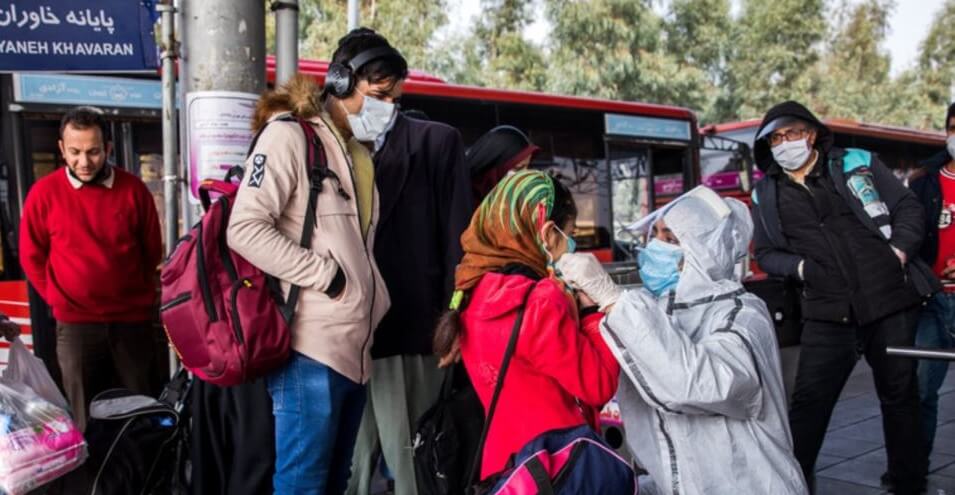
Despite the announcement by the specialized committees of the Coronavirus Response Headquarters that Tehran will enter an "orange" status starting next Saturday, Ministry of Health officials are announcing that restrictions will continue until the end of this solar year.
Meanwhile, the ministry's official daily statistics indicate that in the next day or two, the number of people infected with Covid-19 in the country will exceed one million.
According to a report on Wednesday, December 1, in the ISNA news agency, Alireza Zali, commander of the operation to combat the coronavirus disease in Tehran, called the conditions of this metropolis in terms of combating the spread of coronavirus "unstable and fragile" and added that we must "move with calculated calmness and with a layered plan" to control the disease in this province.
At the same time, he considered the "reduction" of coronavirus statistics in Tehran province to be unrelated to the limitations of the smart coronavirus management plan.
However, he praised the citizens of Tehran for their cooperation with this project and said that "the effects of the restrictions imposed on the urban rhythm are visible. In a way, the congestion in the city has been reduced by about 30 percent and we are witnessing a 30 percent reduction in congestion in public transportation."
Referring to the decision to classify Tehran under the "orange" status starting Saturday, Mr. Zali said: "Some restrictions, such as preventing religious ceremonies and limiting the presence of employees in offices, as well as the nighttime traffic ban, will continue. Of course, a number of restrictions will be eased."
He did not provide further explanation on this matter.
Mehr News Agency also quoted Hossein Zolfaghari, head of the Social Security Committee of the National Headquarters for Combating Corona, as saying that the comprehensive smart plans for Corona restrictions will continue "until the end of the year."
Mr. Zolfaghari stated that the main problem is the disregard for health protocols by all segments of society, and that reducing or increasing the restrictions in each province is subject to reviewing the situation in each province each week.
He said: "This means that if a province's status had been reduced from red to orange this week, the restrictions would be reduced, but if the status had returned to red next week, the restrictions would be increased."
He also explained the red, orange, and yellow status in the provinces as follows: "If there are 10 hospitalized people for every hundred people, the city's status is red, if the hospitalizations are below 6, that is, between 6 and 4, the status is orange, and if it is below 4, the status is yellow."
Meanwhile, the spokesman for the Iranian Ministry of Health announced on Wednesday that 362 people in Iran had died from the coronavirus in the past 24 hours.
According to IRNA news agency, Sima Lari said on Wednesday, December 3, that with the deaths of these people, the number of coronavirus victims in the country reached 48,990.
He also announced that the number of people infected with the coronavirus over the past 24 hours was 13,621, and the overall government statistics on the total number of infected people in Iran were 989,572.
According to Ms. Lari, among the newly identified cases, 2,246 people were hospitalized and 5,828 patients with Covid-19 are under observation in severe condition.
Despite serious doubts from independent sources about the accuracy of the government's coronavirus statistics in Iran, Iranian Ministry of Health officials provide the media with the official number of infected and dead people on a daily basis.
Minoo Mahrez, a member of the National Headquarters to Combat Coronavirus, also told IRNA, "The chain of transmission of the coronavirus has now been broken, but this does not mean the end of this disease."
Ms. Mahrez warned: "If health protocols are not taken seriously, the same soup and the same bowl will await the people."
However, he added: "The number of visits to medical centers, infections, hospitalizations, and transmission of the coronavirus to others has decreased by about 60 percent, because, for example, if about 30 patients visited medical centers daily until 10 days ago, this figure has reached 6 people."
The number of coronavirus infections and deaths in Iran increased so much before the restrictions were imposed that Hassan Rouhani's government, despite knowing the economic problems of its citizens, agreed to impose restrictions.
However, numerous reports on social media indicate that a number of businessmen are indifferent and their businesses are partially closed despite government warnings.
Currently, 64 cities in Iran are in red status, 278 cities are in orange status, and 106 cities are in yellow status.
Source: Radio Farda