Continued Education Budget Deficit and Teachers’ Concerns
Iran’s Ministry of Education has been struggling with budget shortages for years, and this situation continues. Economic concerns of active and retired educators have repeatedly led to protests and demonstrations.
The Ministry of Education’s budget increased in 2019 compared to the previous year, but this increase is less than half the inflation rate announced by official authorities.
Based on available evidence, delays in paying some claims of active and retired educators, which were accompanied by many criticisms and protest movements in previous years, will continue in the current year. It is not unexpected that the situation may worsen due to economic pressures resulting from sanctions on the government.
On Monday, May 6, the government news agency IRNA, in a report titled “Educators and Endless Concerns,” referring to educators’ professional and economic demands, wrote: “This request and concern has always been raised by them that their salaries and benefits differ from other government employees, and the situation is such that even the issued decrees, which are completely legal, are not given importance.”
The Ministry of Education, with 1.7 million active and retired teachers and educators, is considered a very large ministry responsible for managing the affairs of 14 million students in different educational levels.
Discrimination Between Educators and Other Civil Servants
One of the long-standing complaints of education employees is discrimination between them and other civil sector workers. For example, educators’ end-of-service bonuses are typically paid with a few months’ delay, whereas other government employees usually receive their bonuses immediately after retirement.
Apart from inefficiency and mismanagement of administrators in Iran’s education system, which has been extensively reported in both government-supporting and opposition media, the Ministry of Education’s budget shortage has been a deeply-rooted problem for years.
The Research Center of the Islamic Consultative Assembly, while reviewing the proposed 2016 budget, wrote in a report referring to educators’ salaries: “Despite the relative increase in salaries and benefits, since Ministry of Education employees, unlike employees of other ministries, do not benefit from allowances such as assignment allowances, travel allowances, and overtime, their average salary and benefits are undoubtedly lower than the average cost of living for an urban family. Consequently, the reduction in attractiveness of the teaching profession and dissatisfaction of educator colleagues are among the first results of this disparity.”
According to IRNA, 98 percent of the total Ministry of Education budget is spent on personnel costs, which means the ministry has neither a budget to improve the quantitative and qualitative level of the education system nor funds for very necessary expenses such as repairs and equipping educational facilities.
Rising Costs, Declining Budget
According to this report, the share of education personnel salary and benefit costs has been constantly rising since 2015, increasing from around 89.5 percent to over 93 percent in 2017.
Since the start of the eleventh government in 2013, the Ministry of Education’s budget deficit has been increasing with slight fluctuations, rising from 1.8 trillion tomans to 5 trillion tomans in 2017.
Official and final statistics regarding the education system’s budget deficit for last year have not been released, but evidence suggests this figure could be far greater than the previous year’s deficit.
In the approved law for last year’s budget, the Ministry of Education’s budget was set at 49 trillion tomans. The government news agency states that Ali Heydar Turkman, deputy minister for planning and human resources at the Ministry of Education, recently announced that the ministry received close to 35 trillion tomans last year and paid some educators’ claims with it.
Based on these figures, the Ministry of Education’s budget deficit last year could be two to three times that of 2017. According to IRNA, in 2018, nearly 1 trillion tomans from the foreign currency reserve fund and government resources were allocated for “paying examination honorariums, teaching honorariums for soldiers and teachers, and purchasing educational services,” which slightly reduced the budget deficit.
While Iran’s Statistics Center announced that the average inflation rate last year was 27 percent, the total credits for the Ministry of Education in 2019 are projected at slightly over 56 trillion tomans, which is only about 11 percent higher than the previous year.
Stalled Plans Due to Budget Shortage
The suspension of the teacher ranking plan is a clear example of the budget shortage problem and the pressure it places on Iran’s education system workers. The first phase of this plan was implemented in 2015 with an allocation of 1.3 trillion tomans, during which educators’ salaries increased by an average of 400,000 tomans per month.
Continuing this plan was halted due to budget shortages. Recent statements by Education Minister Mohammad Bathaei, who during Teacher’s Week announced that he raised a “request for assistance” from the president to continue implementing this plan, indicate its uncertain status.
Given the intensification of US sanctions, which has severely reduced the government’s foreign currency revenues, the likelihood of adequate budget allocation to the Ministry of Education is very slim.
Forecasts regarding a sharp increase in inflation and a significant decrease in economic growth indicate the continuation of Iran’s economic crisis in the current year, and with this outlook, budget shortage not only further affects the Ministry of Education but also leaves other sectors without their share.
Reuters reported on April 29, citing Jihad Azour, director of the Middle East and Central Asia department of the International Monetary Fund, that inflation in Iran will continue an upward trend for the second consecutive year and could reach 40 percent or even higher.
In its annual report on “Global Economic Prospects” released in early April, the International Monetary Fund projected that Iran’s economic growth in 2019 would reach negative six percent.
Increasing Professional Protests by Educators
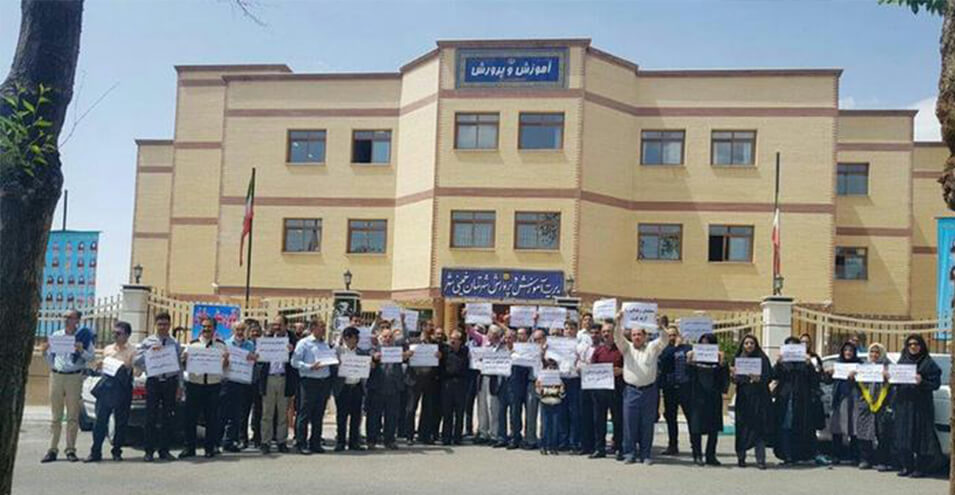
Last week, most provinces and cities in Iran witnessed nationwide protest gatherings of educators on Teacher’s Day. Teachers and educators protested at the call of the “Coordination Council of Professional Associations of Iranian Educators” in front of education administration offices in various provinces and cities and demanded attention to their situation.
ILNA news agency reported the main demands of educators as “improving the living standards of active and retired teachers, abolishing privatization and providing free quality education to all students, implementing salary equalization for retirees, paying education claims by the government, and freedom of association.”
Based on images and videos published on social media, effective and comprehensive insurance, school safety, removing discrimination in the educational structure, and the freedom of teachers and labor activists who were arrested in previous protest movements were among the other demands of the protesters.
According to reports, protest gatherings of educators in some cities turned violent with the intervention of security forces, and a number of protesters were arrested.
Source: DW