Convention on the Legal Regime of the Caspian Sea Signed
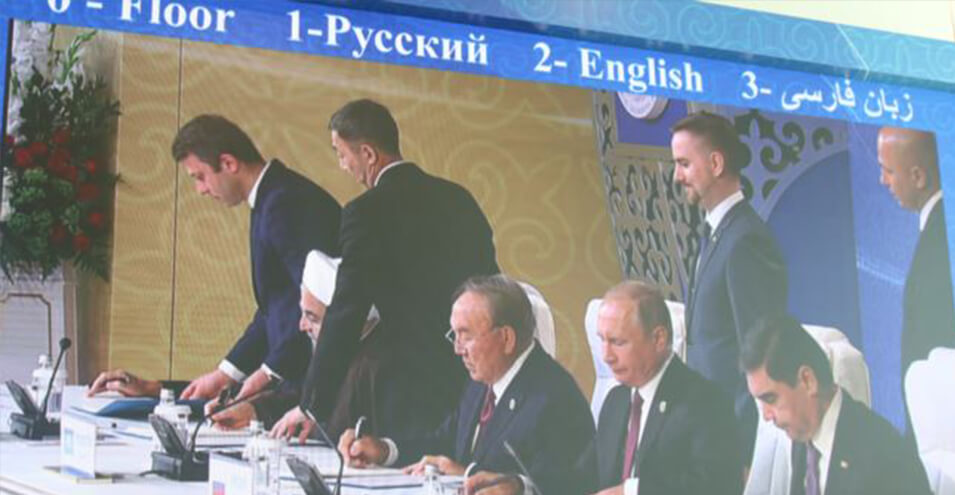
The leaders of the five littoral states of the Caspian Sea signed the Convention on the Legal Regime of the Caspian Sea on Sunday, August 11, in the city of Aktau, Kazakhstan.
This convention makes no mention of the countries' share of the Caspian Sea, and the resolution of this dispute has been postponed to the future.
One of the important issues of this convention is determining the legal status of the Caspian Sea. According to this convention, the Caspian Sea has its own unique status and is not subject to the laws of seas and lakes.
According to Article 8 of this Convention, “The delimitation of the bed and subsoil of the Caspian Sea into sectors shall be carried out by agreement between States with adjacent and opposite shores, taking into account the generally recognized principles and norms of international law, in order to enable those States to exercise their sovereign rights in the exploitation of the resources of the bed and subsoil and other legitimate economic activities related to the development of the resources of the bed and subsoil.”
The Convention on the Legal Regime of the Caspian Sea also prohibits the passage of ships from non-littoral states and military exercises with non-littoral states.
Iran has been emphasizing the equal division of the Caspian Sea for years, but Russia and other countries have signed bilateral agreements to divide the lake before signing the convention.
If the Caspian Sea is divided, Iran's share would be 20 percent, and according to the "half-line" formula, Iran's share would be about 13 percent.
Iranian President Hassan Rouhani, who attended the summit along with his counterparts, Kazakh President Nursultan Nazarbayev, Azerbaijani President Ilham Aliyev, Russian President Vladimir Putin, and Gurbanguly Berdimuhamedow, on Sunday identified the prohibition on the construction and transfer of military bases to foreign countries, the passage of warships, and even the transit of foreign military cargo belonging to non-coastal countries as among the prominent provisions of the convention.
Hassan Rouhani said: "In the Convention on the Legal Regime of the Caspian Sea, the boundaries of the bed and sub-bed have not yet been determined, and this will be done subsequently through an agreement between the relevant parties."
Tehran previously considered Iran's share in the Caspian Sea to be 50 percent, citing the 1921 treaty (Treaty of Friendship between Iran and Soviet Russia) and the 1940 treaty (Treaty of Trade and Navigation in the Caspian Sea); but then, invoking the "principle of fairness," it demanded a 20 percent share of the Caspian.
According to military expert Hossein Arian, in recent years Iranian officials have been less emphatic about this position.
Touraj Atabaki, a university professor in the Netherlands, also told Radio Farda about the sensitivity of dividing the Caspian Sea, saying that currently no group is willing to accept the consequences of the final division of the Caspian Sea in terms of public opinion pressure. He also said that in the current situation, considering the pressures coming to Iran, Iran's position has become weaker.
On the other hand, Bloomberg News wrote in an analysis that the agreement postpones the exploitation of seabed resources to separate agreements between coastal countries, which means stabilizing the current situation, as countries such as Kazakhstan and Russia have signed bilateral agreements for joint exploitation. According to the publication, this agreement paves the way for the extraction of Caspian oil and gas resources.
Source: Radio Farda