The forced migration of Iranians from their homeland and the government's deceptive and repeated promises of return
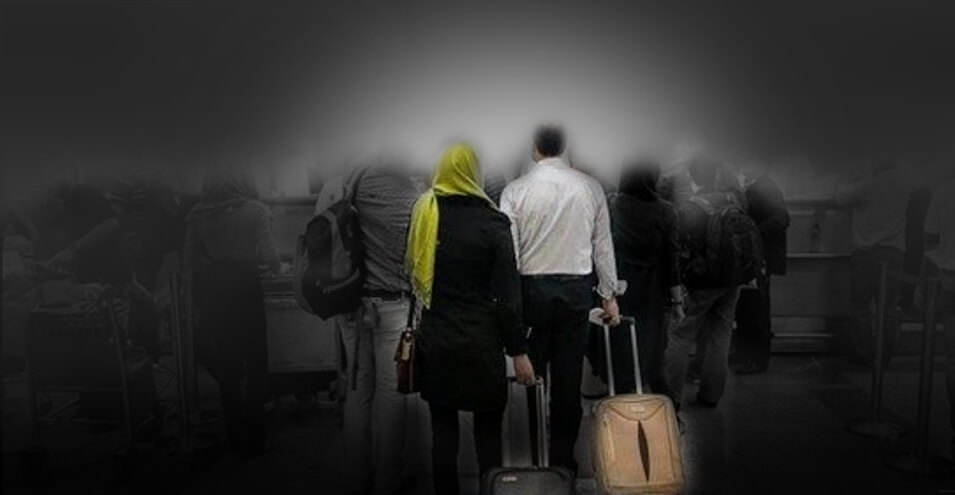
The issue of Iranian "emigration" abroad has been one of the main challenges for Iranian society and governance in the decades following the establishment of the Islamic Republic in Iran. "Brain drain," "voluntary exile," "exit of human capital," "forced migration of athletes," "emigration of artists," and similar concepts have entered the everyday literature of Iranian society in the past few decades.
The question is, what is the main reason for the daily increase in the number of Iranian citizens who want to spend their lives somewhere other than their homeland at any cost? Political and security threats and pressures, economic and cultural constraints, the lack of suitable grounds for many social, artistic and cultural activities, and uncertainty about the future economic situation in Iran, have forced various groups to pack up what they had in their homeland and put on the clothes of emigration. Citizens who seem to be increasing in number as the current situation continues. On the other hand, the issue of Iranian emigration is the issue of the return of those who left their homeland in the past decades. The authorities of the Islamic Republic of Iran claim that the path to return to the country is ready and prepared for all Iranians and insist that there will be no problems for Iranians living abroad in coming and going to Iran. However, security and judicial encounters with many dual-national citizens in recent years have increasingly revealed the fact that the outcome of returning to the homeland can be fundamentally different from what the authorities describe. It seems that the government's approach to the issue of immigration and also to returning to the homeland has one fundamental point in common; deepening the gap between citizens and the government, or in other words, fueling the concept of "insiders" and "outsiders" by forcing citizens to migrate or accusing dual-national citizens of collaborating with security and intelligence services of Western countries. A narrative that has served to cover up the blatant discrimination against citizens by the government over the past forty years and, as a result, the increasing desire of Iranians to emigrate.
The continuous migration of Iranians from their homeland; the fate of time or the ineffectiveness of governance?
In a recent meeting with a group of young elites and top academic talents in the country, Ali Khamenei, the leader of the Islamic Republic of Iran, claimed that "there are elements in some universities who encourage young elites to leave the country. I say clearly that this is treason, this is enmity with the country."
The Leader of the Islamic Republic of Iran’s narrative of the migration of Iranian elites and linking the wave of elite migration to the efforts of “enemies of the system” has a long history in the history of the Islamic Republic; shortly after the 1979 revolution, Ruhollah Khomeini, the Leader of the Revolution, first introduced the concept of “brain drain” in a speech. In the fall of 1979, Ruhollah Khomeini had explicitly defended the “brain drain” and said, “Let them escape. To hell with it, these brains escaped! These were not scientific brains, these were traitorous brains.” The newly-arrived leader had explicitly stated that “there is no place for them to live” and that they “should flee too.”
It can be said that the continuation of this view of the scientific and academic community and the subsequent start of the project to purge universities of professors and students during the Cultural Revolution caused the emigration of the first group of the country's scientific and elite community after the revolution. An emigration that continued among the country's academic and scientific community until the mid-1960s. The government's overall view of the issue of elite emigration in all subsequent years and after Ali Khamenei came to power was built and generalized based on this approach. In contrast, the wave of emigration of the country's elites became widespread after the end of the eight-year war with Iraq and mostly in the late 1970s. In the early 1990s, a report published in the Shargh newspaper indicated that "more than 62 percent of the country's Olympic medalists emigrated from Iran between 1993 and 2007."
In the early 1980s, while meeting with a group of winners of Olympiads and national exams, Ali Khamenei, while claiming about “foreigners’ efforts to steal human talents and the real wealth of other countries,” said, “This issue constitutes a very negative dimension of the departure of some elites from the country. Furthermore, if an intelligent young person leaves his homeland simply for a more comfortable life abroad, this issue is also undesirable.”
Just a few years before the Leader of the Islamic Republic of Iran spoke about comfortable and better living conditions abroad, a bus carrying top students from Sharif University of Technology fell into a ravine on its way back from the city of Ahvaz, killing six elite mathematics students from Sharif University who were among the winners of domestic and international Olympiads. One of the survivors of this accident was Maryam Mirzakhani, the late professor of mathematics at Stanford University in the United States. She emigrated from Iran shortly after the accident and later became the first and only woman in the world to win the Fields Medal, the world's highest mathematics award.
There is no doubt that the number of Iranian academic and scientific elites who emigrated from Iran in the 1980s and 1990s is not comparable to previous decades. Various statistics have assessed Iran's rank in recent years as high among countries facing the problem of "brain drain." The "Iranian Immigration Yearbook 1400" states that Iran's rank in "student sending" is 19th in the world. Of course, it should be noted that this statistic is based on the population of Iranian students living abroad in 2018.
In a broad sense, it can be said that the government's approach to the issue of elite migration over the past years has emerged from this perspective, which has been constructed and implemented based on the narrative of the leaders of the Islamic Republic of Iran. A narrative in which, on the one hand, concepts such as "betrayal of the homeland" or "collaboration and companionship with the enemy" are highlighted, and on the other hand, it increases the desire to migrate among elites and experts.
A note published in the weekly Sobh Sadegh, the organ of the IRGC’s political office, is a clear and precise example of the government’s overall view of the brain drain. The note, published on December 2, 1402, right after Ali Khamenei’s claims about elite emigration, states that “Westerners are conspiring against us by creating opportunities for a better life than in Iran.”
In an analysis by the weekly Sobh Sadeq, one of the most important government publications, it has been claimed that elite migration is part of the “mission of Western embassies in Iran” and has called for the involvement of security agencies in this issue. According to the analysis by the weekly Sobh Sadeq, the “elite migration scenario” was the goal of Western embassies by “providing incentives such as job offers and suitable income, desirable academic positions, and… in general, creating opportunities for a more desirable life than what exists in Iran.”
According to the author of this note, the migrant smuggling is a sinister conspiracy that has been going on for years and is being pursued by elements in scientific and academic circles.
The loss of hope for the future among elite students and the devaluation of the credibility of knowledge and academic ability in the face of rentier relations and the degree of dependence on power, leaves no prospect but for the elite academic community to increase its desire to emigrate. A look at the treatment of Ali Younesi and Amir Hossein Moradi, two young elite students at Sharif University, by the ruling regime and the security apparatuses in power, and the application of the most severe physical and mental torture to these students, simply because they refused to comply with the unjust demands of the security apparatuses for forced confessions, is a clear example of the regime's view of the value of elites.
The politicization of migration: from the forced migration of heroes and artists to the tragedies of citizens seeking asylum
The migration of human capital from Iran has in many cases been based on a kind of "coercion"; a coercion that has been precisely the result of blatant discrimination on the part of the government. The application of strict and discriminatory laws against athletes and the existence of censorship and numerous restrictions for many artists, cultural and media figures, and civil activists have led to the migration of many of this group of people in recent years. Since behind all this form of migration, there is blatant discrimination by the government, the government, with a specific goal and plan, provides the basis for the destruction of these figures. In other words, it once again insists on continuing the same policy of creating a gap between the elites and experts and society, because otherwise it will have to be held accountable for the discrimination against the country's human capital.
In recent days, Alireza Firouzja, an Iranian chess player who recently immigrated from Iran to France, became the vice-champion of Europe and also the second in the world rankings with the French national team. One of the main reasons for his immigration to France was the problems he faced due to the exclusion of Iranian athletes from competing with Israeli athletes during his time on the Iranian national team. Previously, Kimia Alizadeh, the Olympic bronze medalist, participated in the 2020 Tokyo Olympics under the refugee flag after immigrating to Germany. The interpretations and reports of the Islamic Republic's media, especially television, about Kimia Alizadeh's confrontation with an Iranian athlete at the Olympics and the media's attempt to tarnish Alizadeh's image are a clear example of the implementation of the government's policy in the face of this form of forced migration of sports elites. This approach is also seen with other segments of society, such as artists or cultural and media activists. Not long ago, Asghar Farhadi, a well-known Iranian director and winner of two Oscars, wrote in response to a comment by the director of the documentary group Narrative of Victory, who called Farhadi a filmmaker close to the regime: "How can you attribute me to a government that has repeatedly sent the message: 'It is better for Farhadi not to return to Iran'?"
The point that Asghar Farhadi has made is actually indicative of the fact that a group in the government welcomes the emigration of artistic and cultural figures such as Asghar Farhadi and basically insists on emptying all cultural and artistic fields of prominent figures. It seems that the methods of narrowing the field of artistic and cultural activity and discriminating against activists in these fields are various; from security pressures to issuing unjust prison sentences. Pressures that force many activists to emigrate.
The departure of Mehdi Hajati, a former representative of the Shiraz City Council, and Masoud Mosaed, a journalist, from Iran under difficult circumstances, enduring many hardships and suffering the hardships of illegal immigration, is a recent example of this type of immigration, which is clearly the result of unfair judicial rulings issued against these individuals.
This form of migration, which in recent decades had forced some activists to emigrate from Iran, has become more common in recent years, in addition to the academic elite, among a wider range of Iranians, including lawyers and journalists. From uprooting everything they had and giving in to forced migration, even if legal, to finding sometimes very risky ways to become refugees in other countries, all of these decisions have resulted in unpredictable hardships and hardships for many Iranians. In a recent report by the Times, based on new data from the British Home Office, more than a quarter of migrants crossing the English Channel in small, light boats are Iranian. A very dangerous route, and in some cases, people are actually gambling with their lives.
According to statistics from the Iranian Migration Observatory, which is run under the supervision of Sharif University of Technology, the number of Iranian asylum seekers (i.e. those awaiting the outcome of their asylum applications) was 77,217 and the number of Iranian refugees (i.e. those whose asylum applications have been accepted) was 134,776 at the end of 2020.
If for Iranian refugees, leaving the country is more than anything equivalent to abandoning everything they had in their homeland and starting a new, uncertain life, for another large group of Iranians, “migration” is equivalent to “transferring” all the capital they may have earned over the years through work and savings in their homeland, and now, in order to save their capital from being ruined in Iran’s unstable economy, they invest it in other countries. With the significant increase in investment by many wealthy Iranians in various countries around the world over the past four decades, a large volume of material capital that could have played an important role in Iran’s economic cycle was invested in other countries. Perhaps the latest example of this is the significant growth in property purchases in Turkey by Iranians, which even prompted a reaction from Ali Khamenei, the leader of the Islamic Republic.
It can be said that if previously having some material capital was the main obstacle to the migration of small and large capitalists from the country, now these same groups have a desire to emigrate in order to preserve their capital.
Returning to the homeland: a significant gap between the authorities' narrative and the existing reality
The approach of the authorities of the Islamic Republic of Iran in dealing with the issue of Iranian emigration and insisting on distorting the truth has always followed a predetermined and specific path. The authorities' efforts to show their interest in the return of Iranian emigrants also took a more serious form and a new trend in the 1980s.
The formation of the Supreme Council for the Affairs of Iranians Abroad in late 2004 was one such measure. An institution that is under the Ministry of Foreign Affairs of the Islamic Republic of Iran. An institution that has claimed to facilitate the return of Iranians living abroad throughout its years of activity.
A few days after Ali Khamenei claimed that some elements were “betraying” by encouraging students to emigrate and reopening the issue of immigration and the outflow of human capital from the country, Hossein Amir Abdollahian, the Minister of Foreign Affairs of the Islamic Republic of Iran, emphasized that “the issue of Iranians with dual citizenship must be resolved once and for all,” and said, “This issue must be addressed at the legislative level in the parliament.” The Iranian Foreign Minister had announced the launch of a “system in the Ministry of Foreign Affairs” that would guide Iranians who were concerned about returning to the country and inform them whether they had any problems with “entry and exit.” The Foreign Minister had claimed that if, after inquiring about this system, “any problem arises, the Ministry of Foreign Affairs is responsible and we guarantee this.”
The claims of the Minister of Foreign Affairs of the government, Ebrahim Raisi, come at a time when the Ministry of Foreign Affairs basically has no "legal authority" to guarantee the entry and exit of individuals. However, the insistence on providing conditions for returning to the homeland for Iranian immigrants has also been heard from other government officials in recent months. An insistence that is completely inconsistent with the current reality and the experience of the Islamic Republic in dealing with those who returned to their homeland with the desire to work and be active but ended up in prison and imprisonment.
Some time ago, Keyvan Samimi, a political prisoner imprisoned in Evin, wrote on his Telegram page the story of a young elite prisoner named Alireza Golipour, whom he met in prison. The story of a bright student who received a diploma in mathematics at the age of 14 and graduated from Sharif University of Technology in the field of electronics, and then began his doctoral program in telecommunications in Germany, and before defending his thesis, he returned to his homeland at the insistence of Iranian academic authorities and to help with sensitive telecommunications projects. According to Keyvan Samimi, Alireza Golipour’s failure to cooperate with security institutions has led to him being accused of espionage, and he has now been in prison for more than 9 years. This is despite the fact that even the Ministry of Intelligence “has stated in writing to the prosecutor that his case is not espionage.”
It can be said with confidence that the conflict of interests of intelligence and security agencies is more evident than anywhere else in the cases of dual-national citizens or Iranians residing in other countries who have returned to the country and were arrested. Looking at the cases of dual-national prisoners who were arrested in recent years, one can clearly find the traces of security agencies such as the IRGC Intelligence Organization or the IRGC's Sarallah Headquarters. Institutions whose influence in the judicial system, and especially in such cases, not only makes a fair trial impossible, but also turns the promises and imaginary red carpet of the Islamic Republic's officials into cold and dark prison corridors for a large group of Iranians abroad.
Source: Iran Human Rights Campaign