Passing through suffering; one displaced person every four seconds
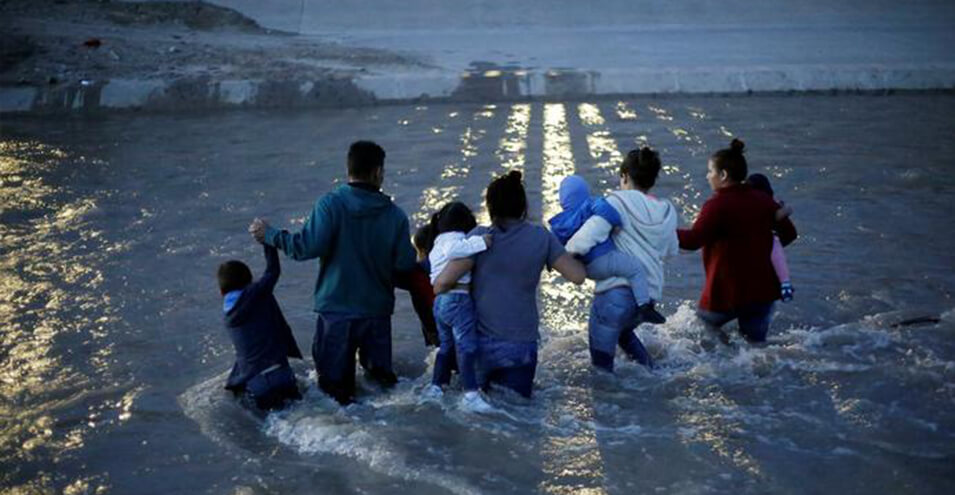
Tens of millions of people around the world have been forced to leave their homes due to political, climate or war reasons. June 20 is an occasion to express solidarity with refugees and displaced persons and to make the necessary efforts to ensure their humane existence.
Seventy-eight million people... This is the latest census by the United Nations High Commissioner for Refugees (UNHCR) of those fleeing insecurity and poverty in their homelands. Ten million of this population have no nationality or citizenship. 40 million of them are refugees who have been displaced within their own country. 25.4 million are war refugees who have settled in other countries. Of these, nearly 20 million are under the protection of the UNHCR, including 5.5 million Palestinians.
Of this vast human population, three million and one hundred thousand people are struggling to gain asylum in another country; a struggle that sometimes leads to the depths of the Mediterranean waters and sometimes to months of wandering in tents, shacks, and sleeping on the streets.
"These figures are unacceptable by any standard and represent a humanitarian crisis that requires solidarity and cooperation," said Filippo Grandi, UN High Commissioner for Refugees. "We must work to ensure that the displaced, the displaced and the refugees find safety, while at the same time finding solutions to the root causes of the problem."
Since 2001, the United Nations has designated June 20 as “World Refugee Day.” A day to pay attention to the fate and rights of millions of people fleeing conflict, persecution, bloodshed, and violence and seeking safety in another corner of the world.
Rights of refugees and war prisoners
The International Refugee Convention was adopted in Geneva on July 28, 1951, and has been signed by 138 countries. Article 1 of this treaty states that those who are persecuted or persecuted for reasons of race, religion, nationality, membership of a particular social group, ethnic minority, or political opinion, and who are unable to find safety, security, or access to justice in their own country, have the right to asylum.
The main responsibility that this Convention places on the shoulders of the States Parties is that a refugee should not be returned under any circumstances or pretext to a country where he would be in danger. The first paragraph of Article 33 of the Convention states: “No Contracting State shall in any manner return a refugee to a territory where his life or freedom would be threatened.”
War criminals, military personnel and human rights violators are not covered by this convention. Germany is one of the countries that has guaranteed the right to asylum in its constitution (Article 16). Denmark was the first country to accept this treaty.
Countries that are signatories to the Geneva Convention are obligated to respect the following rights for refugees and war prisoners:
The right not to be expelled except in special cases (Article 32), the right to work (Articles 17 and 19), the right to education (Article 22), the right to shelter (Article 21), the right to use public facilities and assistance (Article 23), the right to freedom of religion (Article 4), the right to access to court (Article 16), the right to free movement in the host country (Article 26), the right to have identity documents (Article 27).
Statistics and facts
According to the definition of the International Organization for Migration (IOM), a migrant is someone who has left their place of residence for any reason, whether voluntarily or involuntarily, while a refugee is someone who has fled war or persecution based on political, religious or ethnic beliefs. Accordingly, all refugees are considered migrants, but not all migrants are considered asylum seekers.
The latest UN report states:
The stateless; the eternally deprived.
The Universal Declaration of Human Rights states that everyone has the right to a nationality, but about 10 million people in the world are deprived of national identity. These people do not have birth certificates, identity cards, passports, or citizenship documents. They cannot study, enter the labor market, or learn a profession. They are an invisible group because they are deprived of social rights and are considered nothing.
Those who fled the war and had no identification documents with them are also called stateless persons. Many Syrians who have fled to Lebanon or Jordan are in this situation.
The largest stateless group is the Rohingya minority in Myanmar, with almost a million of them currently living in camps in Bangladesh.
Political conflicts
Supporting refugees is a legal and moral obligation, however, the acceptance of refugees and asylum seekers in safe countries has been subject to political conflicts, racist tendencies, or electoral contests.
In Turkey, which is the top receiving country, refugees and asylum seekers have become a threat to Europe. Iran links the continuation of hosting Afghans to the lifting of current sanctions against the country. The struggle over the fair distribution of refugees and asylum seekers in Europe has become a political challenge, fueling nationalism and resistance to pluralism. Right-wing governments in Hungary and Italy are refusing to accept EU migration and asylum agreements. Camps on the Greek islands are full of stranded and helpless refugees, and Libyan camps, the first home for North African refugees, have become open-air prisons. Political and social crises in Latin America have even led citizens of Venezuela and Colombia to join the ranks of asylum seekers.
World Refugee Day comes as human rights organizations and civil rights activists warn of the infiltration of racism and xenophobia into public opinion in host communities.
At the same time, a campaign to express solidarity with refugees has been launched under the hashtag stepwithrefugees, an initiative of the United Nations. In this campaign, which began in March 2019, all organizations, schools, companies and the general public are called upon to take a small or large step to pay attention to refugees. Participants must walk at least one kilometer for the sake of refugees and displaced persons and then encourage three others. This campaign has a symbolic aspect in identifying with the path of refugees and displaced persons, and its visual and content balance sheet is scheduled to be published on June 20.
Source: DW