“March for Jesus” by Thousands of Christians in Belfast Breaks Down Sectarian Boundaries
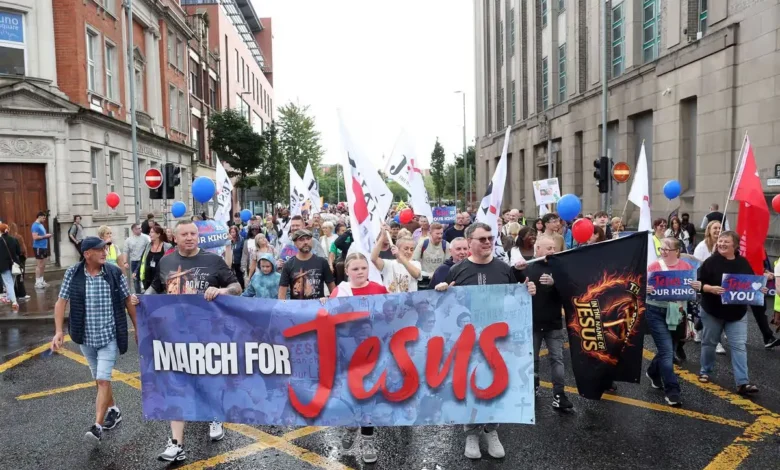
In a city where decades of religious processions had been marked by tension, conflict, and historical divisions, thousands of Christians this time took to the streets of Belfast with a message of unity in Christ; an event that organizers described as “declaring the sovereignty of Jesus over the city.”
March For Jesus announced on its website that thousands participated last week in the second edition of the “March for Jesus” in Belfast, the capital of Northern Ireland; a large-scale event held with the presence of churches and Christians from various movements and denominations, focused on worship, prayer, and public testimony about Christian faith.
The organizers of the event described the atmosphere of the march as “filled with joy, faith, and the presence of God” and stated: “This was not just a march, but a declaration of the truth that Jesus is the Lord of this city.” The official statement of the event also read: “Every song that was sung, every step that was taken, and every flag that was raised was for Jesus Christ alone.”
The march started from “Ormeau Park” and thousands of people moved toward the city center and Belfast City Hall with hymns, prayers, and Christian flags and placards; a place where the program continued with collective worship and prayers for the city and nation. Organizers had emphasized that the event was “non-political, family-oriented, and unity-building” and asked participants to refrain from bringing national flags or inflammatory slogans.
The significance of this march in Belfast is not limited to the number of participants. Northern Ireland has witnessed deep divisions between Protestants and Catholics for decades, and many religious processions in the past have been accompanied by political and sectarian tensions. However, the organizers of the “March for Jesus” attempted to present this event not as a display of religious superiority, but as a symbol of unity around a shared Christian faith in Christ.
“Deborah McCracken,” one of the participants, told media: “It was extraordinary to see churches and Christians from across the country gathered together. We are all here to glorify Jesus in unity and show people that he is the hope of the world.”
“Luke Dean,” a participant from America, also described his purpose for attending as being among “lovers of Jesus” and said that in an age full of darkness, people need “light, hope, and salvation.”
According to organizers, approximately eight thousand people participated in last year’s march in Belfast, and a similar event in Dublin attracted more than 25,000 people. This year, a similar crowd was expected to gather in Belfast’s streets.
At a time when Europe has faced an increasing wave of secularism in recent years, a crisis of religious identity, and declining church attendance, the holding of such gatherings is viewed by many Christian leaders as a sign of efforts to return Christian faith to the public sphere of society; an effort that this year came to the streets of Belfast under the slogan “Jesus Christ, Our Only Hope.”