Crime in the Shadow of Silence; Exposing Torture and Assault Against Nurses at Rajai Hospital
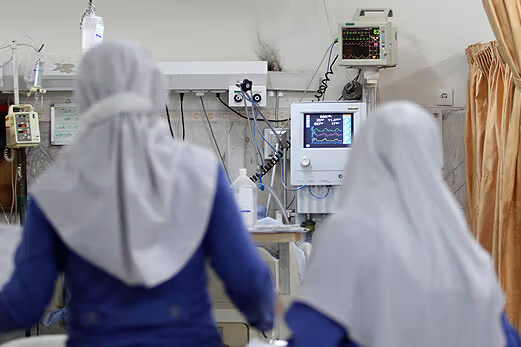
Crime in the shadow of silence and accounts of torture and assault against nurses at Rajai Hospital lift the curtain on the depths of cruelty and moral collapse.
What is being reported from Rajai Hospital is not merely news; it is a stifled cry. A place that should be a sanctuary for human life has now become, in these accounts, a scene of fear, violence, and humiliation.
According to published accounts, nurses whose only crime was saving human lives were arrested and subsequently subjected to the most severe forms of violence; accounts of torture and even sexual assault that are not only shocking but demonstrate a profound descent across human boundaries.
Among the published reports, the account of one arrested nurse reveals the horrifying dimensions of the incident more than any other. According to an informed source, this 33-year-old woman, during her detention, was repeatedly subjected to severe physical and sexual abuse, on multiple occasions and even with various objects, and was confronted with behaviors indicating organized violence.
Reports indicate that the severity of injuries inflicted upon her was such that she required multiple surgical procedures and is now dealing with serious and permanent physical complications. Sources say that due to the severity of sexual assault, her physical condition is such that part of her digestive system has suffered serious damage, and her life has become dependent on continuous medical care. Additionally, severe internal injuries have created serious concerns about her future health.
Witnesses also speak of this nurse’s severely critical psychological condition; to such an extent that, according to these accounts, before undergoing one of the surgeries, she asked the doctors not to let her survive and said if she lived, she would commit suicide. It is reported that she is currently under special supervision due to her grave psychological state.
Meanwhile, reports of severe injury to another nurse have also been published. She too required surgery after her arrest. Due to the severity of damage to her internal organs as a result of sexual assault, part of her intestines were severely damaged, and she currently has a colostomy bag attached. Additionally, due to severe bleeding resulting from sexual assaults, doctors were forced to perform a complete hysterectomy.
In another section of these accounts, claims are made about pressure being exerted on families to secure the release of detainees; including demands for substantial sums of money as well as obtaining commitments from victims to change their accounts of what happened to them. These nurses were made to commit to claiming after their release that they were abused and assaulted by rioters.
This is no longer merely a violation; we are confronted with something that must be named explicitly, and that is a blatant violation of human dignity in one of society’s most sacred spaces: the hospital.
A nurse is a symbol of compassion, an individual who has sworn an oath to save, not to become entangled in politics or power; yet in these accounts, this human commitment has become an “accusation.” When helping the wounded can end in arrest and torture, not only the security of medical staff but the very concept of humanitarianism is called into question.
Perhaps more shocking than the accounts themselves is the silence that surrounds them. A world that takes positions on many crises has yet to voice a powerful response here. This silence, for the victims, is nothing less than being ignored.
The question is simple but weighty: “If a response does not form here, where is the next boundary?”
If even only a portion of these accounts is true, we are confronted with a deep wound in human conscience. A wound that harms not only the victims but the very meaning of humanity.
In a world that claims to defend human dignity, silence in the face of such claims becomes itself part of the crisis. This is not merely a report; it is a test of global conscience.