The Fortieth Day of Organized Crime by the Islamic Republic Against the Iranian People
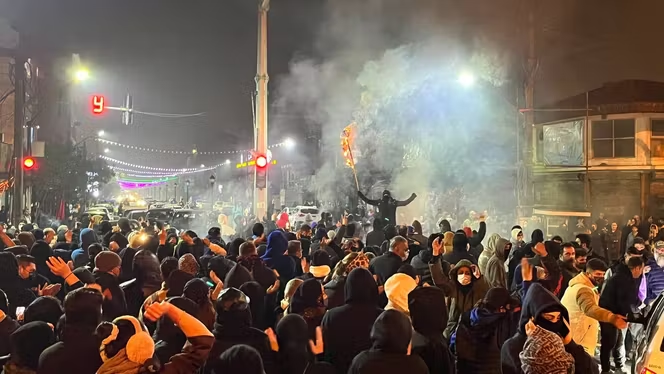
The fortieth day of victims of nationwide protests is yet another document of the Islamic Republic’s crime and the suppressed anger of the Iranian people.
The fortieth day of those killed in nationwide protests that began in Dey month of 1404 (late December 2025), took place yesterday and today on the 28th and 29th of Bahman, corresponding to February 17 and 18, in various cities across Iran; ceremonies that were not only acts of mourning for the deceased, but transformed into a new scene of protest against government suppression and violence. Families, friends, and protesting citizens, by gathering at the graves of victims, once again pointed the finger of accusation at a government that they hold directly responsible for this massacre.
The protests that erupted in the winter of 1404, were initially a response to economic crisis, rampant inflation, and political repression, but as the scope of protests expanded, the response from security forces became unprecedented in its brutality. Multiple reports documented direct fire on protesters, widespread arrests, internet shutdowns, and street suppression.
The fortieth day ceremony holds a special place in Iranian culture; a day to honor the memory of the deceased and express solidarity with the bereaved. However, in recent months, this tradition has also become a venue for civil protest. In Tehran, Mashhad, Isfahan, Karaj, Sanandaj, and several other cities, families and citizens gathered at the graves of the deceased, chanting slogans against the ruling political structure.
Some reports indicate that security forces in a number of cities attempted to prevent large gatherings of people. In some cases, roads leading to cemeteries were controlled and a number of citizens were arrested. These actions intensified the security atmosphere of the ceremonies.
Official authorities have provided limited casualty figures, but independent human rights organizations paint a different picture. According to assessments by some documentation groups, the number of victims reaches forty thousand; a figure that remains fully unverifiable due to media restrictions and widespread communication blackouts during the time of protests.
Human rights organizations in their previous reports on Iran have repeatedly warned about the use of “unlawful lethal force” against protesters. Human rights defenders have also reported widespread arrests of teenagers and youth during the recent protests.
The Iranian government, officially known as the “Islamic Republic of Iran,” has consistently described its actions as “maintaining order”; however, images circulated on social media and eyewitness testimonies tell a different story; a narrative of bullets fired into the chests of protesters and families suddenly found themselves grieving their children.
At the fortieth day ceremony, grieving mothers and fathers were most at the center of attention. Some of them, in interviews with foreign media, emphasized that their children had been unarmed and defenseless. The mother of one of the deceased in Tehran said: “My child only went out to protest the rising prices. They answered with bullets.”
In Sanandaj, another family reported that security forces imposed restrictions on holding mourning ceremonies even after their child was killed. These narratives reveal a broader picture of double pressure on the bereaved; pressure that has not only resulted in loss of loved ones, but has also been accompanied by threats and summonses.
Analysts believe that holding fortieth day ceremonies can lead to a continuation of the cycle of protests; a pattern that has precedent in Iran’s contemporary history. Each commemorative ceremony is considered a new opportunity to raise demands and protest against suppression.
In conditions where economic crisis, widespread unemployment, and a severe decline in purchasing power continue, many observers believe that the roots of social discontent remain intact. Military suppression may be able to temporarily contain protests, but it cannot eliminate the accumulated demands of society.
The fortieth day ceremony of victims of the Dey month 1404 protests has received extensive coverage in global media. Reports have emphasized the continuation of a security atmosphere, arrests of activists, and increased pressure on families. Some Western governments have also expressed concern about the human rights situation in Iran, although no decisive practical action has been taken so far.
The fortieth day of the victims of nationwide protests is not merely a reminder of the past; it is a sign of a wound that remains open. The government is trying to establish its official narrative, but families and segments of Iranian society have kept alive another narrative; a narrative of organized crime and the demand for justice.
What was seen yesterday and today in the cemeteries and streets of various Iranian cities was not merely mourning; it was a statement that spilled blood will not be forgotten.
Iran today stands at a point where the answer to the question of justice will determine not only the future of protests, but also the future of the legitimacy of the ruling government.