Crime and Post-Massacre on a National Scale, Confidential Report of Street Killings in Iran
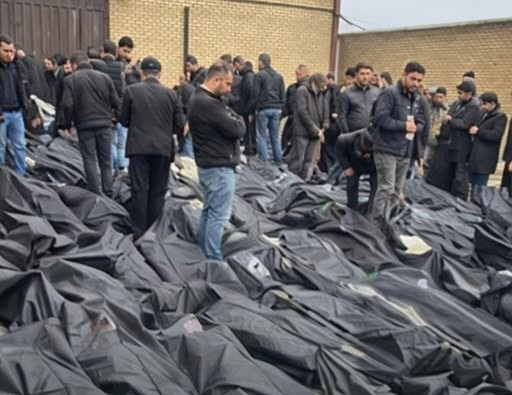
National post-massacre and the exposure of a genocide document detailing thousands of Iranians killed by order of Khamenei, in engineered silence, has lifted another curtain on the crimes of the Islamic Republic government against the Iranian people.
Fresh and shocking reports from within the security structure of the Islamic Republic paint a picture that can no longer be simply called “suppression of protests.” According to a confidential report from the Sepah Intelligence Organization to the Supreme National Security Council, what has occurred in Iran over recent weeks and months has been the largest street massacre in the contemporary history of the country; a massacre in which, according to this report, more than 36,500 people have been killed by direct order of Ali Khamenei. A confidential report leaked from the heart of the Sepah Intelligence Organization.
This report also confirms that security forces have, in some cases, delivered final shots to the wounded in hospitals; an action that is not only a gross violation of human rights, but a clear example of crimes against humanity.
What is currently happening in Iran, according to observers, is a stage beyond suppression. The Islamic Republic has entered a period that can be called “post-massacre”; a phase in which the government no longer even pretends at restraint: “it kills, it buries, it rewrites narratives and cuts off communication.”
For more than two weeks, the country has been plunged into engineered silence, a silence that is not the product of disorder, but part of the machinery of power. Public internet, as the main artery of modern life, has been reduced to rumors and fragmented pieces, and what remains is “white” networks and selected ones that keep the government connected to itself and separate society from civic life.
This situation is often described from outside as “unrest,” but from within, it resembles more the beginning of a revolution with a bloody price.
In this space of severed communication, calls from citizens inside Iran to “the program” have gained doubled importance. These calls are not speeches, they are struggles. Fragmented voices passing through heavy silence and raising a question that is no longer abstract: “What exactly does the world think witnessing is?”
Ali from Mazandaran, in contact with “the program,” said to the Islamic Republic’s suppression forces: “You don’t need to lay down your weapons. No one is afraid of you.” He repeats this sentence; not to display courage, but as a fact.
Pouria from Shiraz said: “The protesters did not abandon even one wounded person and did not allow anyone to be left behind or forgotten.” His language is operational and speaks of a moral boundary: leave no one behind.
Bahram, from a working-class neighborhood in south Tehran, explains why he came to the streets: “For my country and for my children.” Mahsa from Najafabad raised a simpler demand: “I want to tell the story of my city. In today’s Iran, the narrative of a city can be a crime.”
Alia from Bandar Abbas says: “You thought we were afraid. We are not afraid. We are angry and waiting.” She repeats the sentence: “They think we are afraid. We are not afraid. We are angry and waiting.”
These voices echo the life of Raha Bahloulipour, a student who was killed on December 9th near Fatemi Square in Tehran by fire from security forces. Raha was neither a leader, nor an organizer, nor a political figure. She was only interested in art and music. She carried no slogans, but was killed; because she represented a way of living that the government feared.
She documented names—the names of those detained and disappeared. She recorded people as humans, not numbers. She knew how suppression begins: not with bullets, but with erasure.
Navid, a physician resident in Tehran, presents a picture of hospitals collapsing under pressure: the presence of security forces in wards, families wandering for the smallest piece of news, and staff driven to the brink of moral injury.
Statistics and estimates speak of deaths exceeding the 30,000 threshold, but the main issue is not the final number; the government has made counting dangerous and then exploits this very ambiguity.
The era of post-massacre means: “Killing people is one stage and proving the massacre is the second stage of the battle.”
In the voices of the people there is no longer shock, but exhaustion. Violence so repeated that it becomes predictable. Yet these very voices are the most dangerous thing for an authoritarian government: “documents, names, places and sequences of events.”
Calls, the release of photographs and videos continue, so that more curtains may fall on the years of crimes committed by the Islamic Republic regime against the Iranian people and Iranian soil.