Iran’s Gold Under London’s Scrutiny and British Foreign Secretary Questioned Over Russia’s Role and Gold Reserves Exodus
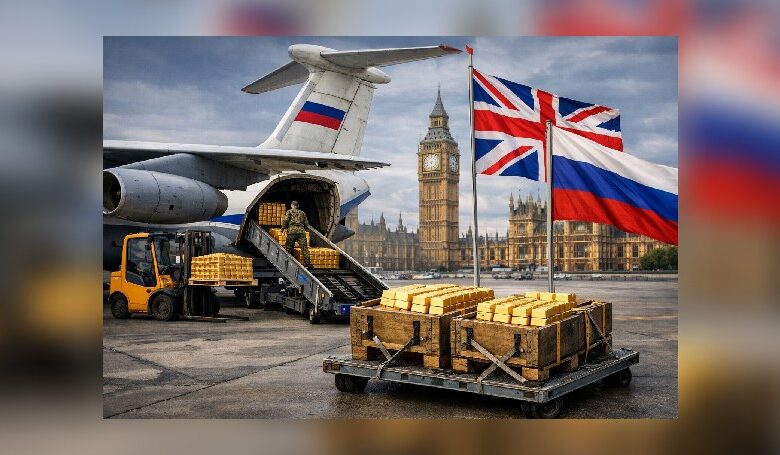
The rivalry between Britain and Russia over Iran’s gold reserves has been brought into the House of Commons amid widespread protests.
In the midst of widespread protests in Iran, a new issue has come to the attention of British politicians: “claims about the export of significant quantities of gold from Iran with Russia’s involvement.” The matter has escalated to the point where Britain’s Foreign Secretary has been held accountable in the House of Commons and forced to answer questions about London’s government information.
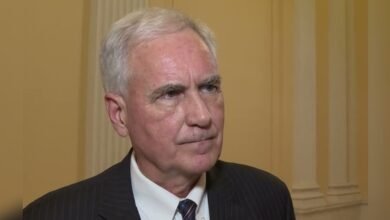
In a recent session of the British Parliament, “Tom Tugendhat,” a Member of Parliament and former British security minister, referred to reports circulating in security and media circles and called on the government to respond. He explicitly spoke of Russian cargo aircraft landing in Tehran and the possible export of gold from Iran; a matter that, according to him, could indicate an attempt by Iran’s ruling authority to transfer strategic assets in crisis conditions.
He said in the House of Commons: “We are also witnessing the arrival and landing of Russian cargo aircraft in Tehran, which are reportedly carrying weapons and ammunition, and at the same time we are hearing reports of large quantities of gold being exported from Iran.”
Although these remarks were presented with the caveat of “reports,” they clearly show that the issue of Iran’s gold has reached the formal level of politics in London.
“Hamish Falconer,” Britain’s minister for Middle Eastern and North African affairs, responded to this question with a cautious tone, stating that the government is not in a position to confirm or deny the details of these reports. However, he emphasized that the British government is closely monitoring developments in Iran and stressed the right of the Iranian people to peaceful protest.
This cautious response, from observers’ perspective, is a sign of the high sensitivity of the gold issue and its geopolitical implications; since any formal confirmation could have broad diplomatic and economic consequences.
The raising of this issue in the British Parliament cannot be separated from the hidden and growing rivalry between Britain and Russia over Iran’s financial resources and strategic assets. At a time when both the Islamic Republic and Russia are under severe Western sanctions, gold has become one of the safest tools for exchange, value storage, and circumventing sanctions.
From this perspective, London’s concern is not only about the fate of Iran’s assets, but about Russia’s role in accessing this gold and using it in financial networks outside the sanctions system. Analysts believe that if Russia can gain access to Iran’s gold reserves, this could strengthen Moscow’s financial capacity to circumvent sanctions, an issue of strategic importance for Britain and its allies.
These discussions are being raised at a time when Iran faces widespread domestic protests, a political legitimacy crisis, and increasing economic pressure. In such circumstances, from critics’ perspective, raising the possibility of gold transfer from Iran could be a sign of the ruling authority’s lack of confidence in its own future and efforts to preserve assets outside the country.
Although no independent international institution has yet officially confirmed a specific figure, such as 63 tons of gold exports, the repeated raising of these claims at parliamentary and media levels shows that the matter has gone beyond mere rumor and has become a trackable issue in Western political equations.
The introduction of the issue of Iran’s gold to the British House of Commons, in the form of a direct question to the government, indicates that the fate of Iran’s strategic assets is no longer merely a domestic issue. At the intersection of public protests, sanctions pressure, and global power competition, Iran’s gold has become a sensitive point in the struggle between London and Moscow, a struggle whose consequences, whether confirmed or not, could become more prominent in the coming months.