Message of Courage from Two Army Officers in Tehran’s Metro: The Iranian Army Stands with the People
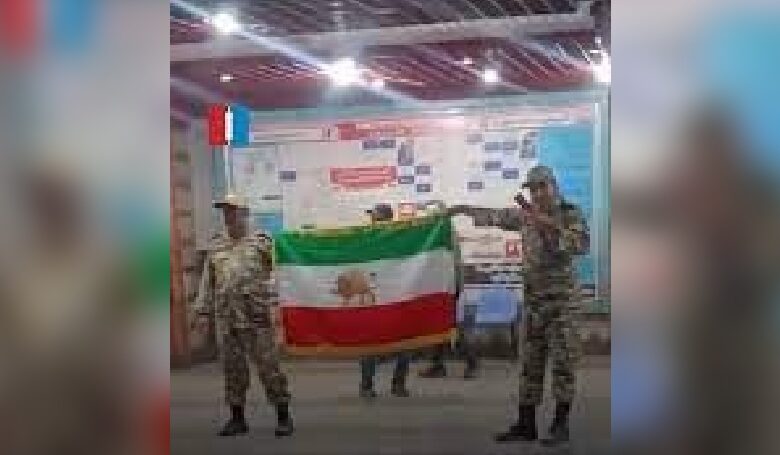
In the recent Tehran metro incident, symbols of protest demonstrated that the Iranian army stands with the people, and true loyalty finds meaning in defense of the nation.
Viral videos on social media revealed an unprecedented action by two army officers in Tehran’s metro, creating a fresh wave of discussion and hope in Iranian society. Two Iranian officers, fully aware of the risk of death, raised the Lion and Sun flag and did not retreat in the face of the onslaught of security forces.
This action, accompanied by a swift reaction from the security apparatus, presented a different picture of the country’s military forces—a picture that unveils the gap between official mandate and true loyalty.
Based on confirmed information, these two officers, in their military uniforms which government sources referred to as “altered,” stood at one of the metro stations and raised the Lion and Sun flag as a symbol of Iran before the Islamic Republic. Security forces quickly intervened to bring down the flag, but they courageously stood their ground and refused to retreat.
One of these officers, in response to a citizen who had assumed their action was a “hidden camera” prank, shouted loudly: “No sir, this is a struggle against the corrupt Velayat-e Faqih regime. This is your country’s flag.”
This statement, recorded in a short video, spread rapidly across social networks within a short time, with many seeing it as a sign of the widening gap between the military personnel and the ruling system.
This protest action was met with a wave of public responses. Many saw this action as a sign of the return of “military honor” in its true sense—soldiers who see themselves as protectors of the Iranian people, not as tools of repression for a political system.
Gohar Eshghi, mother of Sattar Beheshti who has become a symbol of justice-seeking, once again addressed the people, writing: “We must set aside fear. We must know that if we do nothing today, tomorrow we will have no future under the shadow of the Islamic Republic. We all, regardless of language or religion, share one fate.”
She also, in response to the tragic death of Ahmad Baldi, a 20-year-old who set himself on fire after city authorities destroyed his family’s business, once again emphasized the necessity of national solidarity: “Ahmad burned so we would not remain silent. Justice, bread, and human dignity are the right of every citizen.”
While the government quickly arrested these two protesters, their message was recorded in the collective memory of people around the world, far beyond the metro and beyond a brief moment in a video: that the Iranian army (at least part of it) still has roots in the soil and among the people, not in the structure of power. That a flag is not always just a piece of cloth—sometimes it becomes a reminder that a soldier’s true loyalty is not to the government, but to the nation.