Mai Sato Expresses Concern Over Rising Executions, Discrimination Against Women and Minorities
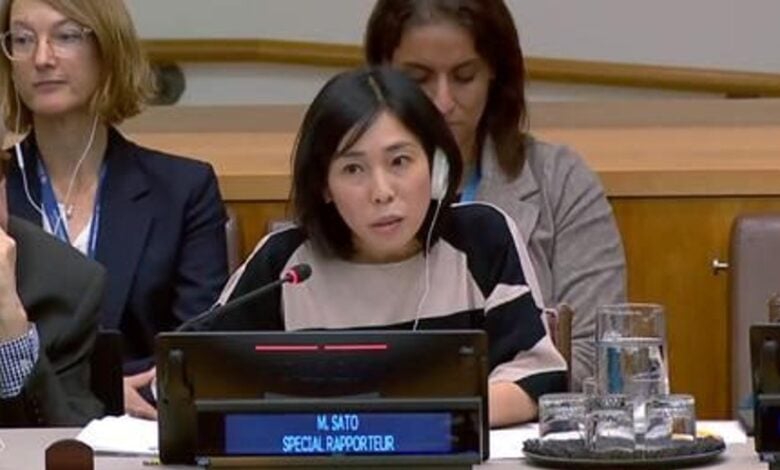
“Mai Sato” expressed concern regarding the rising number of executions, discrimination against women and minorities in Iran during an interview.
Mai Sato, UN Special Rapporteur on the situation of human rights in Iran, during an interview on November 7 with the UN website, while referring to the rise in executions, violations of freedom of expression, systematic discrimination against religious minorities, and the deteriorating situation of women and girls in Iran, said: “According to reports received from civil society organizations, the Islamic Republic government has repeatedly accused detained human rights defenders and journalists of crimes related to national security. Accusations that are vaguely defined. Furthermore, the Islamic Republic government has systematically restricted civil society.”
According to Mai Sato’s statements, courts in Iran have repeatedly detained Christian citizens with accusations such as “actions against national security” and “participation in house churches” and sent them to prison without presenting valid documents and evidence, with many of these detainees facing danger in prison due to limited or no access to medical care.
Among Christian citizens facing health problems in Evin Prison, one can mention “Laleh Saeedi” and “Mina Khajavi,” who have repeatedly been deprived of treatment facilities and specialist examinations in published reports.
The UN rapporteur also continued his statements by emphasizing Amnesty International’s annual report on capital punishment in the world, which had reported a significant increase in such cases in Iran, adding: “Another area of concern for me is the increase in the number of executions. Because according to Amnesty International’s report, nearly 75 percent of all recorded executions in the world in 2023 took place in Iran.”
Mai Sato, a Japanese human rights lawyer who had submitted his first report on Iran to the Human Rights Committee of the UN General Assembly on November 11, in his seventh report on the worsening situation of women and girls in Iran, wrote that while referring to the Iranian regime’s treatment of the Woman, Life, Freedom movement, emphasized that the Iranian government is one of the few countries that has not signed the Convention on the Elimination of Discrimination Against Women.
In addition, the representative of the European Union and representatives of several UN member countries, including representatives from Britain, Ireland, the United States, and Australia, also responded to Mai Sato’s speech by referring to violations of religious and freedom of religion in Iran.
The Irish representative, in response to human rights violations by the Islamic Republic government, called on the Iranian government to amend Articles 499 and 500 of the Islamic Penal Code to ensure that the rights of freedom of expression and freedom of religion and belief are fully guaranteed in accordance with international laws and standards, since Iran is a signatory to the International Covenant on Civil and Political Rights, which guarantees such freedoms to individuals.
Mai Sato in his interview, while referring to the fact that he seeks to travel to Iran but the Iranian government has not responded to his request, called on the global community to support him while encouraging the Islamic Republic of Iran to engage constructively with this mandate.