“Daryoush Azizian”: Iranian Christians Acted Effectively Against Enemy Cultural and Psychological Conspiracies
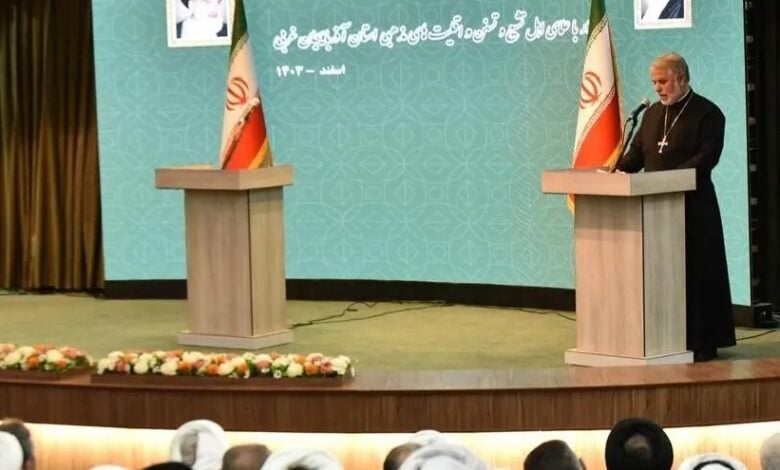
Daryoush Azizian, in a meeting of religious minorities, spoke of the effective performance of Iranian Christians against enemy cultural and psychological conspiracies.
On Thursday, the 9th of Esfand, a meeting was held with the head of the judiciary along with representatives of religious minorities of West Azerbaijan Province, clergy and seminary students. Daryoush Azizian, priest of the Church of the East in Urmia, while referring to the prominent role of Iranian Christians during the Iran-Iraq War, said: “The Christian community of Iran during the sacred defense period presented many martyrs and disabled veterans to the country, and even after the war ended, they were seriously present in the reconstruction and development of the country and countering the soft war of enemies.
Iranian Christians, by utilizing their capabilities, acted effectively against enemy cultural and psychological conspiracies and demonstrated that they have always stood alongside the Islamic Republic system and the people of Iran.”
The term “soft war” in official government discussions in Iran refers to activities such as Western cultural infiltration or weakening Islamic values, and Priest Azizian, representative of Christians in Urmia, provided no explanation in his remarks about the nature of this war or the presence of Christians in neutralizing this war, and his statements about “Christians’ confrontation with enemies’ soft war” remained ambiguous.
This lack of transparency about soft war comes at a time when the Christian community in Iran is considered a religious minority and has actually been a victim of government policies in various religious and cultural spheres, and the government has repeatedly benefited from the minority communities, especially Christians, for its own interests on various occasions.
Among the strict policies of the Iranian government, one can point to the prohibition of publishing the Bible in Persian, pressure on Muslim citizens who have converted to Christianity, and restrictions on holding Armenian religious ceremonies in languages other than Armenian, all of which are red lines of the Iranian government against religious minorities.
In addition to the above-mentioned cases, after the victory of the Islamic Republic revolution in 1357, many Christians were killed in horrific ways and their property was also confiscated, and many were forced to migrate, and these migrations continue as a result of the restrictions against Christians from the past to the present.
Priest Azizian’s remarks come at a time when representatives of religious minorities in the Islamic Consultative Assembly, despite having a specific status, have limited power, and many key positions in the country’s political and administrative structure are not accessible to them. In fact, the minority community does not have the opportunity for real participation at the macro-political and management levels of the country, and only occasionally does the Iranian government prominently display the presence of religious minorities, especially Christians, in elections or special occasions in order to try to present an image of a society in which all people, regardless of religion and sect, participate alongside each other in the government and society structure and are equal.
Priest Azizian, in referring to the historical role of Christians in Iran in his remarks, raises questions about whether they, despite their historical loyalty and participation in defending the country, also enjoy equal rights and freedom of expression, since the Islamic Republic system has seriously prohibited independent cultural activities of this community in interaction with Persian speakers, especially with those born Muslim who have converted to Christianity.
In this regard, one can refer to Priest “Victor Betamraz,” former leader of the Assyrian Church of Iran. He and his wife were accused of “action against national security” in 1393 and were sentenced to a total of 15 years in prison. He served in an Assyrian Pentecostal Church located in Shahrara, Tehran, and the mentioned church was officially recognized by the Iranian government until 1387, but was closed in Esfand 1387 by order of the Ministry of Intelligence, precisely because worship ceremonies in this church were conducted in Persian.
In this regard, “Yonatan Betkelia,” the then representative of Assyrians in the parliament, also stated: “The closure of the Shahrara Pentecostal Church was ordered by the Islamic Revolutionary Court precisely because their ceremonies with the presence of Christian converts were conducted from an Islamic background and in Persian.”