Uncertainty and Continued Detention of ‘Sedighe Vasmeghi’ in Evin Prison
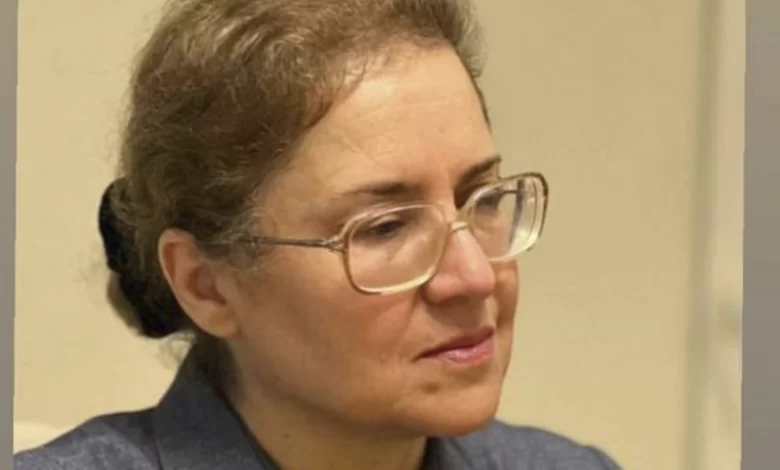
“Sedighe Vasmeghi” remains in Evin Prison in a state of uncertainty and detention after more than two weeks have passed.
Sedighe Vasmeghi, a political and social analyst, religious scholar, and Islamologist who removed her headscarf in protest of the treatment of women and compulsory hijab, was arrested by security forces on March 17, 2024, and transferred to Evin Prison. Days later, her indictment was issued with charges of “propaganda against the system in cyberspace” and “appearing in public places and public view without a hijab,” and was referred to Branch 26 of Tehran’s Revolutionary Court.
“Mohammad Ebrahimzadeh,” Sedighe Vasmeghi’s husband, said regarding her arrest: “Four plainclothes officers, three male officers and one female officer, came to our home and without ringing the doorbell of our apartment, they entered through a neighbor’s buzzer and demanding entry at our unit’s door.”
“Mahmoud Alizadeh-Tabatabai,” Vasmeghi’s lawyer, while noting that his client had a one-year final prison sentence and was summoned by the court, said regarding her arrest: “Ms. Vasmeghi had appointed me as her lawyer and the prosecutor said she should come herself, but Ms. Vasmeghi said she would not go until they tell her what the charges are. The officers came to her home on March 17 and arrested her.”
Sedighe Vasmeghi was deprived of visits with her family on April 25, 2024, by order of “Hedieh Farzadi,” the prison warden, due to non-compliance with compulsory hijab. She has a history of legal proceedings due to her previous activities.
It should be noted that Ms. Vasmeghi suffers from heart disease, high blood pressure, and high blood sugar, and these physical problems have made imprisonment more difficult for her. However, despite these issues, she remains in a state of uncertainty after more than two weeks.
Ms. Sedighe Vasmeghi is not the only woman who is in uncertain detention due to non-compliance with compulsory hijab and opposition to the system. Many Iranian women and girls are imprisoned due to opposition to the Islamic Republic system, and this trend intensified after the death of Mahsa Amini, who was killed by Guidance Patrol officers due to improper hijab. Since Mahsa Amini’s death, many Iranian girls and women have refused to comply with compulsory hijab and thus openly declared their opposition to the system, and their numbers have increased daily, with the number of arrests by regime agents also rising. All detainees who remain in uncertain detention in prisons across the country have been convicted on baseless charges including “propaganda against the system,” “insulting sacred values and the leadership,” “propaganda for a religion contrary to Islamic law,” and others, and in many cases have been deprived of the right to have a lawyer.