Commemorating World Day for Social Justice
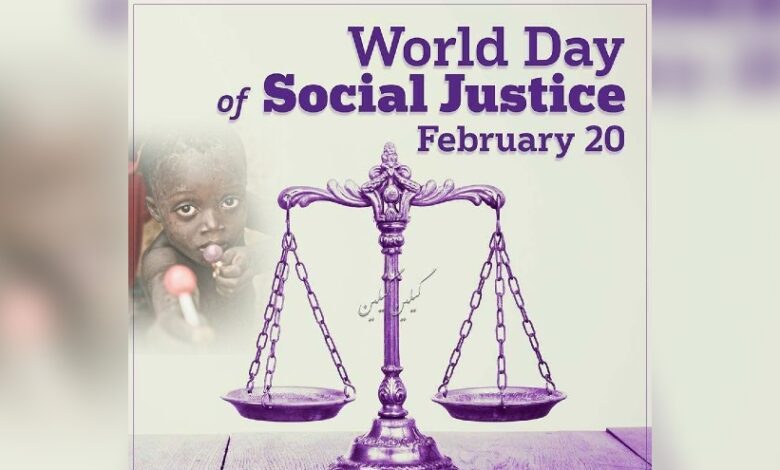
February 20 each year commemorates World Day for Social Justice, a day dedicated to hearing the voice of all.
In 1995, Copenhagen, the capital of Denmark, hosted the World Summit for Social Development, which led to the declaration of the “Copenhagen Declaration” and a “Program of Action.” At this summit, more than 100 political leaders committed to reducing poverty, pursuing full employment, and creating stable, safe, and just societies. It was also decided that people should be placed at the center of development programs.
In 2005 in New York, UN member states reviewed the Copenhagen “Declaration” and “Program of Action” at a session of the Commission for Social Development and agreed to commit to advancing social development. On November 26, 2007, the United Nations General Assembly declared that beginning with the sixty-third General Assembly, February 20 of each year would be celebrated as World Day for Social Justice. On June 10, 2008, the International Labour Organization (I.L.O) adopted a declaration on social justice for a fair globalization.
Now each year this day is dedicated to examining global social injustice and reviewing possible solutions and progress. In fact, this day is for hearing everyone’s voice, exposing structural injustices, and pushing for fundamental change. On this day, people, groups, and governments can assess progress in achieving social justice and identify areas for improvement.
The slogan designated for this day in the current year (2024) is “Bridging Gaps, Building Solidarity.” This slogan emphasizes the importance of cooperation and participation in addressing the challenges facing today’s world, and also stresses the need to promote social inclusion and cohesion and combat discrimination and inequality. According to the United Nations, World Day for Social Justice is essential for establishing and maintaining peace and security within and between nations.
World Day for Social Justice is a day when millions of people in many countries around the world struggle with issues that deprive them of the right to a just life, equality, freedom of thought, access to basic necessities such as housing, employment, healthcare, education, nutrition, freedom of expression, and more. The principles of social justice are based on five pillars: access to resources, equality in justice, participation, diversity, and human rights.
Iran is one of the countries that has trampled on and is not committed to many principles of social justice, including justice in equality, participation, diversity, and human rights, which are among the most important principles of social justice. These are the most pressing issues from which the Iranian people are deprived.
“Fred Petrosyan,” an Iranian journalist and researcher and one of the senior colleagues of “Article 18,” prepared a report on this day and addressed the situation of people in Iran, particularly minorities. In this report, he wrote: “If you enter any hospital in Iran, in any small or large city, and go to the newborn ward, it is enough that with just a word or two about the newborn, we can easily say that under the laws of the Islamic Republic, these newborns, despite their effort and talent, will be deprived of what basic rights until the end of their lives. Why? Because the newborn is a girl or was born into a Zoroastrian, Jewish, Christian, Baloch, Yarsan, Baháʼí, or other minority family.
In Iran, we do not become minorities by birth; rather, the laws make us minorities and devoid of citizenship and human rights. Social justice seeks to eliminate these discriminations and create equality of rights among citizens and fair distribution, and certainly not uniform distribution of resources in society.”
Social justice or the establishment of justice in society is not merely a theoretical discussion and discourse; it can be raised at the macro level of a country or globally, down to workplaces and institutions such as churches. Christians in Iran, particularly those who have converted from Islam to Christianity, in addition to being victims of the dehumanizing policies and injustice of the Islamic Republic, suffer from job and educational deprivation, imprisonment, and even execution. Christians who, even before the revolution, worked to strengthen social justice and public good for all Iranians and established educational centers for the blind, hospitals and schools by missionaries, and built schools in earthquake-stricken areas by Bishop Haik Hovsepian, have always been subjected to persecution, harassment, torture, and imprisonment by the Islamic Republic government.
Discussion of social justice and social injustice has not been a taboo for Christian leaders in various churches, and various discussions and definitions have taken place regarding it. For decades, through the Christian media “Christianity Today” and numerous Christian conferences, emphasis has been placed on the topic of social justice, and it has been stated that discussion of social and structural problems should not replace the preaching of the Gospel, but Christians have social responsibility and must stand against injustice.
Social justice means creating equal opportunities for all and respecting fairness, and is not limited to specific groups with intellectual discussions but applies to all people, especially victims of structural injustice, including Iranian Christians. “Billy Graham,” “John Stott,” “Catherine Booth,” “Desmond Tutu,” and “Martin Luther King” are individuals who spoke about and took action regarding fighting injustice, changing structures, societal laws for the common good, and equal opportunities and fairness for all in society, which are among the principles of social justice.