Two U.S. B-52 Bombers Fly Over the Persian Gulf
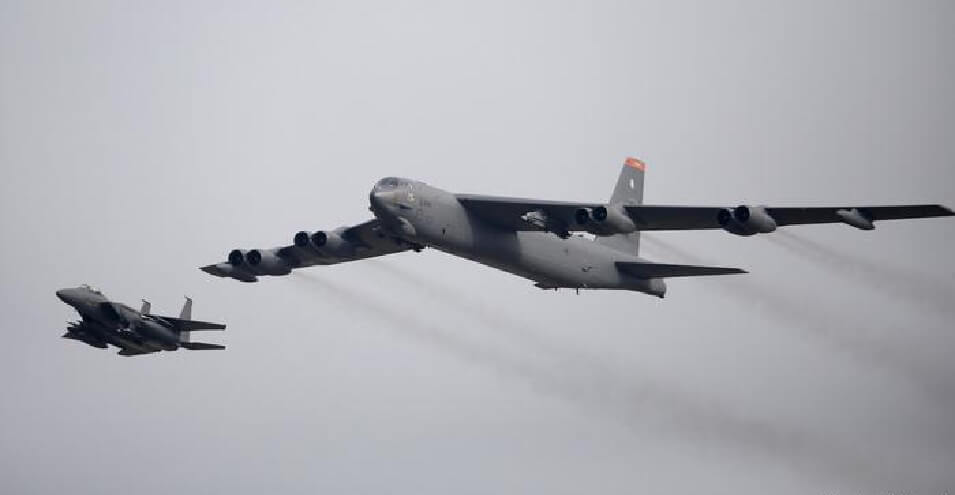
CENTCOM, the Central Command of the U.S. Armed Forces, announced that two B-52 bomber aircraft flew over the Persian Gulf. CENTCOM stated that Israeli F-16 fighter jets escorted these bombers on their return flight.
CENTCOM, the general command headquarters of U.S. Armed Forces in the Middle East and North Africa, published a report on its official Twitter account about the flight of two B-52 bombers of the U.S. Air Force over the Persian Gulf.
The date of these bombers’ flight was announced as Wednesday, June 8 (Khordad 18). According to CENTCOM, “these bombers were escorted by Israeli F-16 fighter jets on their return journey.”
Flights of American strategic bombers have taken place repeatedly in the past over the Persian Gulf and near Iran’s borders during periods of tension in the Middle East.
The flight of these fighters over the Persian Gulf occurred on the same day that the Board of Governors of the International Atomic Energy Agency approved a draft resolution by three European signatories to the JCPOA and the United States. According to the resolution, the Islamic Republic was called upon to respond as quickly as possible to the Agency’s questions regarding uranium particles discovered at three undeclared locations.
Out of 35 members of the Board of Governors, 30 countries voted in favor of the resolution, with only China and Russia opposing it.
One day after the IAEA Board of Governors issued the resolution, Rafael Grossi, the Director General of the International Atomic Energy Agency, announced at a press conference that officials of the Islamic Republic told the Agency that they want to shut down 27 surveillance cameras monitoring Iran’s nuclear activities.
Grossi described this Iranian action as unconstructive and stated that this measure would make the process of returning to full implementation of the JCPOA agreement very difficult.
The shutdown of the IAEA cameras also triggered international reactions.
Germany, France, and Britain condemned this Iranian action and called on Iran to resume monitoring and verification measures related to the JCPOA and stop the “escalation” of nuclear tensions.
Anthony Blinken, U.S. Secretary of State, also said that by shutting down the surveillance cameras of the International Atomic Energy Agency, Iran is risking further isolation and escalation of tensions.
Iran also responded at a high level. Ebrahim Raisi, Iran’s President, in response to the approval of the IAEA Board of Governors resolution condemning Iran, stated that the Islamic Republic will not take a single step back from its positions.
Source: DW