A Bitter Tale of the End of a Historical Era of Nomadic Life in Iran / Kiomars Amiri
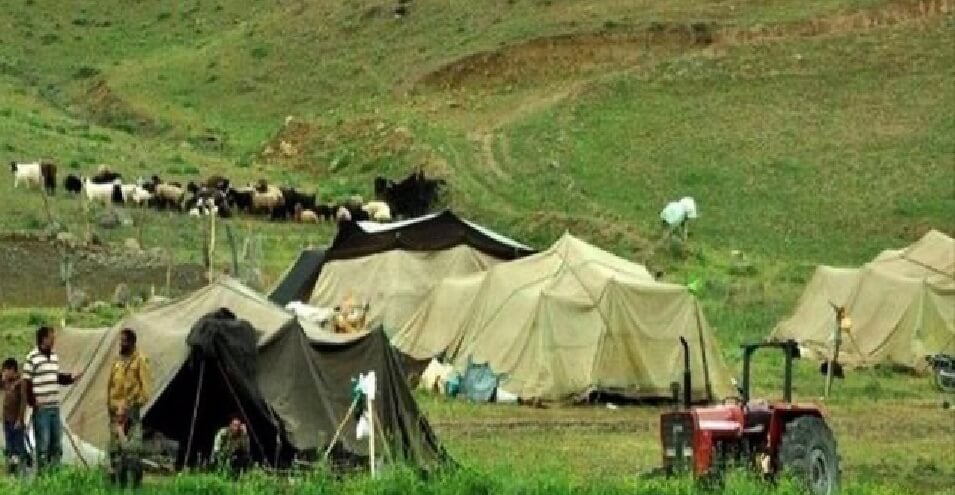
Iran’s tribal and nomadic society, which until a century ago held the first voice in determining the nation’s fate in major political, economic, and social affairs, and which modernizers and advocates of transitioning society from tradition to modernity considered as the greatest obstacle in their path or, in other words, their most powerful rival for the transition to modernity, today in the fifteenth century of the Persian calendar and after suffering severe blows from the implementation of the Pahlavi Land Distribution and Forced Settlement Law for nomads, which was carried out at the desire and order of Reza Shah, finds itself—due to reasons such as mismanagement by Islamic Republic officials, forest destruction, water crisis, environmental devastation, drought, and dozens of other large and small problems in a devastated and displaced life—forced to put an end to tribal-nomadic life and step into an inevitable fate that will bring nothing but misery, poverty, and vagrancy on the outskirts of cities.
The year 1401 (Persian calendar) should be considered the year marking the end of an era and a historical period of tribal and nomadic life in Iran; a life that from this point forward must be read between the pages of books or observed in photographs and paintings.
Barren Nature and the Wasted Suffering of Nomads
To prepare a report on the condition of Kermanshah nomads, who are currently living in difficult and unpleasant circumstances, we travel to the forested and mountainous regions in the southeast of Kermanshah province, so we might see individual nomadic families up close. Leaving the city of Kermanshah, after traveling a long distance on a non-standard dirt road—a road that cries out having been worked on for years with heavy road-building machinery, yet has long been left to its own devices without results—we reach nomads living among mountains and forests. Along the way, every few kilometers our eyes fall upon small flocks of goats and sheep being herded by an elderly shepherd or a young boy through dry, grassless lands and forest trees.
At the end of this road, which passes through the districts of Sarfirouzabad, Jalavand, and Osmanovand, we reach several nomadic families in the village of “Pashtale”—a small village of seven or eight households located midway on the border of Kermanshah, Ilam, and Lorestan provinces and considered the last village of Osmanovand district in Kermanshah.
These few remaining nomadic households in this point of the central Zagros mountains are the remnants of hundreds of nomadic families who previously abandoned their ancestral lands and departed from here; a place that until a century ago was the home of numerous tribes and nomads whose migration commotion, chatter, and tumult with millions of head of livestock, tents, and black-haired felt dwellings made the heavens resound, today struggles with a population of fewer than twenty people, their inhabitants drowning in poverty and despair, in terrifying isolation amid numerous problems, with no way out except to flee.
The nature whose inhabitants once threw “the thousandth milestone” into the air not so long ago and, according to tribal custom, celebrated when their flocks reached a thousand head and continued their nomadic and tribal life generation after generation with thousands of hopes and aspirations, today has reached the end of the road; because in that vast nature, there is no longer any trace of water and civilization or plants, and there is no sign of various animals like deer, gazelles, or beautiful birds such as partridges, geese, and pheasants, and its barren, desolate nature is in complete ruin.
These vast destructions that have occurred in this region over these years have had no cause other than the government officials’ indifference to nature and to the life of the nomadic class, which has led to nature’s destruction, followed by successive droughts that have brought everything to ruin and obliteration, and for this reason no plant cover, water, grass, animals, or insects remain, and most of their species have become extinct forever, and the possibility of continuing life for the last remaining nomads no longer exists, and small herd owners are forced one after another to abandon their homes by selling their livestock cheaply and seeking refuge on the outskirts of cities, and with such circumstances the ruined nature seems to mourn the loss of its beloved and cover itself with earth, remaining in solitary isolation to decay.
A Brief Overview of the Problems Gripping Nomads of Western Iran
The nomads we are currently among are considered part of the migratory nomads of the independent Osmanovand tribe; an area where tribal and nomadic life was once spoken of and held special importance for western Iran’s nomads, yet unfortunately now all signs of life in it are coming to an end.
In this mountainous region whose sparse forests have thus far held out and until recent years were the habitat and grazing grounds for hundreds of nomadic families, now you must traverse kilometers of difficult mountain paths hoping your eyes might fall upon a small flock of goats and sheep and an exhausted, desperate shepherd who has pitched a few tents or mud dwellings in some corner of the mountains and a cave, living in an atmosphere of poverty, misery, and hunger and thirst, watching their own and their animals’ death and end, finding neither hope nor remedy for their life, future, or salvation and their animals’ survival.
The indifference and irresponsible dealings of the country’s administrators in state management, and particularly the continuous and prolonged indifference to nomads’ problems and predicaments, severe water shortage, rapid destruction and devastation of forests and rangelands over the past half century, the high cost of shepherd wages, inflation and daily rises in prices of nomadic and livestock needs, the staggering rate of fodder prices, and beyond all these the droughts that have not left the region’s collar these years, are among the major factors that have kept the few remaining nomads, survivors of the Pahlavi forced settlement law, from migration, quickly bringing their life to an end and transforming the forest into a barren, barren wasteland devoid of water, vegetation, and life.
The remaining nomads who, with the persistence and habit of nomadic life, amid all its hardships struggled against the grasping of modernizing and modernity-seeking government officials on one side and nature’s wrath and the ruling power’s indifference on the other to preserve themselves against modern life and defend their identity and survival, with their numbers decreasing each year as they were forced one by one to flee to city outskirts due to problems, finally in the year 1401 of the Persian calendar witnessed the end of their era of tribal and nomadic life in Iran. The migration of tribes came to a permanent halt and the last migration was a migration that never returned, and thus after centuries of traditional nomadic and livestock herding life in Iran, a permanent end was brought. What might emerge from this terrifying devastation and the event that occurred in tribal and nomadic life?
Among the miseries and predicaments of contemporary Iranian society, first and foremost one must point to the lack of justice and the rampant spread of lawlessness and unrestrained chaos that has drawn all dimensions of people’s lives into a deep and insoluble challenge, and the ruling power instead of solving it has become the architect of this chaos and turmoil that has made society completely ill. In the shadow of lacking justice and lawlessness is a young man expelled from university after three and a half years of medical studies at Kermanshah University of Medical Sciences for frivolous reasons, and the disheartened and desperate young man out of necessity and despair has returned to his ancestors’ nomadic life, this time facing an even more irreversible failure.
This young man driven from university and left shepherding after ten years of herding and enduring difficult nomadic life finally goes bankrupt, and rootless as he puts it, knows not what to do and cannot think of any way out.
We found him, a resident of “Pashtale,” wearing faded clothes and a tired, sun-burned face with defeat and despair pouring from his features, standing beside his flock in his misery.
Among the sparse oak forests of the Zagros with a frail, humiliated stature standing beside his small flock, he has let his flock loose to graze.
In the shepherd’s sorrowful gaze the flock members rub their muzzles on the ground and in search of prickly grass to fill their stomachs roam in every direction. The flock has traveled kilometers through mountains and forests to feed, but as evening approaches, due to the poverty of vegetation cover its stomach remains unfilled and it stays hungry, and this is the animal’s daily pain and the shepherd’s unsolvable problem whose only remedy is this small flock; a flock that if its stomach cannot be filled with mountain vegetation, fodder must be purchased for it, and purchasing fodder due to its high cost means the shepherd’s complete bankruptcy, and this problem has closed all roads before the shepherd. Buying fodder is not economical and the shepherd has already sold more than half his flock to buy fodder. In a rough calculation with himself he has concluded that it will not be long before he must sell the entire flock to buy fodder and sit down empty-handed, expelled from here and driven from everywhere on black earth.
This shepherd’s fate while pitiful and astounding, and his story reminiscent of his compatriots’ suffering and the chaos and turmoil that over these years, in addition to unprecedented problems and disasters created in the realm of higher education in our country, have not spared shepherds’ lives from harm even in distances far from the city center.
The Shepherd Who Studied Medicine
His name is Seyed Alolah and he was born in 1352 (Persian calendar). His frail stature and sorrowful face tell of suffering he has endured in his short life. He is single and says he has no thought of marriage and absolutely lacks the means to start a family. We ask him to speak of his life and fate.
With measured words he explains:
“I spent my entire childhood in nomadic and shepherding life with my family in this very place where I live now. When I was a teenager, my father sent me to Kermanshah to study. In Kermanshah, with thousands of difficulties I obtained my diploma and using the Basij quota in 1372 (Persian calendar) I entered the medical program at Kermanshah University of Medical Sciences. After three and a half years of university studies and completing sixty-one semesters of coursework for frivolous reasons and on the pretext that my Basij documents were defective, I was expelled from the university along with several others. For several years I ran around trying to return to university and continue my studies, but everything led me in circles and no result came of it. While those expelled with me returned to university and continued their studies, but because I had no one, I could not return to university and complete my education. During several years of running around and knocking on every door and failing, while I was spiritually quite broken and exhausted and desperate and could not find employment, I saw no choice but to return to my ancestors’ profession and resume shepherding. For this reason, I sold the small house we had in the city and with that money bought about a hundred breeding ewes and returned to my ancestors’ refuge. Over eight years with thousands of hardships and toil I managed to increase the flock to eight hundred breeding ewes and in my heart I dreamed of throwing the ‘thousandth milestone’ when suddenly over these past two years our days became dark.
I was unaware I lived in a country where due to a sick rentier economy where dealing and brokerage prevail, some become billionaires overnight while hundreds of families fall into the depths overnight. I could not understand what grim fate lay in wait for Iran’s nomads and myself as an individual with nomadic life.
I had torn my heart from city chatter and was making a living with hardship and toil when suddenly everything changed over two years. Two years of successive droughts, lack of even minimal support from the government for the nomadic class, and dozens of other problems caused us to be completely destroyed over these two years.
Two consecutive years of drought meant we could not fill our flocks as in previous years with rangeland vegetation and from spring water. Due to destruction of vegetation cover caused by drought and government mismanagement, for two years we have been forced to purchase fodder and water for our livestock; fodder whose price increases daily. Until today when straw prices reached six thousand tomans per kilogram, barley ten thousand tomans per kilogram, and alfalfa bundles fifty thousand tomans, increasing daily. After the animals became incurable I sold them and purchased straw, barley, and water by tanker for my animals’ survival. The government’s wrong and rentier policies in meat and fodder exports and imports on one hand, and the abundant supply of livestock due to high prices and lack of fodder causing livestock owners to sell their animals on the other, caused a cattle collapse and no one was or is willing to buy livestock. In such conditions everyone wants to sell and in this way we nomadic class got trapped and in this entrapment we were destroyed and we have no remedy.”
He continues with a choked voice: “I cannot let these animals that I have labored for years to raise and which are all my hope and life be destroyed before my eyes from hunger and thirst. In any case we are human and I have special affection for these animals. Property is understood; my conscience does not allow me, and otherwise truly with the situation that has arisen I should have let them loose in mountains and forests so all would be destroyed from hunger and thirst and I would be freed from this killing suffering. I am desperate and know not what to do.”
We leave Seyed Alolah with his pain and suffering and visit another livestock owner.
Ten Million Tomans a Year in Late Payment Penalties—This is How I Loan
His name is Mohammad and in response to our questions about the problems gripping nomads these days, he says:
“Three years ago I took a hundred million tomans in mudaraba loan and for my eldest son who had been unemployed for years, I bought a number of breeding ewes at seven million tomans per pair. I have been renewing the loan for three years and every year just for its late payment penalty I pay ten million tomans to the bank. In these circumstances the livestock I bought three years ago for seven million tomans per pair I am now forced to sell for three million tomans per pair and that too on one-year installment. I don’t know what my son should do from now on.”
We ask him, previously how did you obtain drinking water for yourselves and your animals?
He replies:
“We obtained water for our animals from a spring that until two years of drought provided enough for our animals, and for ourselves we used water from this same spring and from water tankers that the county administration sent for nomads.”
We ask why the county administration? Shouldn’t the water organization have laid pipes for you?
He replies: “Because we are counted as nomads, our legal responsibility is with the county administration.”
We ask if the county administration even now does not bring water by tanker for you?
He answers: “No anymore; the last water tanker the county administration sent was about a month ago and even that only reached two or three households, not us.”
What does the county administrator say? Through a person accompanying us who knows the county administrator of Sarfirouzabad district in Kermanshah, we call and speak with Mr. Shafiei, the administrator who is a man in his thirties, and he says in this regard: “I have emphasized that every ten days a tanker of water should be sent for those few households in ‘Pashtale’. Alright; I will reemphasize.”
Livestock Insurance and the Insurance Company’s Failure to Respond to Livestock Owners
Nourkhoda Jamshidi is among the nomads living in the mountainous region of “Golzheran”. The nomads’ problems are common. When we ask him about insurance for his livestock, he replies:
“Last year insurance company officials came and by taking twelve thousand tomans for each head of livestock, they put ear tags on our animals’ ears and said if your animals die, bring us the ear with the tag and collect compensation. Unfortunately the ear tags caused several of our animals’ ears to become infected and as a result of this infection they died. We took the ears and ear tags and delivered them. In subsequent instances we brought the carcasses of dead animals with ear tags and delivered them, but alas, not even one rial of compensation from insurance. We had to travel nearly one hundred fifty kilometers back and forth and they tired us with ‘come today and come tomorrow’ and the year ended and we saw no compensation for our losses.”
He adds: “Three of my sons left home years ago due to poverty and deprivation; that is, in reality they fled poverty and in the city they are unemployed and without income. I remained with my eldest son who has wife and children and about seventy breeding ewes. We sold all our lambs and bought fodder for them and now we have no money to buy fodder. I calculated and found that each animal needs roughly twenty thousand tomans worth of straw and barley daily and no one is willing to buy them so we can sell them.”
He speaks about obtaining drinking water for himself and his animals: “We use water from a well about three kilometers away from our residence. We don’t know if it is polluted or not.”
We ask if the Agricultural Jihad organization, which claims it gives fodder to nomads at low prices, does not help you?
He replies: “A few years ago sometimes they gave so little that bringing it home was not economical and the delivery point was so distant that it did not even solve one hundredth of a livestock owner’s problem. Now it has also been completely cut off for some time and there is no word of it.”
On our return from among the nomads, our throats gripped by heavy sobs, we think all the way about nomads who have fallen into such a dark fate; nomads who once lived in splendid lives with thousands of hopes and aspirations and now have reached the end of the road and all paths are closed to them and broken and defeated, no one comes to their aid. The mountains and forests have become silent and empty and not even a bird’s call is heard; forests that until recent years whose freshness and beauty transported people to ecstasy and life flowed in them and the clamor of livestock owners with thousands of head of livestock never ceased; livestock owners who annually supplied a large portion of the country’s meat, wool, and organic and healthy dairy products, now are forever in the process of disappearing.
Are there after all only a few households of nomads? Cannot the government with an injection of interest-free loans or granting quotas save this most hardworking and poorest class of society who have fallen from existence and help them pass through this period? Do officials not have a conscience that aches upon seeing these nomads’ situation?
And in the end, nothing but a lump in the throat and despair in the heart about the country’s situation results. With head bowed and a heart more pained than ever, it seems someone sorrowfully murmurs: the house is demolished to its foundations.
Source: Harana