Amnesty International Warning: Ahmad Reza Jalali in Danger of Retaliatory Execution
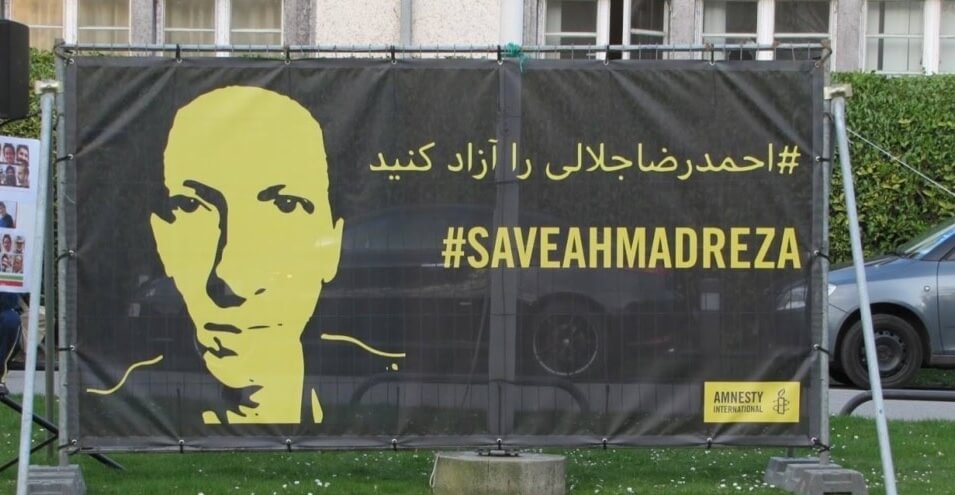
Amnesty International announced on Monday, June 13, through an urgent action appeal that Ahmad Reza Jalali, a dual-national prisoner in Iran, is in danger of “retaliatory” execution.
Amnesty International once again called on Gholam-Hossein Mohseni-Ejei, head of Iran’s judiciary, to overturn Ahmad Reza Jalali’s death sentence and secure his immediate release.
The organization described Ahmad Reza Jalali’s detention as “arbitrary” in its statement and wrote that the Islamic Republic has taken this researcher “hostage.”
Amnesty International has asked everyone to write letters to the head of Iran’s judiciary to work towards overturning Ahmad Reza Jalali’s death sentence and securing his freedom.
The human rights organization says the Islamic Republic is threatening this Iranian-Swedish prisoner with execution due to the trial of Hamid Nouri being held in Sweden.
Hamid Nouri, a former prosecutor at Gohardasht Prison in Karaj, has been accused of “murder” and “committing war crimes” for his role in mass executions of political prisoners in the summer of 1988. His trial proceedings in Sweden concluded in mid-April of this year, with the court’s verdict scheduled to be announced one month later.
Hamid Nouri was arrested upon arrival at Stockholm airport in November 2019 and has been imprisoned in Sweden since then.
In recent months, some media outlets reported the possibility of exchanging him for Ahmad Reza Jalali, but Masoud Setayeshi, spokesman for Iran’s judiciary, rejected this possibility on June 3.
The judiciary spokesman emphasized that Ahmad Reza Jalali’s case is in the execution stage, and determining the execution date is the responsibility of the prosecutor and the execution official.
Vida Mehran-nia, Ahmad Reza Jalali’s wife, stated a month ago in an interview with Voice of America that she is unwilling to exchange her husband for Hamid Nouri, noting that many complaints have been filed against Nouri.
She called on the European Union to make efforts to save her husband’s life.
Ahmad Reza Jalali, an Iranian-Swedish physician and researcher, was arrested in April 2016 when he traveled to Iran to participate in a scientific conference. He was sentenced to death by Branch 15 of Tehran’s Revolutionary Court, presided over by Judge Abolqasem Salavati.
The charge against this Iranian-Swedish physician is “espionage,” which Ahmad Reza Jalali and his family have repeatedly denied.
The Iranian judiciary has not provided any documents or evidence to prove his charge to date and only relies on his coerced confessions.
Amnesty International states that the confessions extracted from Ahmad Reza Jalali were obtained under torture and while he was held in solitary confinement for an extended period without access to a lawyer.
According to a report by Ensaf News website, Mohammad-Hossein Saket, Ahmad Reza Jalali’s lawyer, announced on Sunday, June 1, that in a detailed petition accompanied by documents presented to the court, he proved that the charges attributed to his client are not true.
Referring to the broadcast of his client’s coerced confessions on Islamic Republic of Iran Broadcasting, he stated that according to the law, those confessions are not admissible and “his client made no explicit confession before the court.”
Haleh Moosavian, another lawyer for Ahmad Reza Jalali, also stated that there are numerous legal defects in her client’s case. She described the film of Ahmad Reza Jalali’s coerced confessions as “edited” and said that the lawyers presented multiple reasons to the court in refutation of the charges.
Human rights defenders refer to Ahmad Reza Jalali and other foreign or dual-national prisoners in Iran as “hostages” of the Islamic Republic.
Source: Voice of America