Hamid Noori’s 61st Court Session; The Return of ‘Empty Minibuses’ After the Execution of Prisoners Was Very Painful
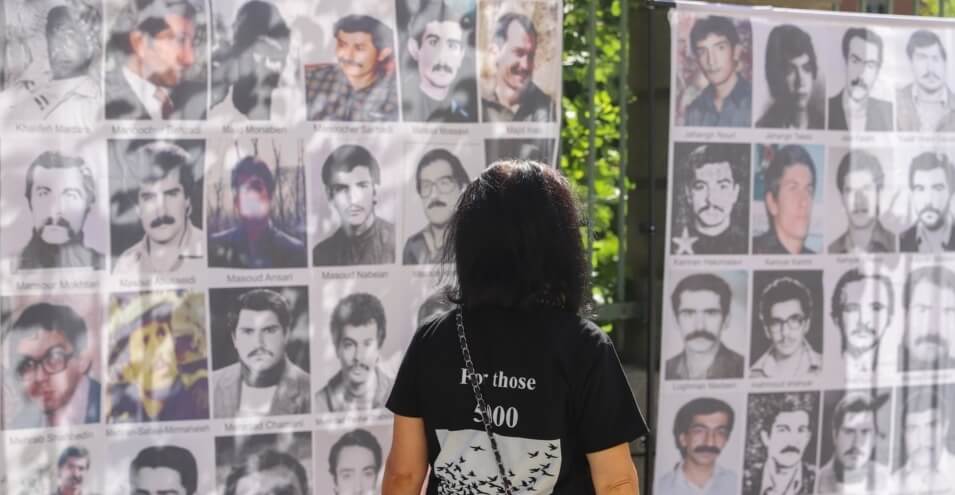
The 61st session of the trial of Hamid Noori, accused of participating in the executions of summer 1988 at Gohardasht Prison, was held on Monday, January 24, 2022, with the first testimony of Amirhoshang Atiabi, a leftist prisoner who survived those executions.
Amirhoshang Atiabi, who was a student expelled in 1980, was arrested in March 1984 for his activities in the Tudeh Party of Iran. The witness was severely tortured with cables from the beginning in the basement of Ward 209 of Evin Prison. He was transferred to the clinic adjacent to Ward 209 in critical condition with many problems such as blood in his urine and legs blackened up to the knee. The witness said that after one week of hospitalization with a bandaged body, he was tortured again with cables in that basement. This time he was hospitalized in the clinic for another week in a state of shock and convulsion.
Amirhoshang Atiabi was sentenced a year after his arrest in a brief trial, but it took another year for his ten-year prison sentence to be notified to him. Amirhoshang Atiabi was transferred from Evin Prison to the quarantine ward of Qazlhassar Prison in late 1985 and to Gohardasht Prison in early 1986.
Among the documents that Amirhoshang Atiabi previously submitted to the court, there is a list containing information on 96 leftist prisoners executed in Ward 20 of Gohardasht Prison and the witness’s interview with the Iran Human Rights Documentation Center in 2009. Among other documents is a map of Gohardasht Prison drawn by the witness. Among the documents is also a calendar from 1988 in which the witness recorded important events of the execution period daily with the help of symbols and in code in the prison, and later completed it after his release.
Amirhoshang Atiabi testified that he personally, along with several other prisoners, heard group conversations in which they discussed the Imam’s ruling, the implementation of it, and the methods of execution.
Amirhoshang Atiabi said that seeing two photos of Hamid Noori after his arrest did not remind him of anything, because more important people were the subject for him. The witness said that in the first prison he saw Mortazavi, who was short, thin, and dressed in clerical clothes. He later confronted Nasserian and Lashkari. He said that during one period he was in charge of Ward 1 and once met with Lashkari to discuss ward issues. He said Nasserian was a jack-of-all-trades in the prison, and Lashkari was more responsible for managing the Revolutionary Guards, prison security, and events inside the prison.
Amirhoshang Atiabi testified that he personally witnessed, through the manipulated shutter slats in the prison bathhouse, the carrying of the bodies of executed prisoners by the Revolutionary Guards from the Husseiniyeh of the prison into refrigerated trucks and an open truck, and their transfer out of the prison. Atiabi witnessed the Guards walking on the bodies, grabbing the hands and feet of the executed, and moving them. In Atiabi’s calendar in Gohardasht Prison, it is stated that the body transfer work continued two to three times a day for twelve days.
Amirhoshang Atiabi testified that according to what he heard and saw, the death committee was present at Gohardasht Prison from the eighth of Mordad and the execution of the Mujahedin started from that day and ended on the 25th of Mordad 1988. Atiabi witnessed prisoners being transported by minibuses two to three times a day in the first phase of executions. He said that observing minibuses full of prisoners and their transfer to the Husseiniyeh and the return of empty minibuses was very painful. Amirhoshang Atiabi testified that the second phase of executions began on the 5th of Shahrivar 1988, focusing on the execution of leftist prisoners. He said Lashkari, with a group of Revolutionary Guards, burst into the ward and told the prisoners to leave their cells. They removed all prisoners from the ward without preparation and even without slippers.
Amirhoshang Atiabi was placed twice by Nasserian before a death committee consisting of Ashraqi, the General Prosecutor of the Islamic Revolution, and Nieri, the religious judge, and another person he did not know. The witness was flogged at two stages—morning and late evening—for not praying. He ultimately survived the execution by claiming to be a Muslim and declaring disassociation from the Tudeh organization.
Amirhoshang Atiabi—at the end of the executions—was transferred to Evin Prison in February 1988 and later released.
Based on the formal announcement of the court judge, another session for the continuation of Amirhoshang Atiabi’s testimony was scheduled for the future and he would be notified.
The 61st session of Hamid Noori’s trial was held at a time when the Islamic Republic, in recent weeks—after more than two years—officially reacted to this trial by broadcasting reports on Mizan, the news agency of the Judiciary. In these reports, Iran’s Judiciary described Hamid Noori as a “simple employee” who was kidnapped, beaten several times, and is being tried in Sweden without free access to a lawyer and the right to visit his family, and even without having reading glasses.
These claims are being raised while Hamid Noori, according to Swedish law, has had a lawyer since his arrest at Stockholm Airport. Noori even thanked his lawyers in his defense sessions and said that everything they said was confirmed by him.
Noori’s family, including his wife, children, and son-in-law, were present in his trial sessions—particularly in his six initial defense sessions in early December 2021—in the courtroom and were introduced one by one to the court members by him. He had access to a tablet in the court sessions in addition to glasses.
The next court session will be held on Tuesday, January 25, 2022, the 25th of 2022, with the testimony of Mansour Kamalzadeh at the Stockholm Court in Sweden.
Source: Voice of America