“Continuation of Crisis Conditions” in Sistan and Baluchestan; New Wave of Rainfall on the Way
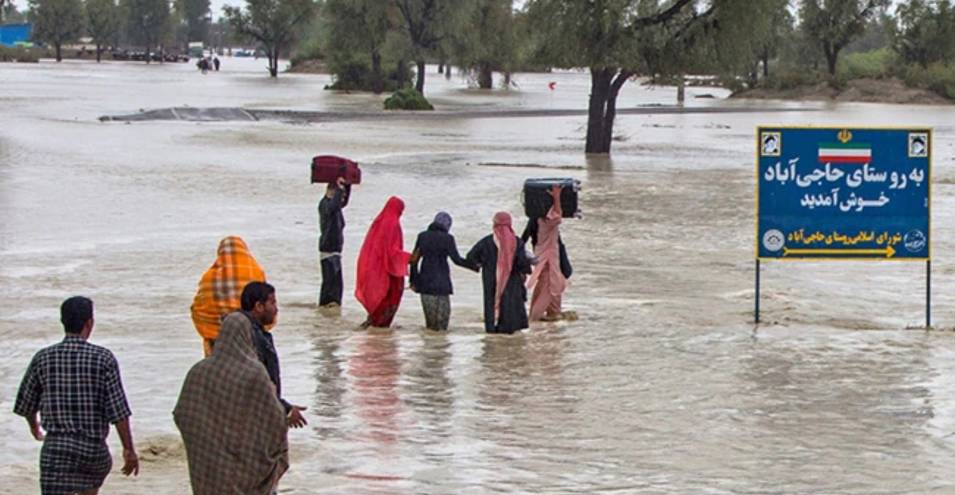
Following the occurrence of floods caused by rainfall in Sistan and Baluchestan, which according to the Minister of Energy was equivalent to four years of precipitation in the province, the situation in Konarak city and living conditions of people in this region continue to be reported as critical.
Simultaneously, the meteorology department of Sistan and Baluchestan has warned that from the morning of Thursday, December 16, a new wave of snow and rain along with severe winds will affect the province.
As a result of rainfall over the past few days in Sistan and Baluchestan, seasonal rivers overflowed, communication routes were blocked, and homes of many residents in several cities and dozens of villages in Chabahar, Konarak, Sarbaaz, Nikshahr, Dashtiari, Fanuj, Qasrqand, and Delgan cities in the south of the province experienced severe flooding.
Abdol-Ghafoor Hoot, governor of Konarak, told the Mehr news agency that water has penetrated at least 2,000 homes in the city and has requested help from all government agencies as well as the private sector and local charitable individuals to collect surface water.
According to Ali-Akbar Mohrabian, Minister of Energy, during recent rainfall in Sistan and Baluchestan province, a total of 334 millimeters of precipitation was recorded, which equals four years of rainfall in this region—that is, four years’ worth of rain fell in four days.
Based on this report, only in Konarak city, whose situation continues to be reported as critical, “108 millimeters of rainfall occurred in approximately half an hour,” which is said to be “one of the heaviest rainfalls in recent decades of Iran’s history.”
Following the occurrence of flooding and critical conditions, the Red Crescent announced on Wednesday, December 15, that 11 emergency accommodation camps are being set up and “essential supplies will reach Konarak today.”
The reason for this is that at least 70 percent of homes in Konarak became uninhabitable and 90 percent of people’s household items became unusable. This statistic was announced by Rahmadal Bameri, Deputy Political Advisor to the Governor of Sistan and Baluchestan.
Nevertheless, the Minister of Energy, who was sent to the region by the government, announced that “the problems created by the flood in the southeast of the country require national determination.”
The reported damages and losses from the destruction of homes and people’s belongings are separate from the extensive damages that the recent flood has caused to farmers. In only one case in Delgan city, it has been reported in “preliminary estimates” that “2,400 hectares of cultivated agricultural land suffered severe damage amounting to at least 60 billion tomans.”
The recent flood and flooding were not limited to Sistan and Baluchestan province, and based on reports, 14 provinces of Iran were affected by flooding, and as of December 14, it was reported that at least eight people have lost their lives due to the flood.
Previously, Mehdi Valipour, Head of the Red Crescent’s Relief and Rescue Organization, announced the flood-affected provinces as West Azerbaijan, Isfahan, Bushehr, Qazvin, Fars, Kerman, Kohgiluyeh and Boyer-Ahmad, Chaharmahal and Bakhtiari, Zanjan, Sistan and Baluchestan, Khuzestan, South Khorasan, Hormozgan, and Yazd.
In recent years, due to climate change and environmental negligence in Iran and neighboring countries, particularly regarding soil erosion, in addition to dust storms, the occurrence of floods has also affected people’s lives in Iran.
Source: Radio Farda