Ahvaz City Council Member Accuses Oil Ministry and Khuzestan Officials of ‘Colonialism’
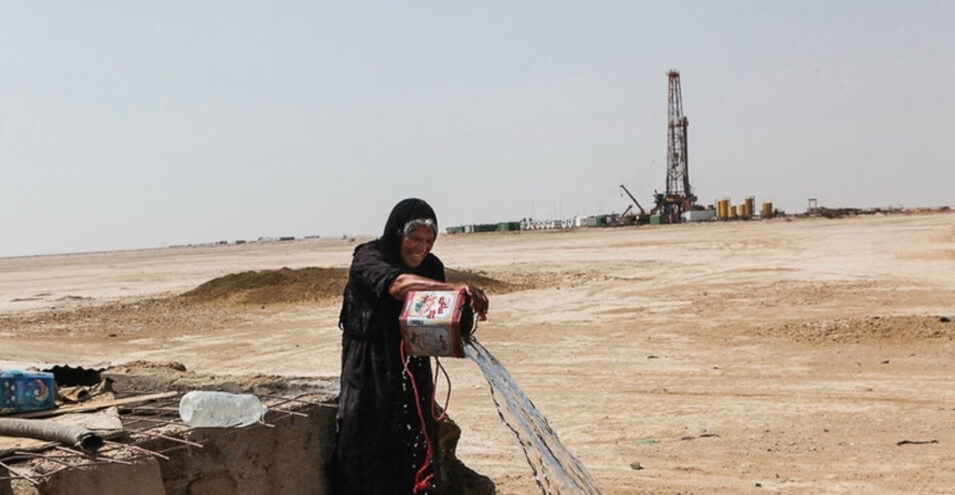
Nasser Mohdavi, head of the Transportation and Traffic Commission of Ahvaz City Council, on Wednesday, December 30th, severely criticized the officials of the Oil Ministry and Khuzestan province authorities for what he called the “plundering of Khuzestan’s capital,” and accused them of “colonialism.”
This Ahvaz city council member began his remarks at the city council session by referring to an accident involving a minibus carrying 16 oil company workers on the Ahvaz-Khorramshahr highway, in which 10 people were killed.
Nasser Mohdavi said: “The question that many will ask and will not receive an answer to is why, after all these years that oil companies and drilling firms have benefited from this connecting road, are they unwilling to fulfill even a fraction of their social responsibilities? Who really is accountable for this plundering of Khuzestan’s capital?”
He added: “The story of Khuzestan and the white-collar officials of the Oil Ministry is like a husband who neither provides financially nor is present at home. On top of that, every so often, the poor wife gets beaten as well.”
This Ahvaz city council member continued: “You might laugh at this analogy, but the reality is that when they suck the lifeblood of your land, don’t give you your share, deny you environmental pollution compensation, and on top of that, throw flares at our health and dry up the Hawizeh Marsh water for cheap extraction, what else can one say?”
Nasser Mohdavi emphasized: “Doesn’t colonialism have a face and name? Isn’t modern colonialism living next to oil pipelines while in poverty and disease? Of course, this is new colonialism and well-presented, and perhaps not so obvious, but if you look carefully, you will see that wherever their hand has reached, they have drilled wells. In Cyrus region of Ahvaz, they have drilled wells within 140 meters of people’s homes. This is a matter of violating their own environmental standards.”
He continued: “Didn’t they say and write that they dried up Hawizeh on higher orders and to welcome the Chinese, and apparently they don’t care that the lives, economy, and livelihoods of people around the marsh were plundered, and dust from other cities in the province covered everything, and cancer, disease, and forced migration became the people’s lot?”
Nasser Mohdavi emphasized: “In the closed-door meetings of those friends where the decision to dry up Hawizeh Marsh was made, wasn’t there even one person to say that a marsh has about 10 times the economic value of forests and 200 times that of agricultural land?”
It was previously reported that in order to reduce development costs for the West Karun oil fields and hand them over to Chinese companies, the Oil Ministry obtained permission from the National Security Council to dry up Hawizeh Marsh in 2010.
In this regard, a representative from Shadegan in the Islamic Consultative Assembly had previously referred to the condition of Hawizeh Marsh as “one of the most horrifying environmental disasters in history.”
Nasser Mohdavi further stated in the Ahvaz City Council: “What’s even more laughable is that sometimes they celebrate news of discovering a major oil field, while this news is like a funeral for the people of Khuzestan. These cases will bring nothing but pollution and disease to the oppressed people.”
The Ahvaz city council member, referring to the fact that “turning Khuzestan black is the common denominator of all oil ministers” in both reformist and conservative governments, said: “The white-collar, centrally-based officials benefiting from astronomical facilities and salaries in the Oil Ministry are one side of the equation, and yesterday’s and today’s officials sitting in the positions of authority in Khuzestan province are the other side.”
He added: “These individuals were never demanding accountability and only resort to empty talk and presenting statistics about non-payment of pollution fees and non-fulfillment of social responsibilities.”
People in Khuzestan have protested in recent years against officials’ negligence regarding the environmental situation in the province. Last summer, farmers in the province, who have long protested water scarcity and the transfer of water to other cities, took to demonstrations following continuous power and water cuts during hot weather.
These protests quickly spread to different cities in Khuzestan. In these demonstrations, citizens protested not only against water shortages but also chanted slogans against Khamenei, the leader of the Islamic Republic, and against the Islamic Republic system itself.
Source: Radio Farda