Second Day of Aban People’s Court; Witnesses Testify About Arson of Public Property by Security Forces
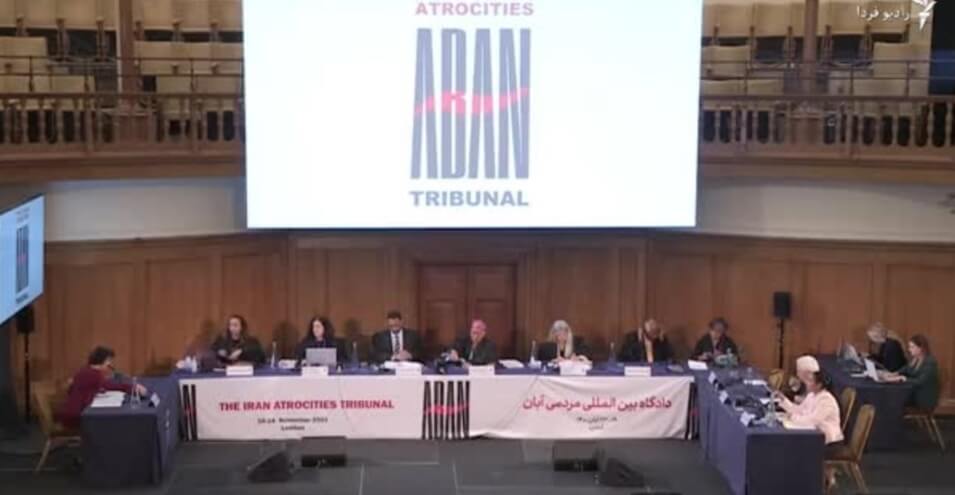
The second day of the international Aban People’s Court to examine “crimes” committed by the Iranian government in Aban 1398 was held on Thursday, November 20, 2021, in London.
The second day of this people’s court in the British capital began with testimony from Raha Bahraini, an expert at Amnesty International.
This court, organized by three organizations—”Iran Human Rights,” “Justice for Iran,” and “Together Against the Death Penalty”—will continue until November 23 and will feature 45 witnesses. According to the court organizers, written testimony from 120 people has also been submitted to the court.
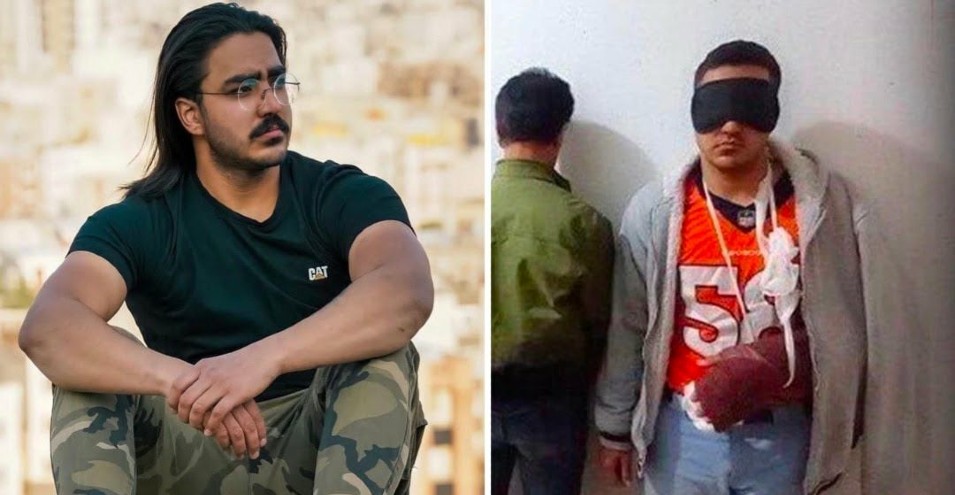
During today’s session, witness number 366, with protected identity and covered face, appeared from inside Iran to testify on camera. This witness testified that they joined the protests on November 25 and was shot directly by security forces that afternoon, an incident that resulted in spinal cord injury.
Judge Zac Jacob, a prominent anti-apartheid activist and former judge of the Constitutional Court of South Africa, questioned witness number 195 during the second session of the international Aban People’s Court about the accuracy of the claim that police forces set fires to public places and blamed the protesters for it.
In response, this witness stated that he had repeatedly witnessed police forces committing arson during the November 1398 protests.
Judge Jacob, referring to claims by Islamic Republic officials about protesters setting fire to public property, said that although fire has long been a weapon of the powerless, those in power have throughout history committed sabotage by fire to make the powerless appear responsible.
Witness 195 explained regarding the direct shooting of protesters by security forces: “When the Security Council issues an order to use live ammunition, it no longer matters under what circumstances or for what purpose a police officer fired. The weapon is only given to the officer so they can put their finger on the trigger.”
This witness also testified that on November 27, 1398, there was an explicit radio order to police officers to use live ammunition. He added: “My understanding of this order was that they wanted to suppress the protests by any means necessary.”
The second session of the international Aban People’s Court ended following the testimony of witness 195. The next court session will begin tomorrow (Friday) at 9:30 AM London time.
On Tuesday, November 18, the organizers of this court announced in a statement that this “court will examine whether crimes committed by Islamic Republic officials, including Ali Khamenei, the leader of the Islamic Republic, and Ibrahim Raisi, the current president and former head of the judiciary, in connection with the November 1398 protests, constitute crimes against humanity.”
Meanwhile, Amnesty International has played a special role in investigating the events of November 1398, because in the absence of official and reliable statistics on the number of victims of the crackdown during those protests, Amnesty International attempted to provide a documented report of these events by gathering evidence.
The organization previously stated in a statement that it has evidence showing that at least 304 men, women, and children were killed during the “ruthless” suppression of these protests by security forces.
According to this human rights organization, based on investigations it has conducted, including reviewing photos and videos related to these events, 220 victims were killed over two days.
However, Reuters reported at the time that at least 1,500 people were killed in the November 1398 protests, citing “three sources close to Khamenei’s circle” and “a fourth official” who said that the Islamic Republic’s leader told senior government officials to “do whatever is necessary to stop” the protests.
Amnesty International, on Thursday, while participating in the Aban People’s Court, expressed hope in a statement that holding this people’s court would be a “wake-up call” for all members of the United Nations.
The organization had requested in May 1399 that the United Nations investigate the killing of protesters by Islamic Republic security forces in November 1398.
The November 1398 protests, which initially were a reaction to the sudden increase in fuel prices, quickly changed direction and targeted the Islamic Republic government and Ali Khamenei at its helm.
The first session of the international Aban People’s Court to examine “crimes” committed by the Iranian government in 1398 ended on Wednesday, November 19, in London, after testimony from 32 witnesses.
The sessions of the international Aban People’s Court from November 19 to 23 are also being broadcast live through the court’s Instagram page (Abantribunal).
Source: Radio Farda