Salameh Orders Regional Revolutionary Guards: Prevent People from Traveling as Much as Possible
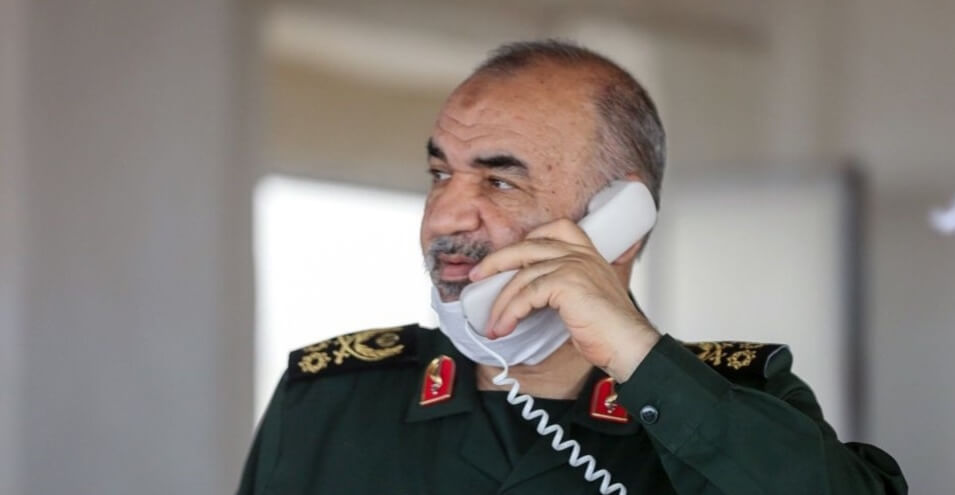
As the spread of coronavirus disease in Iran has spiraled out of control and, according to officials, with hospitals overflowing, patients in some cities are sleeping in the streets, Hossein Salami, commander-in-chief of the Islamic Revolutionary Guard Corps, said on Thursday, August 12: “We must have a fresh start in fighting coronavirus.”
Addressing commanders of provincial Revolutionary Guard units, he said they should “establish command centers in the provinces, go house-to-house, and prevent people from traveling as much as possible.”
In early Esfand 1398 (late February 2020), coinciding with the official announcement of coronavirus spread in Iran with its epicenter reported to be in the city of Qom, many clerics and citizens of that city reacted strongly against preventing travel.
Following the failure to implement quarantine in coronavirus hotspots in Iran, in Esfand 1398, Abdolkarim Hosseinzadeh, a parliament member, reported “the piling up” of coronavirus victims’ bodies in Qom, and at that time a video of numerous bodies in Qom’s mortuary was circulated on social media, but the deputy prosecutor of Qom announced that the “distributor” of this film “was arrested in the early hours.”
Hossein Salami is now announcing his order to prevent people from traveling while Hassan Rouhani, Iran’s former president, had repeatedly said: “We do not have neighborhood or city quarantine… and we must not let America layer a new virus on top of the coronavirus, a virus called the closure of social activities and extraordinary fear; this is the conspiracy we see today and you also see it in foreign propaganda.”
While in most countries of the world, following the start of coronavirus, city quarantines and restrictions were implemented by governments with planning, the Iranian government has so far not imposed serious restrictions, and government officials have only offered some recommendations to citizens, and after a while, they merely complained about people’s “inattention” to these recommendations.
The commander-in-chief of the Revolutionary Guard Corps said on Thursday that he has concluded that “the coronavirus does not die on its own, but goes through a dangerous path in the evolutionary stage. This virus increases its transmission rate over time and acts in a complex and mysterious manner. Everyone should understand that this virus cannot be left alone and one cannot wait for improvement in conditions.”
The commander’s statement about deaths from coronavirus has no scientific basis.
However, Hossein Salami’s remarks to prevent people from traveling come at a time when, despite warnings from health officials about holding Muharram ceremonies, these religious observances are set to continue this year, and Ayatollah Ali Khamenei, the leader of the Islamic Republic, also did not object to holding Muharram ceremonies on Wednesday nor recommend widespread closures in a video message.
One day later, Ghasem Meshar Movahed, deputy medical director at Nishapur University of Medical Sciences, reported a “critical coronavirus situation” in that city and “no energy remaining for medical staff,” and referring to the first ten days of Muharram and holding of ceremonies, said: “Unfortunately, despite the current critical conditions, the rate of compliance with health protocols in some ceremonies is very low.”
Based on official statistics from Iran’s Ministry of Health in recent days, new records have been set in coronavirus cases in the country, with daily death toll exceeding 500 and the number of new cases per day reaching over 40,000.
These statistics are being published daily while the Medical System Organization had previously stated that the actual number of coronavirus cases in the country was three to four times the official announced figures.
Alirezа Zali, head of Tehran’s coronavirus response headquarters, also reported on Wednesday, August 20, of “concealment” by officials in presenting true figures of coronavirus deaths in the country to the World Health Organization.
He also said: “They did not allow us to buy vaccines because they thought it was expensive.”
Source: Radio Farda