Amirabdollahian: We Consulted with Lavrov on Vienna Negotiations
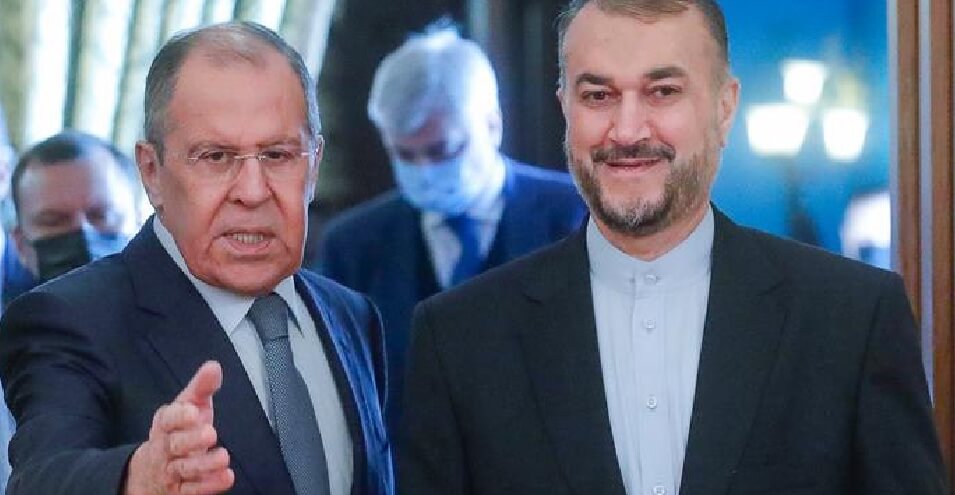
Iran’s foreign minister says he consulted with his Russian counterpart about returning to talks on reviving the JCPOA in Vienna. He added that Lavrov emphasized that the director general of the International Atomic Energy Agency should “make more visits to Iran”.
Hossein Amirabdollahian arrived in Moscow on Tuesday evening at the head of a delegation and on Wednesday afternoon, October 5, participated in a joint press conference after holding talks with his Russian counterpart Sergey Lavrov.
The negotiations of the JCPOA Joint Commission were one of the main topics of the Moscow talks. These negotiations began in early 2021 in Vienna and six rounds were completed during Hassan Rouhani’s administration. With the announcement of Ibrahim Raisi’s victory in the thirteenth presidential election, the continuation of negotiations remained uncertain.
Consultation with Lavrov
According to FARS news agency, Iran’s foreign minister said about Iran’s return to Vienna negotiations: “We consulted with Lavrov on this matter and emphasized that after concluding our reviews, we will soon resume the Vienna talks.”
In these negotiations, representatives of the Islamic Republic and the remaining five parties to the nuclear agreement participate, and American representatives are participating indirectly for the first time since that country’s withdrawal from the agreement in May 2018.
The thirteenth government’s Foreign Ministry has repeatedly stated it will “soon” return to Vienna talks but has not announced a specific date.
Amirabdollahian said at the press conference in Moscow that the process of reviewing six rounds of Vienna talks in the new Iranian government is nearing completion and finalization, and Vienna talks will soon resume.
Saeid Khatibzadeh, spokesman for the Islamic Republic’s Foreign Ministry, said on Monday that Vienna negotiations could resume in November.
Iran, in continuing to reduce its commitments under the Joint Comprehensive Plan of Action (JCPOA), created restrictions on the work of International Atomic Energy Agency inspectors, part of which was resolved by a visit to Tehran by IAEA Director General Rafael Grossi.
Lavrov’s Emphasis, Iran’s Compliance
Iran’s foreign minister says his Russian counterpart “emphasized” during Moscow talks that Grossi should visit Iran more frequently. He added: “Whenever Grossi decides to travel to Iran to follow up on his technical issues within the framework of existing regulations, we will welcome it.”
Another issue discussed in talks between Iran and Russia’s foreign ministers was recent tensions between the Islamic Republic and the Republic of Azerbaijan.
Tehran accuses Baku of actually changing border lines following last year’s clashes in Nagorno-Karabakh and the occupation of parts of that region by establishing a corridor connecting Azerbaijan to Nakhchivan, and blocking direct land communication between the Islamic Republic and Armenia.
The Islamic Republic expects Russia to use its influence over the Republic of Azerbaijan and respond to developments in the South Caucasus.
South Caucasus, Expressing Concerns to Lavrov
Amirabdollahian said at the joint press conference with his Russian counterpart: “We have concerns about the South Caucasus region and shared our concerns with Mr. Lavrov. We believe the region cannot tolerate new encroachments. Our approach to all neighbors is one of friendship, brotherhood, good neighborliness and development of cooperation and relations.”
Raisi government’s foreign minister emphasized that Iran “under no circumstances” accepts geographical changes and map alterations in the Caucasus region and remains “seriously concerned” about the presence of Israeli and terrorist forces in the region.
The presence of Israeli forces in the Republic of Azerbaijan and near Iran’s borders is an issue that this country’s senior political and military officials have repeatedly raised and faced harsh reactions from Baku.
Ilham Aliyev, president of the Republic of Azerbaijan, has on several occasions explicitly or indirectly rejected Iran’s claims about the presence of Israeli forces near its borders.
The reference to the presence of terrorists apparently relates to groups of Syrian paramilitary forces that Turkey is said to have brought into the region to help Baku in the Nagorno-Karabakh war.
Russia, Turkey, and the Republic of Azerbaijan have closer positions on South Caucasus issues and have held several joint exercises in the region so far.
Iran Does Not “Feel Good” About Regional Exercises
The Islamic Republic’s army ground forces recently held an exercise in the northwest of the country near the borders of the Republic of Azerbaijan, which faced a reaction from Baku.
This exercise was also raised in talks between Iran and Russia’s foreign ministers. Amirabdollahian said about this: “Mr. Lavrov referred to military maneuvers in the South Caucasus region, and I should say that 6 maneuvers were conducted by the Republic of Azerbaijan jointly with some countries, which in my view was a provocative action in the region. This decision is up to each country, but the concentration of these maneuvers does not create a good feeling in the region.”
Thirteenth government’s foreign minister says it was agreed in Moscow talks that “in the near future a strategic cooperation document between the two countries would be reviewed in written form” and this document would serve as the basis for long-term cooperation.
The Islamic Republic describes its relations with Russia as strategic, but the volume of trade between the two countries is very small and Moscow has not always been a reliable partner of Tehran on political issues.
Amirabdollahian says Iran and Russia have considerable capacities, but there is a “long way” ahead for developing relations in the trade and economic sphere, and for us to “witness a leap in relations,” obstacles to such a leap must be identified.
Source: DW