Khamenei: Not participating in elections means distancing from the Islamic Republic
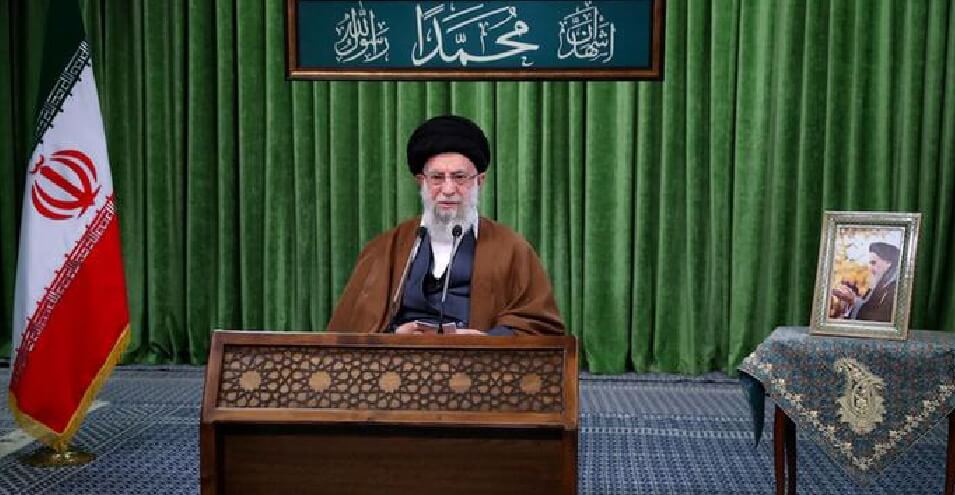
The leader of the Islamic Republic referenced Qasem Soleimani in his speech on the occasion of the presidential election. He said that not participating in the elections means people distancing themselves from the Islamic Republic.
Ayatollah Ali Khamenei said on Wednesday, June 16 (June 26 in the Persian calendar) in a televised address that the failure of people to participate in the presidential election on June 28 means the nation distancing itself from the Islamic system.
Poll conducted show that only 40 percent of eligible voters will participate in Friday’s election. In this case, this election would be the presidential election with the lowest turnout in Iran’s history.
Khamenei drew a correlation between participating in elections and increased pressure on people, which ignores the government’s role in creating the current economic and social turmoil. He said: “If we see a decrease in people’s presence, on the other hand we will face an increase in enemy pressures.”
The 82-year-old politician referenced sanctions in this regard, part of which is due to Iran’s nuclear program and another part due to other reasons including human rights violations by the Islamic Republic and support for groups on terrorist lists.
Regarding the economic pressures on the Iranian people, Khamenei made no reference to billions in domestic embezzlement, rent-seeking, and the presence of petty and major thieves who are connected to circles of power.
Creating fear instead of motivation
Khamenei accused opponents of the Islamic Republic of “mentally undermining people against elections” and warned the people that if they boycott ballot boxes, those who “seek to weaken the system” will make Iran “suffer from insecurity and terrorism.”
The most powerful figure in the Islamic Republic referenced Qasem Soleimani to encourage people to participate in the elections. He compared the elections to the funeral procession of Soleimani and said it is good for people to view the elections “beyond political preferences.”
At the funeral procession of Qasem Soleimani, the slain commander of the Quds Force, various segments including prominent reformist figures participated.
Khamenei speaks of rising above political preferences while the Guardian Council under his command eliminates all political preferences other than the “leader’s line” from the arena of political competition through its vetting authority.
The difference between the Islamic Republic and a real republic
Ali Khamenei further explained that “in the Islamic Republic, republic is one part and Islamic is another part” and if people stay home on election day, “the Islamic Republic will not be realized.”
Many observers and political analysts consider the republican aspect of Iran’s system to be very faint or even non-existent because not only are free and fair elections held with the participation of all preferences and groups, but individual and social freedoms, freedom of parties and freedom of media are also disregarded in this system of governance.
In Iran, individual and social freedoms are defined based on religious law and the interpretation of religious leaders. Moreover, the government, which represents the majority of voters, cannot make decisions independently or with the help of parliament in general policies, especially in foreign policy, but must obtain the approval of the system’s leader.
“The presence of people is blessed”
Khamenei went on to talk about the “blessing” and “political benefits” of people’s presence but did not say what these blessings and benefits are and who will receive them.
The leader of the Islamic Republic only contented himself with being “aware of people’s grievances, especially the deprived classes, about not addressing their livelihood problems” and considers the grievances legitimate but did not explain why no action has been taken to resolve them so far.
He asked people to solve the problems “by choosing a strong, hardworking, powerful and tireless individual.” This is while according to the principle of absolute guardianship of the jurist in the Islamic Republic’s constitution, no individual is more powerful than him.
Source: DW