Iran Announces Design of Advanced Fuel Type for Tehran Research Reactor
Iran’s permanent representative to international organizations in Vienna announced the beginning of the design of an advanced fuel type for the Tehran research reactor and stated that all stages of this program have been reported to the International Atomic Energy Agency.
Kazem Gharibabadi, Iran’s permanent representative to international organizations in Vienna, announced on Wednesday, December 15, that the design of an advanced fuel type for the Tehran research reactor has begun. According to IRNA, the director general of the International Atomic Energy Agency informed member states of this matter through a report. According to Kazem Gharibabadi, Iran’s activities in this field are carried out in three stages, and in the first stage, metallic uranium is produced using natural uranium.
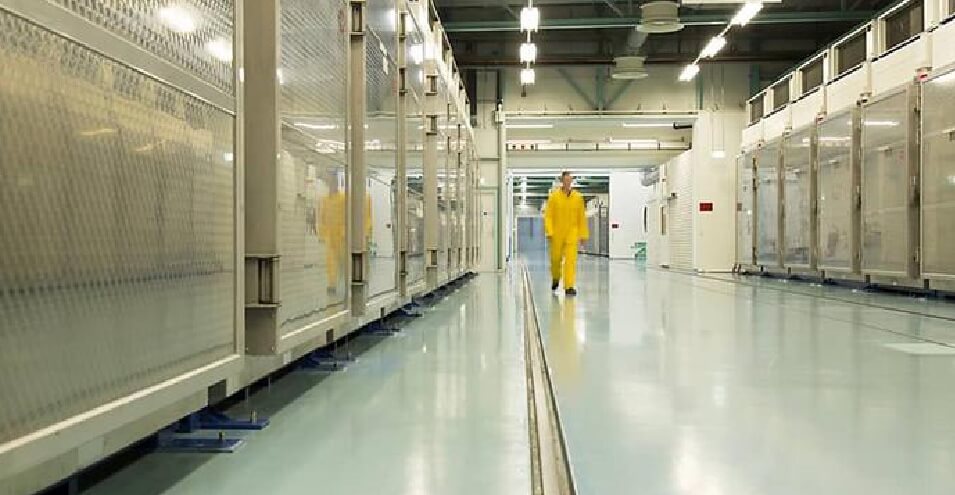
Speaking to journalists, he said: “All these stages have been and are being reported to the Agency, and the Agency’s inspectors also visited the fuel plate manufacturing plant three days ago.” Kazem Gharibabadi claimed: “Technically, this measure will place Iran among leading countries in the production of new fuels.”
Following the United States’ withdrawal from the JCPOA, the Islamic Republic has gradually expanded its nuclear activities and sought not only to counter America but also to pressure the European Union to confront American sanctions. Iran’s deviation from JCPOA commitments has accelerated in recent months, to the point where Ali Rabiei, Iran’s government spokesperson, announced on Monday, December 6, that the gas injection process has begun at the Fordow facility and Iran’s first enriched uranium product is being produced.
He also told IRNA that the 20 percent uranium enrichment process was carried out following notification to the International Atomic Energy Agency.
The Islamic Republic has brought uranium enrichment to the 20 percent level and to the level prior to the nuclear agreement and the implementation of the Comprehensive Joint Plan of Action (JCPOA). A measure that is highly concerning for the 27 member countries of the European Union. They have assessed 20 percent uranium enrichment at the underground Fordow facility as a serious step in developing the Islamic Republic’s nuclear programs and called for its immediate cessation.
Iran’s action even concerned countries like China and Japan, with China calling for restraint by both sides. Last week, a Chinese Foreign Ministry spokesperson also said that Iran’s nuclear issue is at a “sensitive stage” and is “extremely complicated.” Russia’s representative to the Agency also said after the news was released that Moscow is not particularly “pleased” with Iran’s action.
The European Union has called on the Islamic Republic to give an opportunity to diplomatic processes to resolve disputes rather than expanding nuclear activities. This comes as Iran’s Parliament in December and through a rapid process examined and approved a “strategic action plan to lift sanctions and protect the interests of the Iranian nation” and passed it by the Guardian Council. A law that requires the government to suspend all monitoring beyond the JCPOA, including the voluntary implementation of the Additional Protocol, if within two months after its implementation in parliament “in case of non-complete fulfillment of commitments by the 4+1 countries to Iran and non-normalization of complete banking relations and non-complete removal of obstacles to exports and complete sale of Iranian oil and oil derivatives and complete and rapid return of currency from the proceeds of sales.”
Source: DW