Student Day Parade on Rooftops of Homes
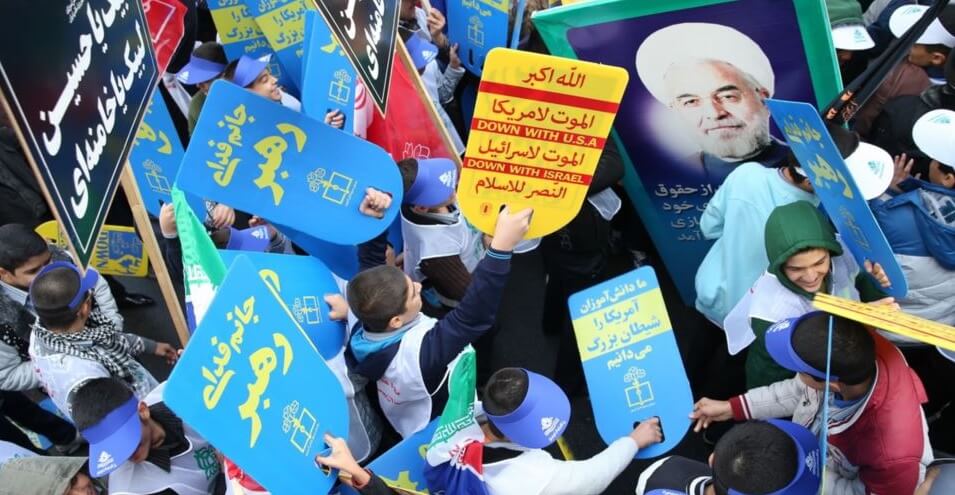
It is the year of coronavirus, and students’ education and schooling have been affected by the pandemic. In most countries of the world, the health of students and teachers has been prioritized over attendance at school and learning.
Nevertheless, the deputy head of Iran’s Basij student organization says that on the eighth of Aban month—if conditions permit—students will be gathered at Behesht-e Zahra cemetery next to the memorial of Hossein Fahmideh, and with adherence to health protocols, the memory of 36,000 student martyrs will be honored.
First, I ask Saeid Pivoandeh, an educational sociologist, whether the existence of what the Basij student organization calls “student martyrs” in a country’s educational institution is a matter of commemoration and remembrance, or an open violation of children’s rights? Mr. Pivoandeh says:
“I think everyone who has followed Iranian educational news over the past three or four years was aware of Supreme Leader Khamenei’s and his associates’ strong opposition to UNESCO’s 2030 document. Because this document included criticism of countries that in some way use children in military affairs, provide them military education, and involve them in military matters in any case. Iran is one of those systems that UNESCO is addressing. A system that in the distant past did this extensively and in recent years has tried to maintain this military and warlike atmosphere in Iranian schools, especially in high schools. This is a policy that is in complete contradiction with international conventions on children’s rights.”
The Convention on the Rights of the Child has prohibited any participation of children in war, although during the Iran-Iraq War, Iran was not yet a signatory to this convention. Pegah Banihashemi, a human rights lawyer, discusses international laws in this field:
“In the 1970s, the international community began thinking about working on treaties to prohibit the use of children in wars. The Convention on the Rights of the Child was adopted by the international community, and in Article 38 it specifically discusses that political groups should not use persons under 15 years of age in war. Later, in the Optional Protocol on the involvement of children in armed conflict, parties to conflicts were asked not to allow persons under 18 years of age to participate in war.
This protocol defines any person under 18 years as a child and calls for comprehensive protection by states and governments of persons under 18 years.”
However, holding memorial celebrations for child soldiers whose lives were taken by an adult war and promoting war and student participation in war are issues that Saeid Pivoandeh, an educational sociologist, says probably exist only in Iran’s education system:
“We have very few countries that probably consider such programs for their students. Programs that have a military dimension and discuss war and conflict with other countries and the use of weapons and military equipment.
This remains active in Iran with the presence of the government’s military sector [in the education institution], and its very negative impact on society and the culture of young people is that we want to raise a generation that, instead of learning peace and friendship with other countries and learning peaceful coexistence within and outside the country, is trained in a culture of warfare and enmity with others.
It can be said with certainty that this volume of hostile and military programs is unprecedented in the world, and Iran may be the only country that implements such programs for students in schools.”
The deputy head of the Basij student organization, in his press conference, called child soldiers “small brave men” who, according to him, can be models for today’s student generation. Furthermore, according to this official, on the occasion of the Basij student week, a book containing lessons from the school of Hajj Qasem has also been designed and is in the process of compilation!
Simultaneously, competitions beyond the normal curriculum have been planned. Competitions such as “essay writing on the topic ‘Why Death to America?’,” video messages to American soldiers on the topic of their withdrawal from the region and severe revenge for the blood of martyr Hajj Qasem Soleimani, and also painting on the topic of anti-arrogance and depicting American crimes! Saeid Pivoandeh emphasizes:
“Everywhere in the world, extracurricular programs are devoted to sports and recreational programs or collective activities in the field of environmental protection or similar activities. In Iran, we have 166 educational programs that are imposed on students outside the course content in a year, the majority of which are political, ideological, and religious, which not only have no relation to children’s age, spirit, and needs, but even their effectiveness and impact on children are questionable—what kind of impact do these types of programs generally have on children, and to what extent has the government been able to impose its ideology on the young generation?”
This is where Pegah Banihashemi, a human rights lawyer, emphasizes that the issue is not just about not involving children in war. Even exposing them to war and ideological propaganda is prohibited:
“It is not limited to the use of children in war. The use of children even in propaganda related to war, such as cases where we use children to promote warfare, is also [included in this prohibition]. We see that, regrettably, in the Iran-Iraq War, many of those who were martyred or returned and faced very serious problems were persons under 18 years of age, and they were even used at very young ages of 13 and 14.
As a human rights lawyer, I believe that just as we mention in financial transactions and even in non-financial contracts that a person must have legal capacity, persons under 18 years of age also do not have the necessary capacity to participate in war. I even find the lack of capacity, intent, and consent in children under 18 years to such an extent that even parental permission cannot be appropriate for them to want to go to war and put themselves in danger.
Because sometimes individuals become victims of their parents’ beliefs. It is possible that a child under 18 years who is present in the scene of war may later think to themselves that this was an emotional matter and a matter about which I did not have enough knowledge, and I became a victim of my parents’ wishes or a victim of their encouragement.”
Apart from all this, in the midst of the coronavirus crisis, is holding a ceremony of this kind not a threat to the health of students and teachers? Saeid Pivoandeh answers:
“In a situation where coronavirus in Iran, like in some other countries, has reached such heights, instead of moving towards limiting communications and securing educational spaces and social environments, we are actually exacerbating the crisis of this epidemic with such programs, and despite all the promises made about adhering to protocols, we know in practice that such a thing does not really exist in Iran, and this type of initiative can even worsen Iran’s health situation.”
The deputy head of the Basij student organization has announced that this year’s gathering on the 13th of Aban will not be held and has asked students to film themselves at 9 AM on the 13th of Aban in public spaces such as on the rooftops of homes, in the neighborhood yard, and loudly say “Death to America.” He said that if students are creative, they will make American flags and, according to him, the Zionist regime and burn them, and thus add points to their credit!
One should hope that playing with fire does not endanger the health of students and their families.
Source: Radio Farda