Palace of Ardashir Babakan Not Spared from Floods
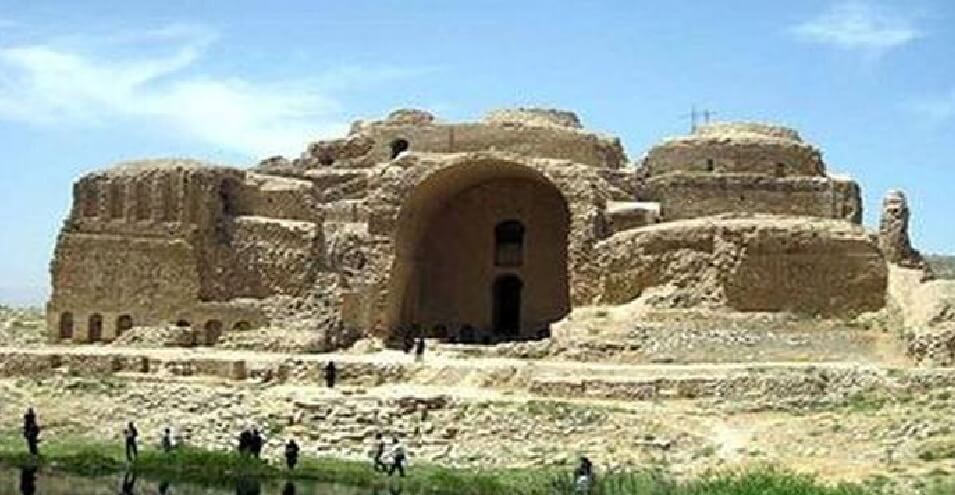
As rainfall continues in mainly southern Iranian provinces and floods spread, the historical Palace of Ardashir Babakan in Firuzabad city of Fars Province faces the threat of water inundation. So far, 9 people have lost their lives due to the floods.
Recent rainfall in mainly southern Iranian provinces has caused floods and inundated homes and streets. According to the spokesperson of Iran’s Emergency Organization, six people have died in Hormozgan Province, two in Bushehr Province, and one in Gilan Province due to the floods.
However, the Crisis Management Director of Gilan Province stated that no flooding has occurred in the province, and only due to heavy rainfall, the water level of rivers has risen. Despite warnings against approaching river boundaries, a car fell into the river and its driver drowned.
According to him, “this accident occurred due to the driver’s negligence and positioning the vehicle on a steep slope toward a swollen river.”
The head of the Red Crescent Society’s Relief and Rescue Organization stated that 19 provinces have been “affected by weather disasters,” which include: East and West Azerbaijan, Isfahan, Bushehr, Tehran, South Khorasan, Zanjan, Sistan and Baluchestan, Fars, Qazvin, Qom, Kerman, Golestan, Hormozgan, Gilan, Mazandaran, Central, Hamadan, and Yazd provinces.
Damage to Ancient Monuments
BaharNews reported that part of the walls surrounding the Palace of Ardashir Babakan in Firuzabad, Fars has been damaged due to water inundation.
Based on this report and citing videos of the destruction of this fortress’s walls published by several domestic news agencies, “the possibility of mismanagement in timely cleanup and neglect of the natural water drainage route in this complex” has been strengthened.
The Palace of Ardashir Babakan was built by Ardashir himself, the founder of the Sassanid dynasty, in the third century AD.
Last year, rainfall and water flow also caused damage to “Naqsh-e Rostam.”
IRNA also reported, citing the mayor of Firuzabad village in Abarkuh city of Yazd Province, the destruction of 70 percent of Firuzabad Residential Fortress. This fortress was one of the tourist attractions of Firuzabad village, and 23 families also lived in it.
This historic fortress belongs to the Qajar period and is located northwest of Abarkuh.
Who is Responsible?
Every time floods occur and cause extensive material and human losses, relevant agencies scramble to shift blame from their own shoulders to another institution.
This time, the Deputy Minister of Energy and CEO of the Water Resources Management Company, in an interview with IRNA, defending the “indiscriminate dam construction” policy that has been repeatedly criticized by environmental activists, considered the existence of these dams as a barrier to flooding and said: “If the Karun, Dez, Karkheh, and Simarre dams did not exist, it was unclear what would have happened, but fortunately these dams played their role very well in flood management.”
Qasem Taghizadeh Khamesi considered the main problem of cities in Khuzestan Province to be their wastewater network and said: “The issue of surface water and wastewater should be viewed separately. The implementation of the wastewater network is the responsibility of the Ministry of Energy, and the collection of surface water is the responsibility of municipalities. In cities where there is no surface water collection plan, the wastewater network loses its efficiency even with slight rainfall when water enters the sewage pipes.”
According to the Deputy Minister of Energy, the main problem in southern cities such as Ahvaz and Abadan is surface water, and this problem must be solved first. He said: “Given that streets in Ahvaz have no slope and no surface water collection system has been installed, water accumulates in the wastewater system, causing sewage pipes to break and water and sewage to accumulate in the streets.”
The problem of Ahvaz’s wastewater system and other cities in Khuzestan Province has been a matter of discussion and debate for years, and recently the case has been brought to the Supreme Audit Court of the country.
The head of this organization said on Tuesday, December 18: “The condition of the wastewater network in the province is very deplorable, which was mentioned to provincial officials in today’s session. According to the report of provincial officials, the plan to improve Ahvaz and Karun wastewater was launched in 2006, but unfortunately, we have only achieved 40 percent progress to date.”
Hasan Darvishian also mentioned the need to review this plan due to climate changes that have occurred over the past 15 years.
Source: DW