Conflicting Reports About Imminent Execution of Mohammad Reza Hadadi
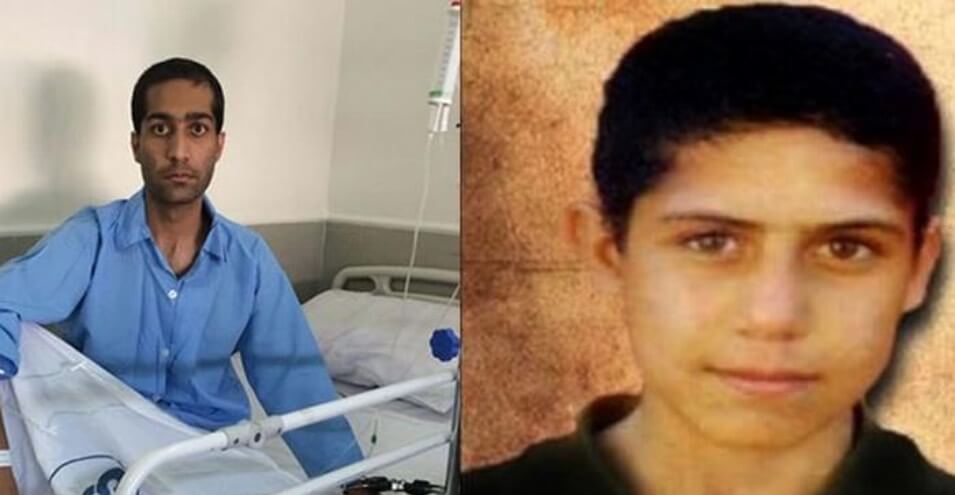
Mohammad Reza Hadadi’s father has reported that his son faces imminent execution. Amnesty International and Hadadi’s lawyer, in conversations with Deutsche Welle, believe that after 17 years of imprisonment, Hadadi’s case remains open and they consider execution unlikely.
Mohammad Reza Hadadi’s father said on Monday, August 27 (August 17), in contact with Deutsche Welle: “My son called me from prison and said he will be executed on Wednesday, August 29 (August 19), and we will be able to visit him for a farewell meeting”.
Mohammad Reza Hadadi is imprisoned in Adel Abad Prison in Shiraz. He is accused of committing murder during a theft in 2003. Hadadi was 15 years old at that time.
Mohammad Reza Hadadi wrote in a letter on Monday, August 27 (August 17) to the head of the judiciary that at age 15, he was “unjustly charged with premeditated murder as a result of immaturity, inexperience, and under the influence of economic hardship and lack of knowledge of laws”.
In part of his letter, he emphasized that after obtaining documents, evidence, and proof of his innocence, he sought “recourse through the Supreme Court according to law, but due to interference, reached nowhere and the efforts proved futile”.
Hadadi further stated in his letter that he has submitted audio and video conversations and notarized letters from defendants in the case who had suffered from guilt and confessed to the truth, “but hidden hands have cast shadows over his case”.
At the end of his letter, he urged the head of the judiciary to intervene in his case, writing “Before the unjust execution of Qisas, you, the head of the judiciary, personally intervene”.
According to Iranian criminal law, a death sentence can be annulled with the consent of the victim’s heirs, but Hadadi’s efforts over the past 17 years to obtain the murdered victim’s family’s consent have been unsuccessful.
Given the young age of the accused (15 years old at the time of the crime), news related to Hadadi’s case has been raised beyond Iran’s borders, and international organizations, including the United Nations and Amnesty International, have repeatedly urged Iranian authorities to revoke his death sentence.
Raha Bahraini, a lawyer and researcher at Amnesty International working on Iran issues, said to Deutsche Welle regarding the possibility of executing Hadadi’s imminent death sentence: “As far as we know, Mohammad Reza Hadadi is not in imminent danger of execution. Nevertheless, this young man has been under a death sentence for 17 years in connection with a crime he committed when he was under 18 years old, and this represents the peak of cruelty of the criminal justice system for children and juveniles in the Islamic Republic of Iran.”
What does Hadadi’s lawyer say?
Hossein Ahmadi Niaz, Mohammad Reza Hadadi’s lawyer, also told Deutsche Welle that he succeeded in halting the execution of his client’s death sentence in 2017 through the head of the judiciary at that time.
According to this lawyer, the medical examiner of Fars Province announced that based on scientific medical examinations of Mohammad Reza Hadadi, they concluded that at the time of his minority “he lacked rationality and understanding of the importance of confessing to murder”.
Despite this, Hadadi was sentenced to death. What is the reason?
Ahmadi Niaz says: “Unfortunately, out of the panel of judges in this branch, only one judge, based on the medical examiner’s opinion in the form of a dissenting opinion, ruled in favor of overturning the death sentence, while two other judges, based on the judge’s knowledge, ruled to uphold the death sentence, which will again be appealed to the Supreme Court, and is currently being reviewed in one of the branches of the Supreme Court.”
According to Mr. Ahmadi Niaz, according to Article 477 of the Code of Criminal Procedure, one of Iran’s sources of emulation has also been asked for a religious ruling.
Hadadi’s lawyer continued to tell Deutsche Welle that his case, at the order of the chief judge, was referred to a team of judges in Fars Province for review and assessment, and this case is under review, and the execution of the death sentence is not valid. With today’s efforts by the legal team of the case, Adel Abad Prison in Shiraz, the Fars Judiciary, and the Kazerun Prosecutor’s Office completely deny this news and it is baseless.
According to international commitments related to the Convention on the Rights of the Child, issuing and executing the death penalty for those who were under 18 years old at the time of the crime is absolutely prohibited. Iran is among the last countries in the world that continues to issue sentences for juveniles.
Source: DW