“They Targeted My Son’s Head with Bullets”: Report on Widespread Killing of Protesters in November 2019
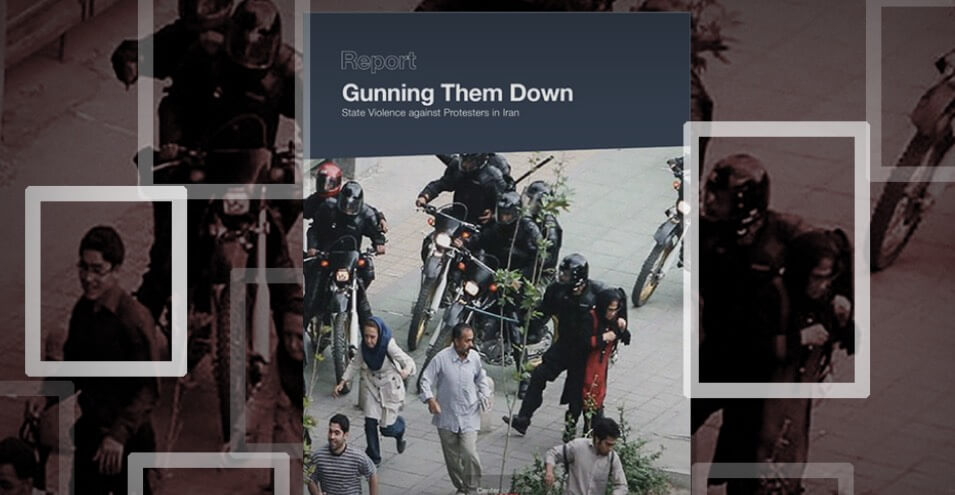
A new report released today by the Iran Human Rights Campaign depicts the Iranian government’s widespread violence against protesters during the severe unrest in November and December 2019.
The 66-page report in English titled “Shots Fired and Protesters Killed: Government Violence Against Demonstrators in Iran,” provides readers with dozens of first-hand accounts from witnesses, families of the killed, and lawyers of detainees. The report details in considerable specificity the extensive firing of ammunition by state forces at unarmed civilian populations, which in less than a week resulted in the killing of hundreds of people including women, children, and bystanders, as well as thousands of arrests.
Download the Full Report (English) Here
Hadi Ghaemi, Executive Director of the Iran Human Rights Campaign, stated: “The shocking testimonies in this report about the deaths of women, bystanders, and children by security forces demonstrate that the state has completely abandoned any pretense of rule of law, and in response to the people and public discontent, resorts to weapons and widespread killing.”
“Shots Fired and Protesters Killed: Government Violence Against Demonstrators in Iran” covers two periods of unrest: the November 2019 protests triggered by an increase in fuel prices, and the December 2019 protests that intensified following the Islamic Revolutionary Guard Corps’ admission of shooting down a Ukrainian passenger plane on December 8, 2019. Both periods of protest reflected fundamental public anger over declining economic conditions, mismanagement, corruption, and political repression.
No measures have been taken to clarify the responsibility of the Iranian government and state regarding the killing and reckless violence. A nationwide internet shutdown lasting one week by the Iranian government and news censorship meant this violence occurred without public and media oversight, and the government has not yet released any official statistics on the actual number of dead, wounded, arrested, and those held in detention.
Consequently, the testimony of survivors and witnesses is of particular importance, and the report “Shots Fired and Protesters Killed: Government Violence Against Demonstrators in Iran” provides comprehensive documentation of these accounts.
Hadi Ghaemi also said: “The international community should not only condemn the suppression of citizens’ rights and their killing by the Iranian government, but should also demand an independent investigation into the government’s actions during these protests.”
Summary of the Report “Shots Fired and Protesters Killed: Government Violence Against Demonstrators in Iran”
In November 2019, mass street protests began in hundreds of cities and villages across Iran. The demonstrations that month initially began with a government-imposed fuel price increase and subsequently intensified mainly due to increased social deprivation resulting from deteriorating economic conditions, government mismanagement, corruption, and political repression in the country.
Government and state violence in response, including reckless shooting at unarmed civilian populations that left at least 304 dead (through a high number of shootings to the head, neck, and chest, intended to cause fatal injuries), injuries and wounds from weapons, tear gas, and beatings, more than 7,000 arrests in less than a week, all demonstrated a level of state violence not seen in Iran since 1988. Furthermore, the nationwide internet shutdown by the government lasting one week and news censorship allowed this violence to occur without public scrutiny.
Protests recurred less than two months later in December 2019. This unrest stemmed from public anger at the Islamic Revolutionary Guard Corps, which targeted a Ukrainian passenger plane on December 8, 2019 of that year. In this crash, 176 people were killed, and the government only admitted to intentionally downing the plane three days after initially denying it. Given that these demonstrations occurred just days after the beating and killing of 56 people at a chaotic funeral ceremony for Qassem Soleimani on December 7, this reflected public outrage at government incompetence and lack of transparency.
The December protests were also suppressed through mass arrests and government violence including attacks on protesters using unidentified weapons, beatings by security officers, and the use of tear gas and water cannons.
The November and December 2019 protests essentially followed the December 2015 unrest, which was markedly different from previous protests in the country. Until that point, public demonstrations had been a persistent feature of the Islamic Republic’s political landscape. However, despite the government’s intolerance of protests and the constant danger of state violence, arrest, and imprisonment, protests have continued. This includes student protests including major demonstrations at universities across the country in 1999 and 2003; as well as public gatherings by citizens and the Green Movement protesting the 2009 presidential election results; by women (and men) against mandatory hijab; and by steel workers, teachers, heavy machinery workers, bus and truck drivers, railway workers, nurses, sugar cane workers (Haft Tappeh), bazaar merchants, petrochemical workers, farmers, and many successive labor sector protests over several decades.
Nevertheless, the unrest that began in December 2015 was fundamentally different from previous demonstrations; these protests were scattered, unorganized, and lacked management, with less focus on organized protests. The number of participants in these protests grew rapidly, covering hundreds of cities and villages across the country. The demonstrations aimed to express fundamental opposition to the country’s economic and political system and to express anger at economic hardships and inequalities. It is worth noting that this occurred mainly in working-class residential areas in provinces that were previously strongholds of support for the Islamic Republic, and included many young men and women who had left their small drought-stricken towns for larger cities and become unemployed.
This unrest continued until December 2015 when it faced government suppression including mass arrests and widespread beatings of protesters and prisoners by security officers and a short-term internet access cutoff (approximately 30 minutes) that at that time seemed to have somewhat calmed the situation. However, scattered protests continued throughout 2015; including by farmers protesting water shortages in that summer in areas facing drought and environmental mismanagement, and by workers protesting unpaid monthly wages and arrest of their leaders; as well as protests by bazaar merchants in September 2016 that led to bazaar closures.
In this report, the Iran Human Rights Campaign has documented in detail the government’s response to these two recent series of protests, namely the November and December 2019 protests, both of which were accompanied by deadly state violence, mass arrests and detentions, obvious government lawbreaking, media censorship, and prolonged internet shutdown.
Furthermore, extensive reports from first-hand sources have been documented in this report by the Iran Human Rights Campaign showing that official authorities have refused to notify families of detainees, the wounded, and the dead, and have refused to hand over bodies to families until either families have paid money to the government or have committed formally to remaining silent to the media, not holding funeral ceremonies, and secret burial in government-approved cemeteries.
Lack of transparency by officials and lack of independent investigations means that certainty about the number of dead, accurate statistics of the wounded (except verified figures and reports from hospitals that were flooded with the wounded), as well as the actual number of those arrested and the conditions and status of detainees’ cases remains impossible.
Moreover, no accountability has yet taken place regarding the dead and wounded of the protests. Even in cases where verified reports indicate that unarmed people were pursued by security forces, came under fire, and were killed, no independent investigation has been conducted and no steps have been taken to ensure accountability.
The Iran Human Rights Campaign compiled this report based on dozens of first-hand accounts as well as interviews with witnesses, victims, their families and lawyers, and images and videos verified by witnesses in Iran between November 15, 2019 and December 2019. The report also relies on the Campaign’s secondary research, including extensive media review in the country, review of statements by the Iranian government, statements and decisions of Parliament and judicial rulings, statements and assessments by the United Nations, and credible and verified reports by other human rights organizations to substantiate sources and findings.
Conclusion
Governmental corruption and suppression of opposition and peaceful popular protests in the Islamic Republic has a long history. However, the widespread killing of hundreds of protesting and unarmed people in less than a week demonstrates government violence on a large scale not seen since the Iranian government’s 1988 order to kill thousands of prisoners. The government and state’s violence against protesters occurred so quickly, without delay, and with severe anger that this not only indicates the limited space for political opposition in Iran, but also demonstrates the state’s fear of the people and public discontent. This level of government violence, accompanied by increased intensity of mass protests, demonstrates the vast gap between the government and society in the Islamic Republic.
It is necessary that the international community, including the United Nations and its human rights bodies, international institutions such as the European Union, and governments around the world, demand accountability of Iranian officials for the Iranian government’s extreme and unlawful use of widespread violence against protests in the country, as well as for the widespread violation of the right to life, the right to protest, and the right to peaceful collective demonstration, prohibition of arbitrary arrest and detention, and the right to fair trial proceedings.
It is essential that the international community pressure Iranian officials to allow independent investigation and examination of government actions and demand their accountability for their illegal actions. The Iranian people have been subjected to severe and unlawful state violence resulting in the loss of hundreds of lives. At minimum, there has been no accountability for this issue to date. This openly gives the Iranian government the ability to easily resort to violence against unarmed protesting civilians in the future and increases the likelihood and even severity of future government confrontations with people in Iran.
Source: Iran Human Rights Campaign