UN Nuclear Agency Chief Expresses Concern Over Iran’s Lack of Full Cooperation
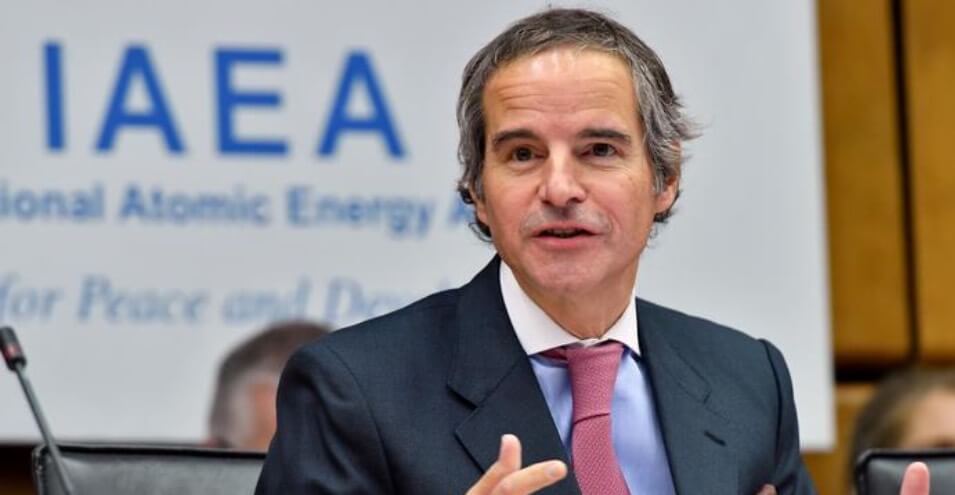
At the ongoing Board of Governors meeting of the International Atomic Energy Agency, the agency’s director general expressed serious concern about Iran’s denial of access to two nuclear sites and called for immediate and complete cooperation from the country with the agency.
The meeting of member states of the Board of Governors of the International Atomic Energy Agency, which is being held virtually this time due to the coronavirus outbreak, began today Monday (June 15/June 26) with remarks by Rafael Mariano Grossi, the agency’s director general.
Rafael Grossi expressed his “serious concerns” in part of his opening statement to today’s Board of Governors meeting on two issues; that Iran “has not provided access to two locations for more than four months and for almost a year has not participated in fundamental negotiations to answer our questions regarding possible undeclared nuclear materials and nuclear activities.”
Grossi called on Iran to cooperate fully and immediately with the agency.
Grossi will hold a press conference today at 12:15 local time on various topics including the matter of Iran.
The Agency Should Not Engage in Baseless Marginalization
While the IAEA Board of Governors meeting is underway, Abbas Mousavi, spokesman for Iran’s Ministry of Foreign Affairs, at a press conference on Monday (26 Khordad) called the UN Secretary General’s new report against Iran, which refers to Iranian origin of missile attacks on Aramco, “completely in line with the new American policy and plan against Iran.”
Mousavi considered the content of this report “groundless and baseless” and said: “We evaluate the accusation based on American and Saudi regime pressures.”
Iran’s Foreign Ministry spokesman described the basis of accusations against Iran as “claims by the Zionist regime and Netanyahu” and said: “It is unfortunate that the agency, instead of relying on solid evidence and looking at Iran’s high-level cooperation so far, accepts regime claims and makes them the basis of its questions, whose animosity toward our people and system and the international system is clear to everyone.” Mousavi, stating that “America has held the United Nations and international institutions hostage to its objectives,” advised the agency: “Be realistic in this regard and do not base your questions on American and Zionist regime claims.”
Mousavi emphasized in this press conference that “the agency should appreciate these cooperations and not engage in baseless marginalization.”
A Report Based on “Baseless Claims”
In the International Atomic Energy Agency’s latest report, while emphasizing Iran’s violation of the limits set in the JCPOA, the agency expressed its “serious concern” about Iran’s denial of access to several disputed nuclear sites.
The Board of Governors of the International Atomic Energy Agency, one of the two policy-making bodies of the agency, has based its session today on this report.
Although the two sites in question are not particularly significant in terms of Iran’s current nuclear activities, the IAEA needs to obtain information on whether past activities at these centers, which go back almost two decades, have been properly declared and identified by Iran according to principles and regulations, and whether all activities have been accounted for.
The agency’s recent report provides a detailed account of efforts by this institution’s officials to access the aforementioned locations. Iran, expressing “deep regret,” said in response that this report was compiled based on “fabricated intelligence information.”
Israel had previously claimed that its intelligence services had discovered reports about Iran’s past nuclear weapons program and activities. Western countries have also expressed their concerns about Iran’s denial of access to nuclear facilities.
The latest dispute over access to nuclear facilities comes as the historic agreement between Iran and world powers in 2015 is heading toward collapse.
Under the JCPOA, Iran committed to limiting its nuclear activities in exchange for the lifting of sanctions and other benefits.
However, in response to the United States’ unilateral withdrawal from the agreement and the imposition of sanctions against the country by America, Iran announced its gradual step-by-step withdrawal from these commitments.
In the agency’s latest report, Iran’s enriched uranium reserves are now eight times the limit set in the agreement. However, this level of enrichment is still far below what is needed for nuclear weapons production.
The IAEA says it still has access to all the necessary facilities to monitor Iran’s nuclear activities.
U.S. Efforts to Extend UN Arms Sanctions Against Iran
Recent tensions will complicate the efforts of the three European signatories to the JCPOA—Germany, Britain, and France—to preserve the deal and prevent its collapse. Trump has called on these countries to follow the United States in withdrawing from the JCPOA.
The U.S. ambassador to the United Nations said last Friday that the United States has submitted a draft resolution extending Iran’s arms sanctions embargo to Russia. Although Russia and China have announced that they have begun taking steps to prevent the extension of Iran’s arms embargo, American officials are confident about extending the UN arms sanctions against Iran and say Washington has planned to achieve this goal.
Iran is following American efforts in this regard with concern. According to the JCPOA and Resolution 2231, Iran’s arms embargo will end in October. Last week, Iran’s president called on other members of the UN Security Council, particularly the two veto-holding countries Russia and China, to stand against the American “conspiracy.”
Source: DW