Heavy Artillery Exchange Intensifies in Nagorno-Karabakh Dispute
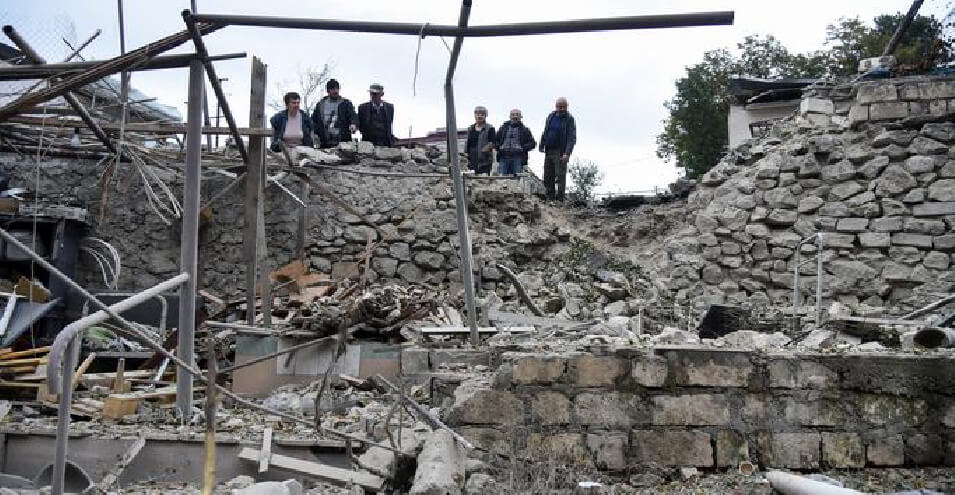
Missile strikes on Stepanakert, the capital of the self-declared Nagorno-Karabakh Republic, as well as on Ganja and several other Azerbaijani cities continue. Diplomatic efforts to establish a ceasefire between the two republics of Azerbaijan and Armenia have so far been unsuccessful.
The mountainous Nagorno-Karabakh region and the border areas between Armenia and Azerbaijan experienced unrest on Sunday. A week after the start of renewed conflict between the two countries over Nagorno-Karabakh, military clashes between Baku and Yerevan have intensified.
Missile attacks on Ganja, the second-largest city in the Republic of Azerbaijan, and continued missile strikes on Stepanakert, the capital of the self-declared Nagorno-Karabakh Republic on Sunday, have added new dimensions to the military confrontation between the two countries.
The French news agency reported several explosions and the rise of black smoke columns from various locations in the city of Stepanakert.
Images released by Azerbaijani media also show the destruction left behind by missile attacks on Ganja.
On Sunday evening, Hikmet Hajiyev, political advisor to Ilham Aliyev, president of the Republic of Azerbaijan, wrote in a tweet that the Armenian army has targeted civilian and non-military areas of Azerbaijan in its missile attacks.
The industrial city of Mingachevir and Absheron, located 80 kilometers from Baku, the capital of Azerbaijan, are also said to have been targets of missile attacks by the Armenian army.
This comes as Arayik Harutyunyan, president of the self-declared Nagorno-Karabakh Republic, has announced that all Azerbaijani territory will be targeted by military operations.
Azerbaijan and Armenia have each accused the other of attacking civilians. So far, according to unconfirmed reports, 250 people have been killed in military clashes between the two countries. It is reported that 42 of this number were civilians.
Aliyev’s Conditions for a Ceasefire
Ilham Aliyev, president of the Republic of Azerbaijan, on Sunday addressed the people and announced conditions for ending the war, stating: “Armenian forces must leave our territory; not in words, but in action!”
Aliyev has set a timeline for the complete withdrawal of Armenian military forces from Nagorno-Karabakh and has asked the Yerevan government to formally recognize Azerbaijan’s sovereignty over this region.
The Armenian government responded to Aliyev’s demands as expected with a refusal. Anna Nagdalyan, spokesperson for the Armenian Foreign Ministry, told a French news agency correspondent: “Aliyev’s conditions are unacceptable.” She urged Baku to stop using force to resolve this dispute and return to the table for “constructive negotiations.”
“One Nation, Two States”
The Turkish government, which has effectively sided with Azerbaijan in the recent conflict, has condemned the Armenian army’s attack on the city of Ganja and accused Yerevan of attacking civilians in the Republic of Azerbaijan.
Turkish officials emphasize their support for the “friendly and brotherly” country of Azerbaijan. Recently, some Turkish officials have described relations between the two countries as “one nation and two states.”
In response to statements by officials in Baku and Ankara, Arayik Harutyunyan has said his country permits attacks on Azerbaijani military bases and facilities. In a Facebook post addressed to the people of Azerbaijan, he said: “I urge the residents of these cities to immediately evacuate these areas.”
Russia, the United States, and France have called on the warring parties in the recent Nagorno-Karabakh conflict to end the fighting as soon as possible and return to the negotiating table to find a political solution.
Sergey Lavrov, Russia’s foreign minister, has also expressed concern over the increasing number of civilian casualties in the recent clashes between the two countries.
Since the establishment of a ceasefire in 1994, talks on finding a solution to the Nagorno-Karabakh crisis have begun but have made little progress.
Following the collapse of the Soviet Union, in the early 1990s, a full-scale war broke out between Armenia and the Republic of Azerbaijan over Nagorno-Karabakh, which, according to statistics released by news agencies, resulted in approximately 30,000 deaths.
Source: DW