Iran’s Health Minister: We Must Prepare Ourselves for Harder Days
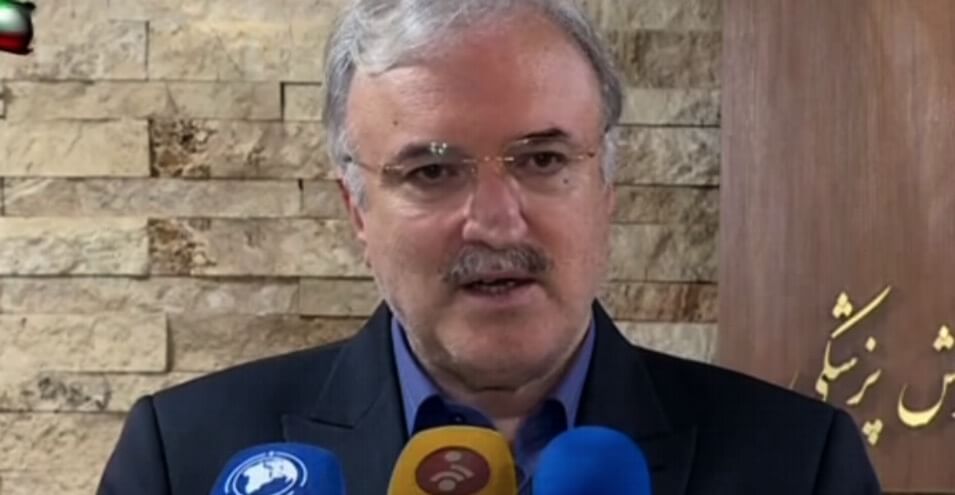
Iran’s Health Minister has warned of the possibility of a second wave of coronavirus in the autumn and winter of this year, describing the fight against this virus as a kind of chess game. The Deputy Health Minister has also stated that we must reach a “peaceful” coexistence with this virus.
Saeed Namaki, Iran’s Health Minister, said on Monday, April 15, during a meeting that the current wave of coronavirus may be contained by June, but we may face a second wave from autumn onwards.
According to IRNA, Namaki said during a meeting of managers of the Health Insurance Organization, which was held via video conference: “We are playing a chess game with the coronavirus. The subsequent behavior of this virus is unpredictable.”
Although he said the coronavirus that comes in the second half of the year might be “more noble and calmer than the current virus.”
The Health Minister expressed hope that the first wave of this epidemic would be contained by late Ordibehesht or in Khordad, but said: “Do not think that this virus will silently leave us alone. We may have new waves of this epidemic in autumn and winter, and we must prepare ourselves for much harder days.”
Iran’s Health Minister emphasized that even if a coronavirus vaccine is produced, it will not reach Iran for another two years. He said: “If people produce it, they must be very skilled to produce it for themselves. We must also try in this path, but we cannot work with an optimistic outlook.”
Saeed Namaki addressed the number of hospital beds in Iran and compared it with France, saying that in the most optimistic scenario, Iran has 1.6 beds per thousand people, while this figure is 6.6 beds in France.
He then, referring to the decline in oil revenues, said: “There is also a possibility of the virus changing, so we must be prepared for the worst conditions.”
The Health Minister, however, also considered it likely that coronavirus could become chronic like SARS and MERS, but subsequent waves would not be “terrible and silent.”
“There is no such thing as herd immunity”
Concurrently with the Health Minister’s remarks at the Health Insurance Managers meeting, his deputy Kianoush Jahanpour held a video news conference.
Jahanpour, in response to IRNA’s question about herd immunity, said: “The unit for counting people is not a herd, and there is no such thing as herd immunity.”
The spokesman for the Corona Coronavirus Control Headquarters continued: “The health system’s strategy is not to create group immunity, and if it happens somewhere, a disease may overcome all human tools, and this is a necessity and not a choice, and such a thing is not on the agenda of the Ministry of Health.”
The Deputy for Health of the Ministry of Health also said that up to 15 percent of the country’s population may become infected with SARS-CoV-2. He emphasized that “measures such as social distancing and education and enforcement of restrictions and monitoring are so that we do not move toward mass infection of society and have time and opportunity so that a burden is not imposed on hospitals and treatment centers.”
In a method called herd immunity, 60 to 70 percent of society members must become infected so that the entire society is protected against the virus. This was the approach taken by the Swedish government, but after some time it made changes and agreed to implement certain restrictions.
Jahanpour further expressed hope that in the coming weeks we could get closer to controlling the disease, but he emphasized: “We cannot say that the evil of this virus will be permanently reduced from humanity. The expectation is that we must have a peaceful coexistence with this virus in the coming years.”
“False death certificates are a violation”
Unconfirmed news and also on social media, there is news circulating that some hospitals and doctors, even though an individual’s coronavirus test was positive and their relatives were told that he died as a result of coronavirus, write something else as the cause of death in the death certificate.
This news has been noted because international organizations consider Iran’s statistics inaccurate. Especially regarding the death rate from coronavirus, Iran’s model is very different from other countries; while the average death rate in Italy is close to 13 percent, in Britain close to 12.5 percent, and in Spain slightly more than 10 percent, this figure in Iran’s official statistics is only slightly more than 6 percent.
Nevertheless, Kianoush Jahanpour, in response to a question about this, said: “In Iran, who can ask a doctor to enter something else as the cause of death? If a doctor does such a thing, it is a kind of negligence. If a certificate is recorded contrary to the information, it is considered an error and a violation. If a person has advised a doctor to write something other than coronavirus in the death certificate, he should report to us who advised him, so we can follow up on what its source is.”
He emphasized that “no position in the Islamic Republic of Iran has advised doctors who stamp death certificates that if the diagnosis was COVID-19, they should record something else.”
Source: DW